Manual ad budgeting is one of those tasks that never appears on a timesheet but quietly consumes a significant portion of every media buyer's week. I have run agencies where the team spent more time managing budgets in spreadsheets than they spent on the strategic work that actually moves performance. The 10-hour figure is not an exaggeration. For agencies managing 15 or more accounts across multiple platforms, it is often conservative.
The problem is that manual ad budgeting does not feel like a single task. It is distributed across dozens of small activities throughout the week, each one taking "just a few minutes." Those minutes accumulate into hours that nobody tracks.
Where the 10+ Hours Actually Go
Breaking down the time audit reveals five core activities that consume the bulk of manual budgeting hours.
Data pulling (2-3 hours/week): Logging into Google Ads, Meta Business Manager, and LinkedIn Campaign Manager to export spend data. Each platform has a different export format, different date range defaults, and different reporting lag. A single account across three platforms takes 10 to 15 minutes. Multiply that by 15 accounts, and you have spent half a day just downloading numbers.
Spreadsheet updating (2-3 hours/week): Pasting exported data into your master tracking spreadsheet, reconciling discrepancies, updating formulas, and calculating remaining budgets against remaining days. This is where the hidden cost of spreadsheet-based pacing becomes most visible. Every paste operation is an opportunity for error. Every formula is a potential point of failure.
Cross-platform checking (1-2 hours/week): Comparing spend across platforms for the same client to ensure total spend stays within the overall monthly allocation. This involves switching between browser tabs, mentally aggregating numbers, and checking whether one platform's overspend is being offset by another's underspend.
Client reporting (2-3 hours/week): Compiling the budget data into a format suitable for client consumption. Taking screenshots, building charts, writing commentary. Most of this work is duplicative, as you are reformatting data that already exists in the ad platforms into a presentation layer the client will look at for two minutes.
Manual bid and budget adjustments (1-2 hours/week): Going back into each platform to adjust daily budgets based on the pacing calculations. This is the actual execution step, and it often happens at the end of the day when the media buyer is tired and most likely to make errors.
The Industry Data Confirms It
This is not just anecdotal. Industry research from WordStream found that 33% of agencies cite "too much manual effort" as a top operational challenge. A separate HubSpot study found that 35% of marketers struggle with tool integration, meaning their systems do not talk to each other, forcing manual data transfer between platforms.
These percentages represent thousands of agencies worldwide, each with media buyers spending hours on work that machines handle more accurately in seconds. The industry knows it is a problem. The adoption of automated solutions has simply been slower than the growth of the problem itself.
The Compounding Cost of More Clients
Manual budgeting scales linearly at best, and exponentially at worst. Going from 10 clients to 20 clients does not simply double your budgeting workload. It doubles the number of platform logins, the number of spreadsheet tabs, the number of client reports, and the number of potential errors that need to be caught and corrected.
But the real scaling problem is cognitive. A media buyer managing 10 accounts can hold the status of each account in working memory. They know which ones are running hot, which ones are behind, and which ones need attention. At 20 accounts, that mental model breaks down. Details get missed. The media buyer compensates by checking more frequently, which consumes even more time.
I have watched agencies hit a growth ceiling at around 15 to 20 clients, not because they could not win new business, but because their manual budgeting processes could not absorb the additional workload. They had to choose between hiring another media buyer (at $60,000-$80,000 per year) or limiting their client count. Neither option is attractive.
The Error Rate Nobody Talks About
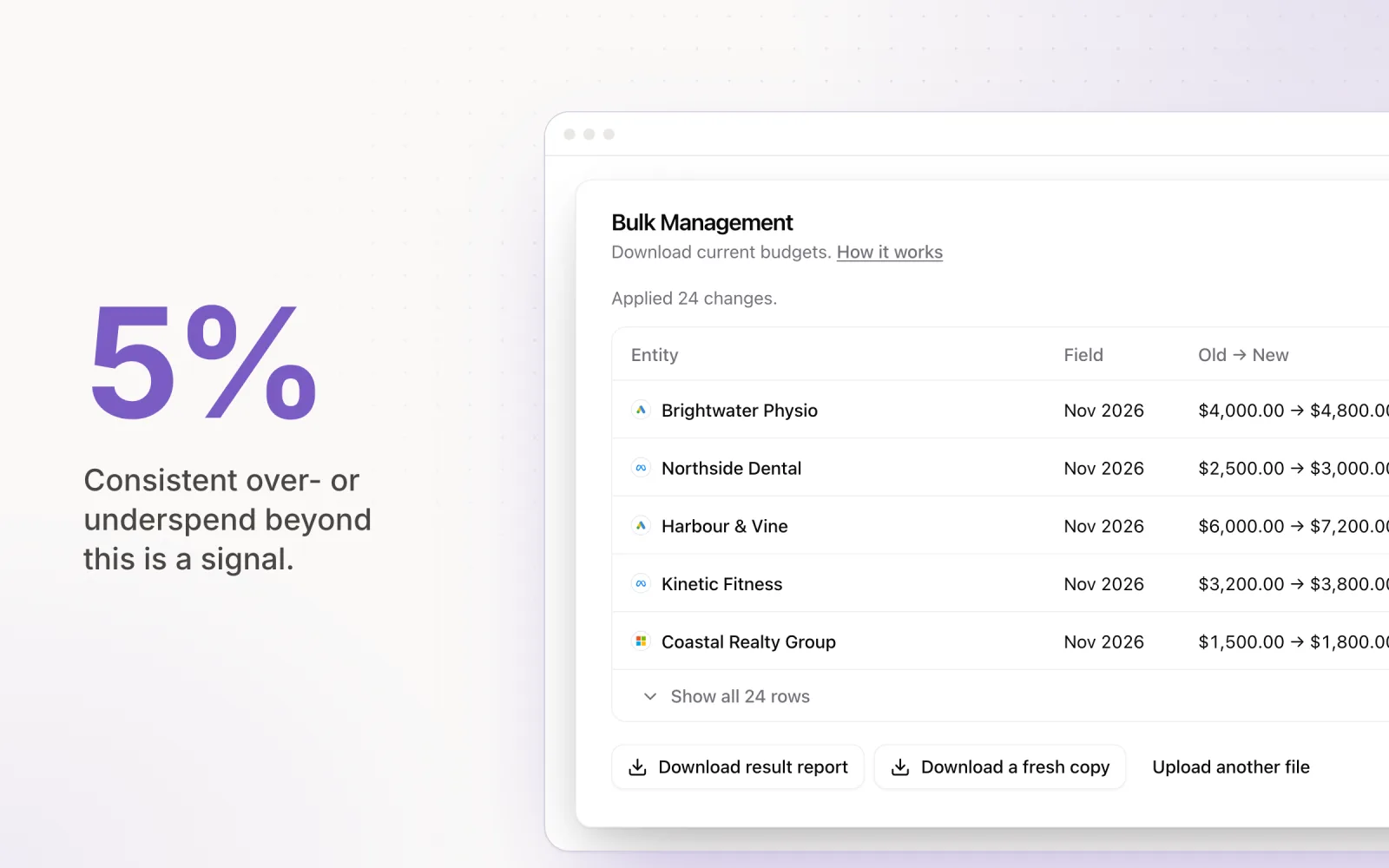
Manual processes introduce errors. This is not a criticism of the people doing the work. It is a statistical reality. Research on human data entry accuracy consistently shows error rates of 1% to 3% for manual transcription tasks. In ad budget management, a 1% error on a $50,000 monthly account is $500 of misallocated spend.
Common errors include transposing digits when entering budgets (typing $5,300 instead of $3,500), applying budget changes to the wrong campaign, using yesterday's data when the spreadsheet has not been updated, and forgetting to account for weekends when calculating remaining days in the month.
Each of these errors has a real-dollar consequence. An overspend error means the client pays for impressions that were not planned. An underspend error means the client missed conversion opportunities they were willing to pay for. Both outcomes damage the agency-client relationship, even when the amounts are relatively small.
What "Automated" Actually Means
Automation in this context is not a vague concept. It refers to specific technical capabilities that replace manual steps with programmatic ones.
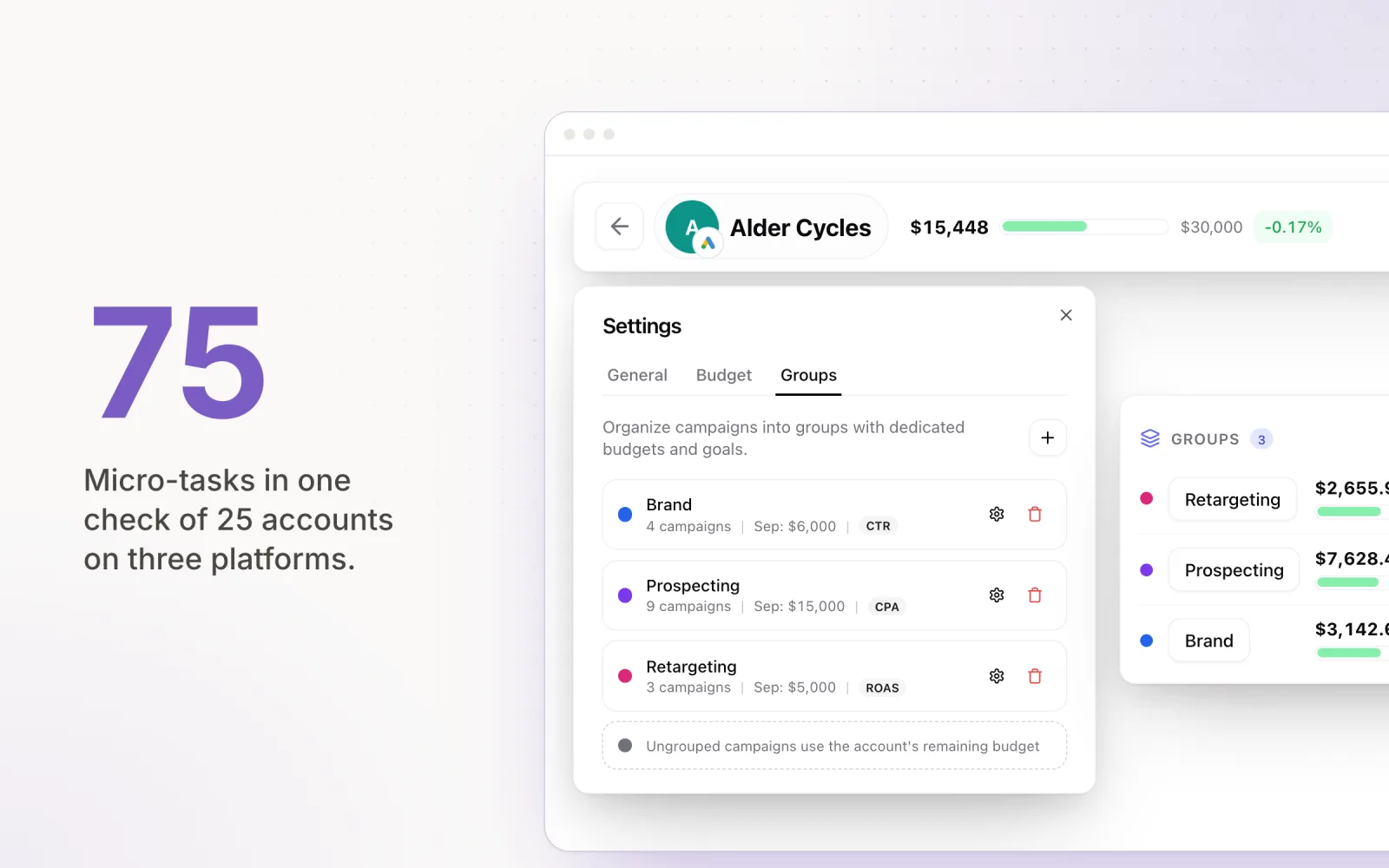
- API connections: Direct read/write access to Google Ads, Meta, TikTok, LinkedIn, Microsoft, Reddit, X Ads, and Amazon Ads APIs. Spend data flows into the system automatically, eliminating the data-pulling step entirely.
- Real-time syncing: Budget data updates continuously throughout the day, not once when someone remembers to check. This replaces the cross-platform checking step.
- Auto-adjustments: The system calculates remaining budget divided by remaining days and applies the resulting daily cap directly to the ad platform. This replaces the manual bid and budget adjustment step.
- Alerting: Automated notifications when a campaign deviates from its pacing target by more than a defined threshold. This replaces the constant mental tracking that media buyers perform throughout the day.
Each of these capabilities maps directly to a manual task that currently consumes time. The automation is not abstract. It is a direct substitution of machine execution for human execution, performed faster and with fewer errors. With consolidated budget management across platforms, that efficiency multiplies. For a practical guide to deciding which tasks to automate and which to keep manual, see our breakdown of PPC automation in 2026.
The ROI of Recovered Time
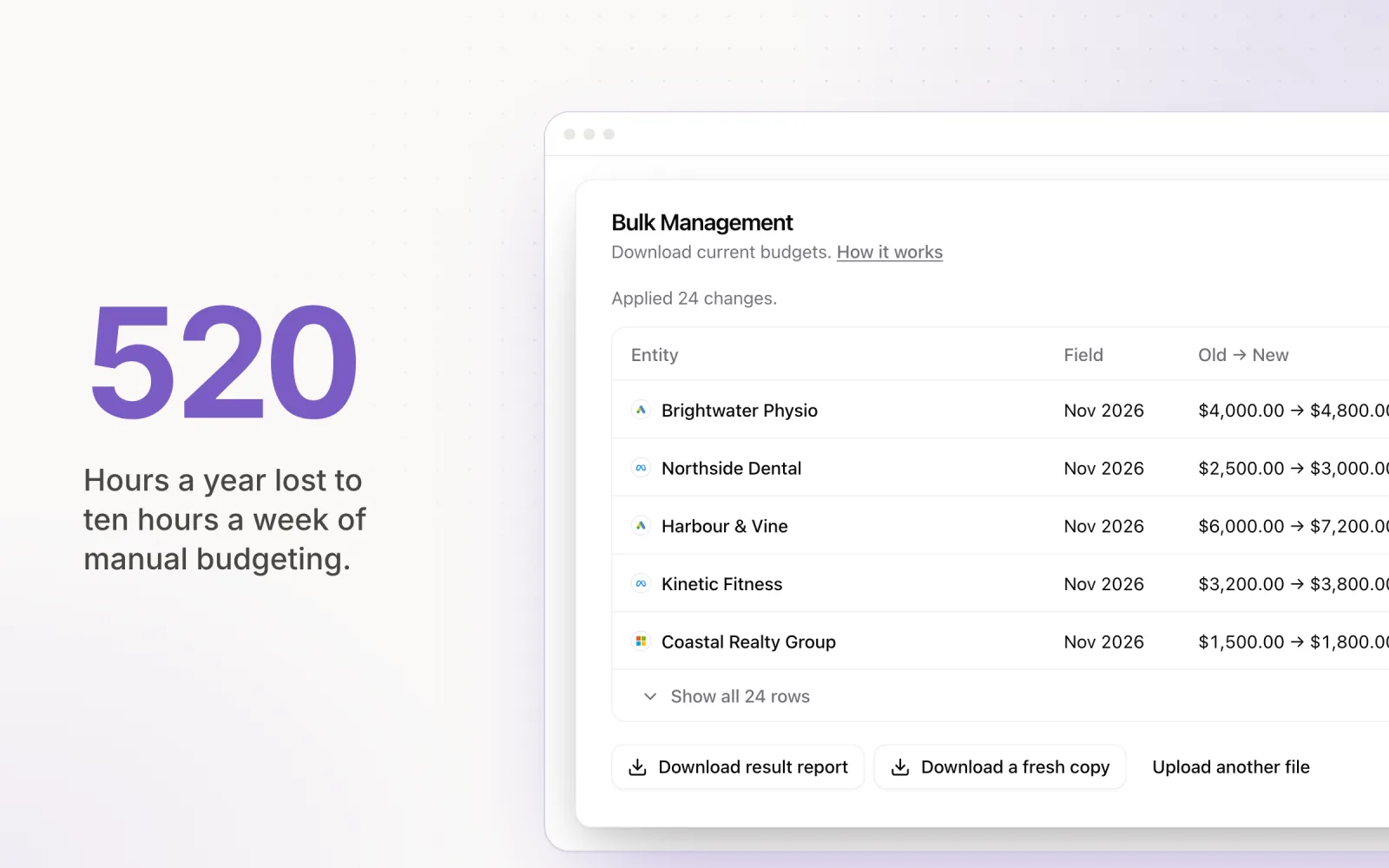
Ten hours per week is 520 hours per year. At different agency billing rates, that recovered time has a concrete dollar value.
- At $75/hour (junior media buyer cost): $39,000 per year
- At $125/hour (mid-level strategist cost): $65,000 per year
- At $200/hour (senior consultant billing rate): $104,000 per year
These figures represent either direct cost savings (if the recovered time eliminates the need for an additional hire) or revenue opportunity (if the recovered time is redirected toward billable strategy work). For most agencies, it is a combination of both.
The calculation becomes even more compelling when you factor in error reduction. If manual budgeting errors cost an agency $500 to $2,000 per month in misallocated spend, client credits, or lost trust, that adds another $6,000 to $24,000 in annual value.
Manual ad budgeting persists in most agencies not because people prefer it, but because the transition cost feels uncertain while the current cost is invisible. Tracking your team's actual time spent on budgeting tasks for a single week is usually enough to make the case for change. If you want to see what that change looks like in practice, start a free Pace trial and we will show you.

Jordan Parrello
Founder of Pace. Ran an agency pacing sheet by hand for years before building the thing that checks it every 5 minutes. About Pace or LinkedIn