Optmyzr alternatives become a practical search query the moment your agency starts running significant spend on Meta or LinkedIn. Optmyzr built its reputation on Google Ads and Microsoft Ads optimisation, and it does that job well. But the platform was not designed to manage budgets across social channels, and that gap grows more noticeable as client media mixes diversify. Agencies that previously relied on now-discontinued platforms have faced similar pressure — see our breakdown of what to use instead of Acquisio for the cross-platform pacing options that have emerged since.
I used Optmyzr for over a year while managing a mix of search and social campaigns. The Google Ads automation was solid, but I found myself using a separate spreadsheet to track Meta and LinkedIn pacing alongside Optmyzr's Google data. The moment you need two systems to get a full picture of a client's spend, efficiency drops. Here is what each alternative offers that Optmyzr does not.
Pick Your Alternative by Use Case
If you only have time to read one section, read this. The six tools below sit in four different buckets. Find your bucket first, then read that tool's section in full.
| Use case | Tool | Price floor (per month) | Best for |
|---|---|---|---|
| Cross-platform pacing | Pace Ads | From $49/mo | Agencies running Google, Meta, TikTok, LinkedIn and Microsoft in one view |
| Cross-platform pacing | EDEE (OptiPacer) | Custom (demo-gated) | Agencies wanting pacing inside a broader management suite |
| Google-only optimisation | Adalysis | From $149/mo | Google Ads audits and monitoring without auto-pacing |
| Meta-led performance | Madgicx | From $79/mo | Agencies whose client base sits 70%+ on Meta and TikTok |
| Enterprise reporting and scale | Marin Software | From $500/mo (Connect); cross-channel tiers quoted | Enterprise agencies with $500K+ monthly spend across five+ platforms |
| Enterprise reporting and scale | Skai (formerly Kenshoo) | $114K/yr entry tier (~$9,500/mo) | Retail media depth on Amazon and Walmart Connect |
Confirm directly with each vendor before you budget on these numbers. The figures above are public list prices read from vendor pricing pages in July 2026, and several of these vendors quote higher tiers privately — Marin publishes a $500/mo entry plan but quotes its cross-channel tiers, and Skai lists tiers by annual ad spend. For a broader cross-tool comparison that includes Shape.io and Skai side by side, see our comparison of the best budget pacing tools for agencies.
What Optmyzr Does Well
Before comparing alternatives, it is worth acknowledging where Optmyzr earns its market position. The platform offers deep Google Ads and Microsoft Ads automation: rule-based optimisations, budget projections, quality score monitoring, and a scripting layer for custom workflows. The one-click optimisations are genuinely useful for bulk changes across large Google accounts.
Optmyzr's reporting is also strong, with pre-built templates that agencies can white-label for client delivery. If your agency runs exclusively Google and Microsoft Ads, Optmyzr may be all you need.
Where Optmyzr Falls Short
The gap is cross-platform budget management. Optmyzr does not connect to Meta Ads or LinkedIn Ads APIs. You cannot set a monthly budget that spans Google and Meta campaigns. You cannot see a unified pacing view across platforms. And you cannot automate budget adjustments on social channels.
Optmyzr also operates at the account level rather than the client level. For agencies where a single client has separate Google, Meta, and LinkedIn accounts, there is no native way to group those accounts under one budget target. This forces agencies to manually reconcile spend across platforms, which is the exact problem a pacing tool should solve.
For a broader look at the pacing tool landscape, see our comparison of the top budget pacing tools for agencies. And if you landed here from the old Shape.io world — the other pacing tool that got absorbed into a bigger platform — the Shape.io alternative guide covers that migration specifically.
Optmyzr Alternative 1: Marin Software
Marin Software is the enterprise-grade option for agencies that need cross-channel management at scale. The platform connects to Google, Meta, Amazon, Apple Search Ads, and more. Budget allocation and pacing features let you set portfolio-level budgets that span multiple platforms and campaigns.
Marin's strength is its breadth. If you manage large accounts with complex channel mixes, the platform provides a single control plane for bidding, budgeting, and attribution. The trade-off is price and onboarding time. Marin is built for agencies spending hundreds of thousands per month, and the platform complexity reflects that. Smaller agencies will find the setup overhead difficult to justify.
Best for: Enterprise agencies with $500K+ monthly ad spend across five or more platforms.
Optmyzr Alternative 2: EDEE
EDEE positions itself as an agency management platform with its OptiPacer module handling automated budget pacing. OptiPacer connects to Google Ads, Microsoft Ads, Meta, and LinkedIn, making it one of the few tools with genuine four-platform pacing support.
The pacing engine runs on configurable schedules. You set the monthly target, define how aggressively the system should adjust daily budgets, and OptiPacer handles the rest. The broader EDEE platform includes task management, client reporting, and workflow tools, which may appeal to agencies looking for an all-in-one solution.
The consideration is that pacing is one feature within a larger platform. If you only need pacing and already have separate tools for reporting and project management, the additional features add cost and complexity without proportional value.
Best for: Agencies seeking an all-in-one management platform with integrated pacing.
Optmyzr Alternative 3: Pace Ads
Pace is the tool I built to solve the exact problem that pushed me away from Optmyzr: managing budgets across Google, Meta, TikTok, LinkedIn, Microsoft, Reddit, X Ads, and Amazon Ads from a single platform, with full automation and transparent audit trails.
Pace connects via OAuth to all eight platforms, pulls spend data in real time, and calculates the daily budget adjustment needed to hit monthly targets. The AI engine factors in platform-specific pacing rules (Google's 30.4x cap, Meta's CBO learning phases, LinkedIn's lifetime pacing) when making adjustments, rather than applying a one-size-fits-all formula.
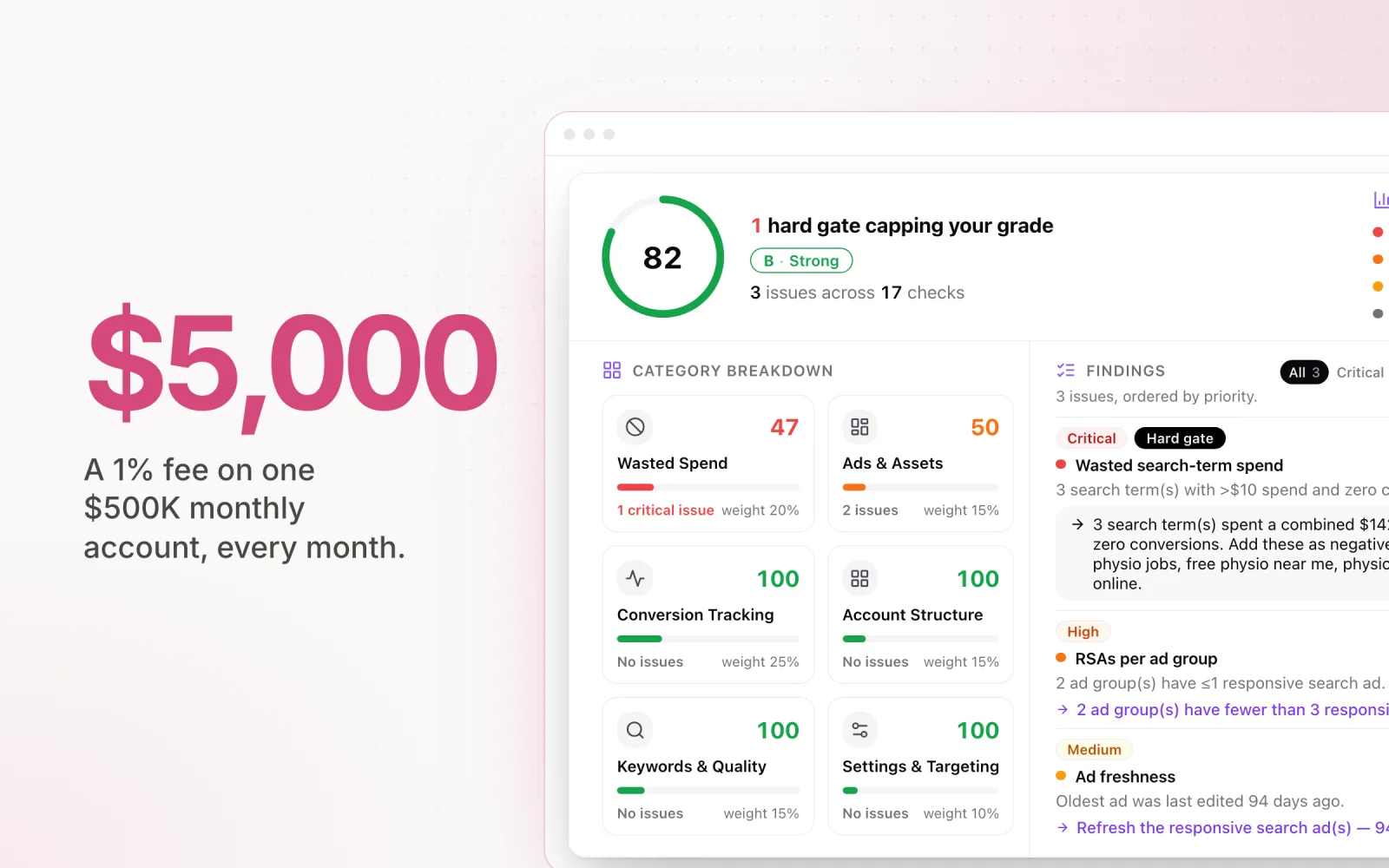
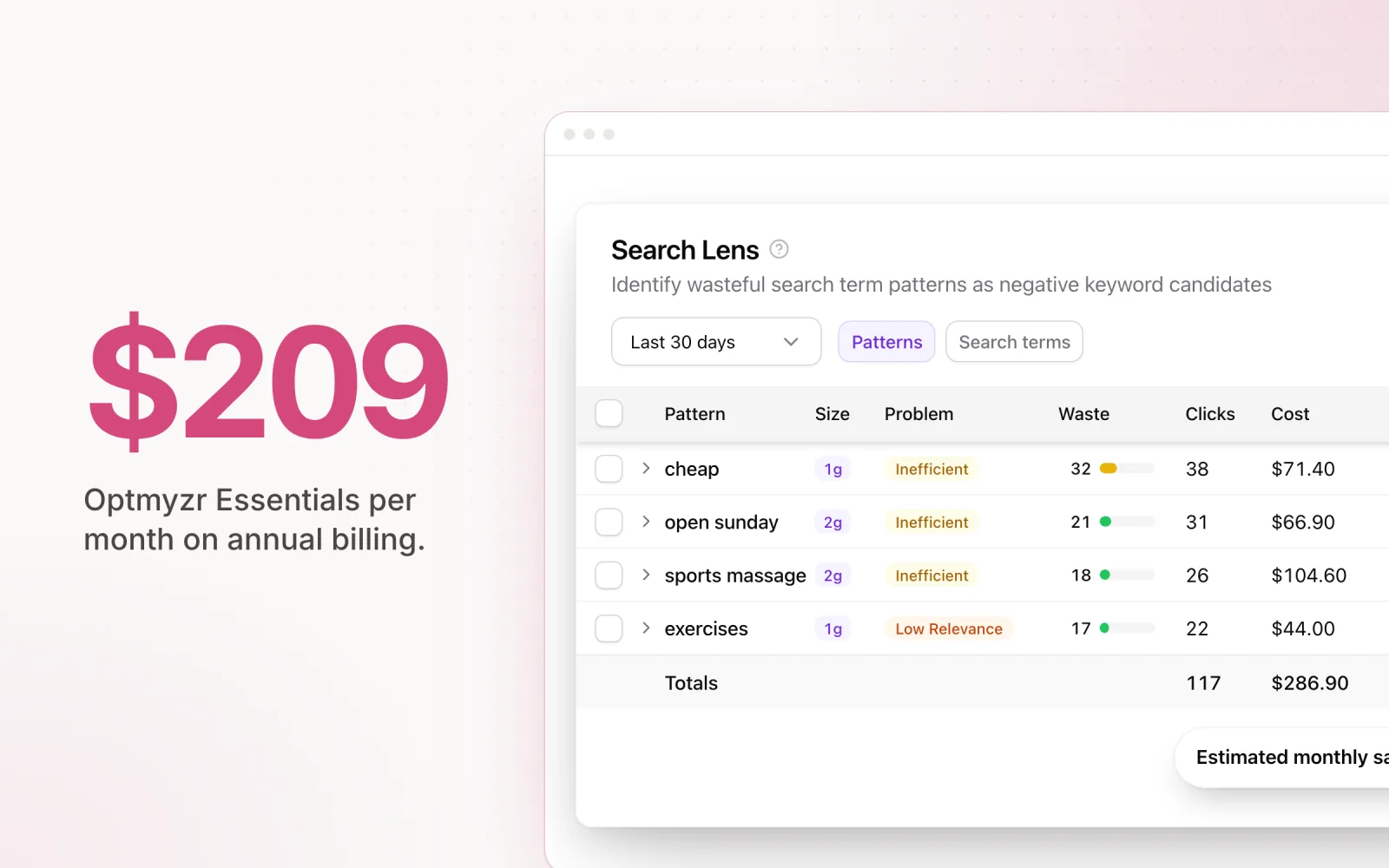
The differentiator is the audit trail. Every automated change is logged with a timestamp, the before/after values, and the reasoning behind the adjustment. These logs can be shared directly with clients as change reports, which builds the kind of transparency that retains accounts long-term. Beyond pacing, Pace includes Findings for automated anomaly detection, Dot (a conversational AI agent for investigating account data), Search Lens for keyword and search term analysis (directly comparable to Optmyzr’s keyword tools), and overspend protection with hard spending limits enforced every 5 minutes. Start a free trial to get started.
Best for: Agencies managing 10 to 50 accounts across Google, Meta, TikTok, LinkedIn, and Microsoft Ads.
Optmyzr Alternative 4: Adalysis
Adalysis is the closest alternative in philosophy to Optmyzr, focusing primarily on Google Ads auditing and optimisation. The platform provides automated audits, ad testing analysis, quality score tracking, and budget monitoring with pacing alerts.
Adalysis does not auto-adjust budgets. Instead, it monitors pacing and alerts you when campaigns are off track, leaving the corrective action to you. For agencies that prefer manual control with better visibility, this approach has merit.
The limitation is the same as Optmyzr's: no Meta or LinkedIn support. If your reason for leaving Optmyzr is cross-platform coverage, Adalysis does not solve that problem. It is a viable alternative if your primary concern is price (Adalysis is generally cheaper than Optmyzr) while staying within the Google Ads ecosystem. For a wider look at Google-only options, our roundup of the best Google Ads management tools covers the platforms that focus on search depth over breadth.
Best for: Google Ads-focused agencies looking for a more affordable audit and monitoring tool.
Optmyzr Alternative 5: Skai (formerly Kenshoo)
Skai is the enterprise cross-channel platform that grew out of Kenshoo. Budget pacing sits inside a much larger product surface covering search, social, retail media, and app campaigns, with portfolio-level allocation across channels. For agencies running multi-million dollar retail or commerce accounts, Skai's depth on Amazon Ads and Walmart Connect is genuinely hard to match.
The trade-off is the same one you make with any enterprise platform. Skai tiers by annual ad spend, and the entry tier — for advertisers spending up to $4M a year — lists at $114,000 a year. Onboarding takes weeks rather than hours, and the workflow assumes a dedicated platform admin. If you are a 12-person agency managing 25 mixed accounts, Skai will overbuild your workflow and overrun your tool budget. Sit Skai alongside Marin in your evaluation if retail media is a meaningful slice of your client mix.
Best for: Enterprise agencies with significant Amazon and retail media spend.
Optmyzr Alternative 6: Madgicx
Madgicx is the Meta-focused entry on this list and the most useful alternative if your reason for leaving Optmyzr is the opposite of what most teams cite: you are not Google-heavy at all, you are Meta-led, and Optmyzr never covered the platform you actually spend on. The AI Marketer and Autonomous Budget Optimiser handle pacing and reallocation across Meta campaigns specifically, and a TikTok Ads integration extends the same logic to short-form video.
Pricing starts at around $79/month, which makes it one of the more accessible options for social-led agencies. The limitation is platform coverage in the other direction: Madgicx does not pace Google or Microsoft Ads budgets, so a Google-heavy agency will need to pair it with something else (Optmyzr itself, or one of the Google-focused options in our guide to the best Google Ads management tools). For agencies whose client base sits 70% or more on Meta, Madgicx covers the core pacing job with depth that broader cross-platform tools do not offer.
Best for: Performance shops with Meta-led media mixes.
What Pace Does That Optmyzr Doesn't (and Where Optmyzr Still Wins)
I built Pace because I needed cross-platform pacing that Optmyzr could not provide, but credit where it is due: Optmyzr remains the better tool for several real-world scenarios. Here is the split.
What Pace does that Optmyzr doesn't:
- Native pacing across Google, Meta, TikTok, LinkedIn, Microsoft, Reddit, X Ads and Amazon Ads in a single account-group view, with the AI engine factoring in platform-specific behaviour (Google's 30.4x cap, Meta's CBO learning phases, LinkedIn's lifetime pacing).
- Per-change audit trails clients can read. Every automated adjustment is logged with the before-and-after values and the reasoning, so monthly reports build themselves.
- Overspend protection enforced every 5 minutes via hard spending limits, not just daily-budget alerts.
- A 14-day free trial with no monthly spend floor, so smaller agencies can prove out the workflow before committing.
Where Optmyzr is still the better choice:
- You run almost exclusively Google and Microsoft Ads. Optmyzr's scripting layer, rule library, and one-click optimisations on these platforms are deeper than anything Pace ships today.
- You rely on Optmyzr's custom scripts. Rebuilding bespoke automation in another tool has a real switching cost, and that cost is rarely worth it if the social-channel gap is small for your book.
- You need white-labelled client reports out of the box. Optmyzr's reporting templates are mature and require less setup than rolling your own from Pace's audit feed.
- You have an in-house Google Ads specialist whose workflow already lives in Optmyzr. Tool migrations cost more in retraining time than most agency owners budget for.
If you sit closer to the second list than the first, stay with Optmyzr. If you sit closer to the first list, the migration usually pays back inside two billing cycles. Start a free trial and run Pace in monitor mode alongside Optmyzr for one full month before cutting over.
Optmyzr Pricing: What It Actually Costs
Optmyzr (also commonly searched as Optimyzer, Optmyzer, or Optymzr) prices on the ad spend under management, with two published tiers and a custom Enterprise level. The figures below are list prices observed in mid-2026; confirm directly with Optmyzr before you budget on them. Our full Optmyzr review goes deeper on the overage rules and where the model stings as your clients grow.
Essentials: Lists at $209/month on annual billing (around $299 month-to-month; annual carries roughly a 30% discount) for up to $150K in monthly managed spend and 25 ad accounts, with a $5/month charge per additional account. Core optimisations, rule-based automation, and budget monitoring for Google and Microsoft Ads, with limited social tools.
Premium: Around $389/month on monthly billing, lifting the ceiling to $500K in monthly managed spend with unlimited accounts under a fair-usage policy. Adds the full social feature set, cross-platform dashboards, and daily automation scheduling.
Enterprise tier: Custom pricing for agencies above $500K in managed spend. Includes dedicated support, custom integrations, and the full scripting layer.
The pricing is competitive for Google-focused agencies, but the cost-per-platform value drops when you factor in the need for a separate tool to manage Meta and LinkedIn. An agency paying $389/month for Optmyzr and then adding another $200 to $300/month for a social budget pacing tool is spending more than a single cross-platform tool would cost. Exceed your plan's spend ceiling and overage charges apply per $1,000 of excess, so the bill also floats upward with client growth.
Optmyzr vs. Opteo: Which Should You Choose?
Opteo is the other major Google Ads optimisation tool that agencies frequently compare against Optmyzr. Both focus primarily on Google Ads, but they approach the problem differently.
Opteo takes a recommendation-based approach. It analyses your Google Ads accounts and surfaces specific improvement suggestions (pause this keyword, increase this bid, add this negative). The interface is clean and the recommendations are generally actionable. Opteo is simpler and more affordable than Optmyzr, making it a popular choice for smaller agencies and freelancers — our Opteo review goes through the feature set and where it tops out.
Optmyzr goes deeper with rule-based automation, custom scripting, and more granular control. If you want to build complex automation workflows or need bulk management across large accounts, Optmyzr provides tools that Opteo does not.
Neither Optmyzr nor Opteo offers cross-platform coverage. Both are Google Ads tools (with Optmyzr adding Microsoft Ads). If you need to manage budgets across Google, Meta, LinkedIn, and Microsoft Ads from a single platform, the alternatives listed above are where you should focus your evaluation.
When to Stay with Optmyzr vs. When to Switch
Stay with Optmyzr if: your agency runs 80%+ of its spend on Google and Microsoft Ads, you use Optmyzr's scripting layer extensively, and your clients do not require unified cross-platform budget reporting. The switching cost of rebuilding custom rules and scripts in a new tool may outweigh the benefit.
Switch if: your clients' media mixes include significant Meta or LinkedIn spend, you are maintaining separate tracking for social budgets, or you need client-level budget groups that span multiple platforms. The efficiency gain from a unified tool typically justifies the migration effort within two to three months.
The transition itself is straightforward for most tools on this list. Connect your ad accounts via OAuth, set your monthly targets, and run the new tool in parallel with Optmyzr for one billing cycle. Compare pacing recommendations between the two systems, confirm alignment, and then disable Optmyzr's automation before enabling the new tool's auto-pacing.
The PPC tool market has matured beyond single-platform solutions. Agencies that invest in cross-platform tooling now will be better positioned as client media mixes continue to fragment across channels. For a side-by-side breakdown of how these tools and others compare on specific capabilities, see our full digital ad management tools comparison.

Jordan Parrello
Founder of Pace. Ran an agency pacing sheet by hand for years before building the thing that checks it every 5 minutes. About Pace or LinkedIn