
The best PPC software for agencies solves a problem that spreadsheets cannot: keeping multi-platform ad spend on target in real time without requiring manual intervention every day. At the centre of this is budget pacing. It is the capability that determines whether you land on budget at month-end or scramble to explain overages and underspend to clients.
After managing millions in ad spend across Google, Meta, and LinkedIn, I have tested most of the pay per click tools on this list firsthand. Here is an honest breakdown of what each PPC management tool does well, where it falls short, and which type of agency it suits.
Pick by Agency Size (the Short Version)
If you do not want to read the full breakdown, here is the decision matrix I would hand to another agency owner. It is opinionated, and it ignores edge cases on purpose.
| Agency size | Spend under management | Strongest fit | Honest second choice |
|---|---|---|---|
| Solo or freelancer (1 to 5 accounts) | Under $30K/mo | Adalysis | Opteo for Google-only |
| Boutique agency (5 to 15 accounts) | $30K to $150K/mo | Pace Ads | Shape.io if you already own NinjaCat |
| Mid-market agency (15 to 50 accounts) | $150K to $750K/mo | Pace Ads or EDEE | Optmyzr if you are Google-and-Microsoft heavy |
| Performance shop with social tilt | Any size, Meta-led | Madgicx for Meta depth | Pace Ads for cross-platform roll-up |
| Enterprise agency (50+ accounts) | $750K+/mo | Skai or Marin Software | Pace Ads for portfolio-level pacing without enterprise onboarding |
What to Look for in PPC Software
Before comparing individual tools, it helps to understand what separates a genuine PPC management platform from a simple dashboard. The best PPC tools share five capabilities that matter most for agencies managing multiple accounts:
Budget pacing and management. The core function. PPC software should track actual spend against monthly targets and either alert you to deviations or automatically adjust daily budgets. Without this, you are still managing budgets in spreadsheets regardless of what else the tool offers.
Cross-platform coverage. Most agencies run campaigns across Google Ads, Meta, LinkedIn, and Microsoft Ads. Pay per click software that only covers one platform forces you to maintain separate workflows for each channel, defeating the purpose of a unified tool.
Bid management and automation. Beyond pacing, strong PPC management software includes bid strategy optimisation, automated rules, and script support. These features reduce the manual workload of campaign optimisation.
Reporting and audit trails. Agencies need to demonstrate what changed and why. The best PPC tools log every automated action with context so you can share transparent reports with clients.
Pricing that scales. Enterprise-priced pay per click tools are not viable for agencies managing 10 to 30 accounts. The pricing model needs to work at your current scale without forcing a commitment designed for larger organisations.
Why Agencies Need Dedicated Budget Pacing Tools
Manual pacing breaks down the moment you scale past a handful of accounts. The process of logging into each platform, pulling spend data, updating a spreadsheet, and calculating the daily budget adjustment takes time that compounds across every account you manage. At 20+ accounts, you are looking at hours per week of repetitive work that adds zero strategic value.
The cost is not just time. Manual pacing introduces errors at every step: stale data, copy-paste mistakes, formula drift, and delayed responses to spend spikes. A dedicated tool eliminates these failure points by connecting directly to platform APIs and recalculating budgets automatically. If you want to see the daily arithmetic these tools automate, run one account through our free ad budget pacing calculator, then imagine repeating it forty times every morning.
How We Evaluated Each Tool
Every tool on this list was assessed against five criteria that matter most to agencies:
- Platform coverage: Does it support Google Ads, Meta, LinkedIn, and Microsoft Ads? Or just one or two?
- Automation depth: Can it automatically adjust daily budgets, or does it only flag issues and leave the action to you?
- Transparency: Does it log every change with a reason and timestamp? Can you share audit trails with clients?
- Pricing: Is the pricing model viable for mid-market agencies (10 to 50 accounts), or is it enterprise-only?
- Ease of setup: Can you connect accounts and start pacing within a day, or does it require weeks of onboarding?
The 8 Best PPC Software Tools for Budget Pacing
1. Optmyzr
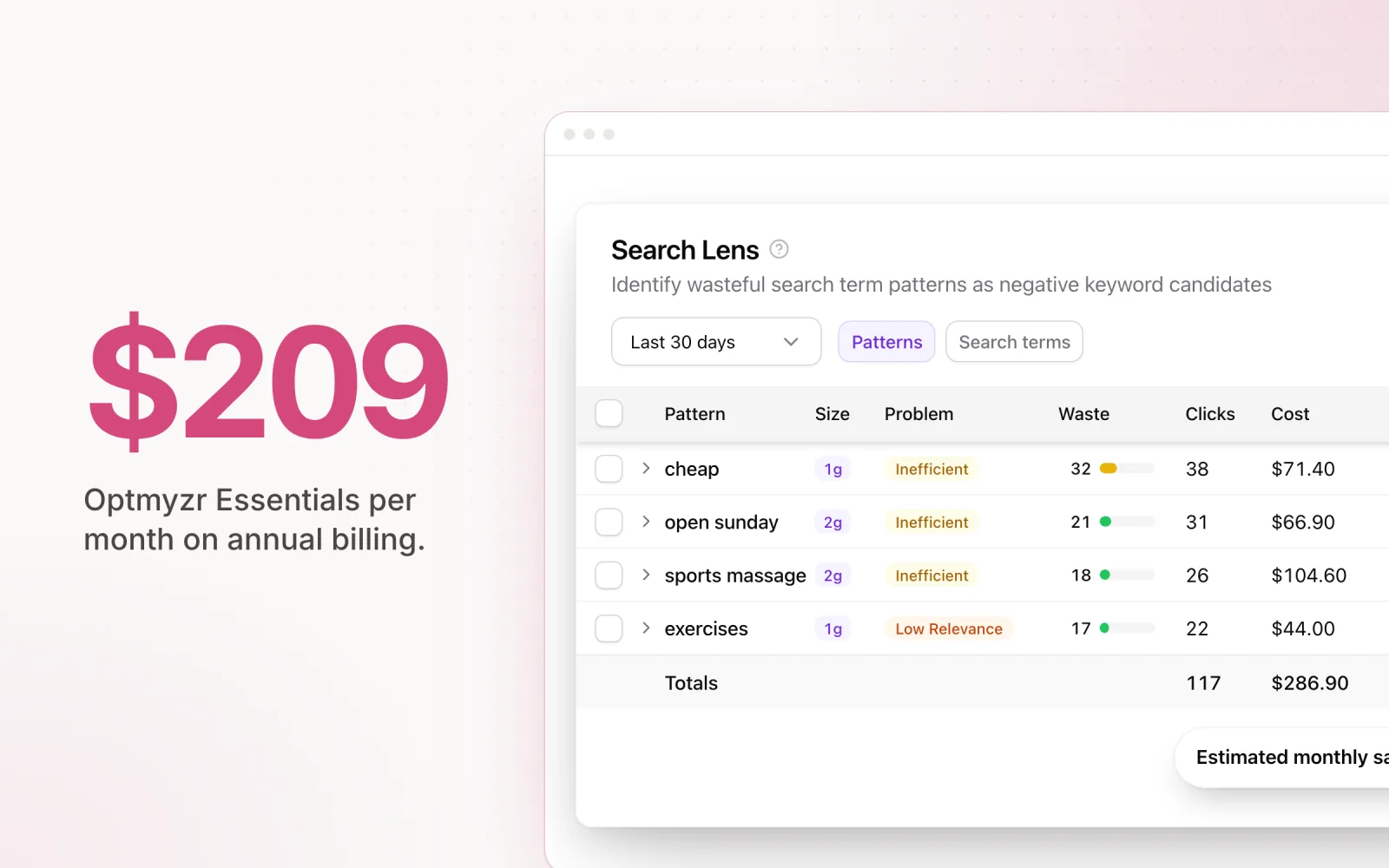
Optmyzr is the most established name in PPC optimisation tooling. Its budget pacing feature projects monthly spend based on current trajectory and alerts you when campaigns are off pace. The strength is in its Google Ads and Microsoft Ads depth, with strong scripting capabilities and rule-based automation.
The limitation is cross-platform coverage. Optmyzr does not natively pace Meta or LinkedIn budgets. If your agency runs significant social spend, you will need a second tool to cover the gap. Pricing starts around $250/month for smaller accounts and scales with spend under management. Our full Optmyzr review covers the current pricing tiers and where the tool breaks for cross-platform agencies, and if Optmyzr is where you are starting your search, our five Optmyzr alternatives that go beyond Google Ads covers the cross-platform options in more depth.
2. Shape.io (NinjaCat)
Shape.io was one of the original budget pacing tools and remains a solid option for Google, Meta, and Microsoft pacing. It was acquired by NinjaCat in 2022, and the integration with NinjaCat's reporting suite adds value for agencies that already use that ecosystem.
The pacing logic is straightforward: set a monthly budget, connect accounts, and Shape adjusts daily caps. The concern is that development focus has shifted toward NinjaCat's broader platform, and Shape's standalone feature set has not evolved as quickly as some competitors. Pricing is custom and typically requires a demo call. For a deeper look at how Shape.io compares with a newer entrant, see our head-to-head comparison of Shape.io and Pace Ads.
3. EDEE (OptiPacer)
EDEE's OptiPacer module covers Google, Microsoft, Meta, and LinkedIn, making it one of the few tools with genuine cross-platform pacing. The interface is functional, and the automated budget adjustments run on configurable schedules.
EDEE positions itself as a broader agency management platform with pacing as one component. If you need pacing alongside client reporting, task management, and workflow tools, the bundled approach may appeal. If you want a focused pacing tool without the extras, the broader platform adds complexity.
4. Marin Software
Marin is the enterprise option on this list. It offers cross-channel budget management across Google, Meta, Amazon, and more. The budget allocation and pacing features are designed for large advertisers managing millions in monthly spend.
The trade-off is price and complexity. Marin's platform requires significant onboarding, and pricing reflects its enterprise positioning. For mid-market agencies with 10 to 30 accounts, the cost per account often does not justify the investment unless you are also using Marin's bidding and attribution features.
5. Adalysis
Adalysis focuses on Google Ads auditing and optimisation. Its budget monitoring feature tracks spend against targets and provides alerts, but it does not auto-adjust budgets. Think of it as a pacing dashboard rather than a pacing engine.
For agencies that prefer manual control with better visibility, Adalysis fills a gap. It is strongest as a Google Ads audit tool with pacing monitoring as a secondary feature. It does not cover Meta or LinkedIn.
6. Pace Ads
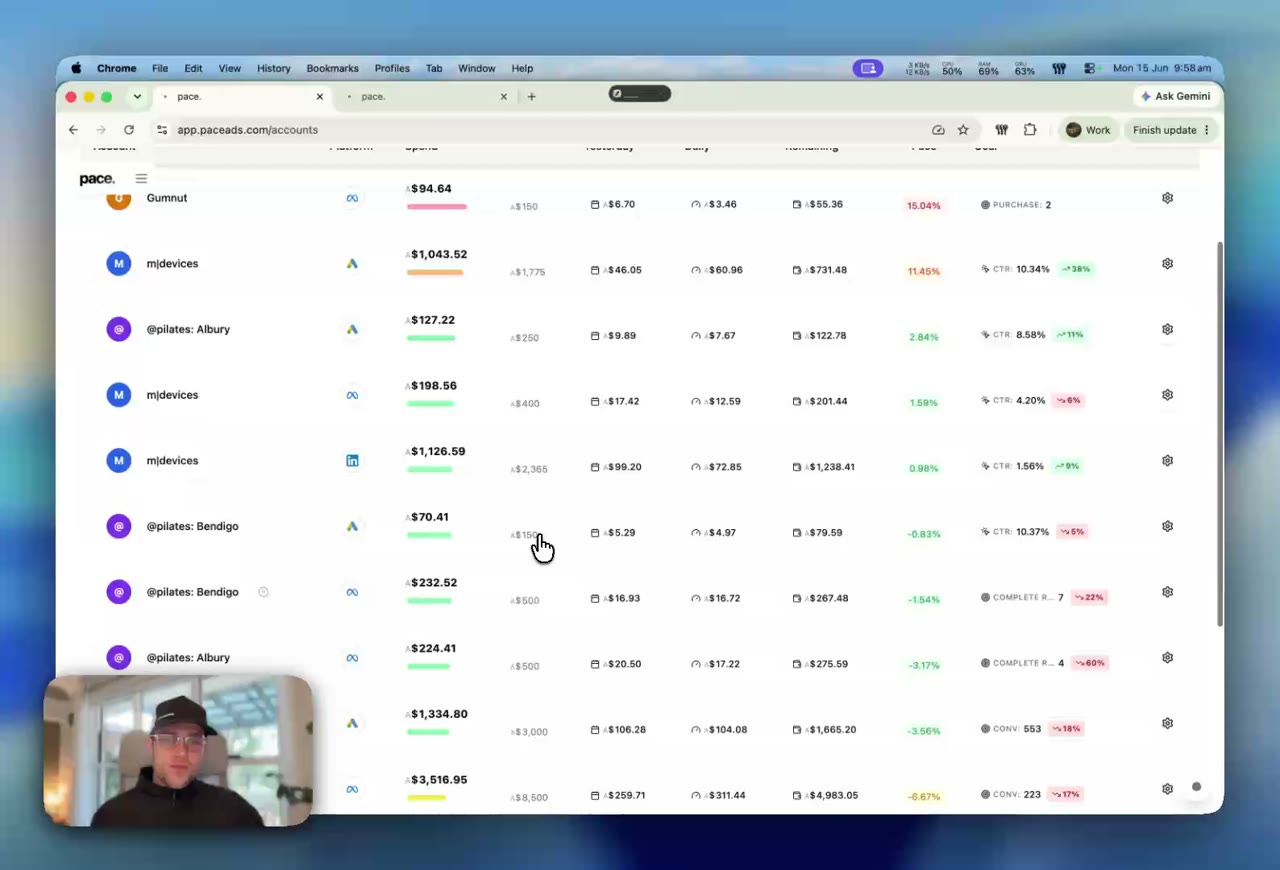
Pace is the tool I built after years of managing pacing manually across platforms. It connects to Google Ads, Meta, TikTok, LinkedIn, Microsoft Ads, Reddit Ads, X Ads, and Amazon Ads via OAuth, pulls real-time spend data, and calculates the exact daily budget adjustment needed to hit your monthly target.
What sets Pace apart is the combination of AI-driven pacing with full audit trails. Every automated adjustment is logged with the reasoning behind it, so you can share transparent change reports with clients. The system also supports cross-platform portfolio views, letting you group accounts across platforms with blended metrics and portfolio-wide optimisation. Pace also includes Findings for automated anomaly detection, Dot — a conversational AI agent for investigating account data in real time — and overspend protection with hard spending limits enforced every 5 minutes. Start a free trial to get started.
Pace is also younger than Optmyzr, Marin, and Shape, and the integrations library is narrower outside the eight core ad platforms. Amazon Ads support landed in August 2026 with the same pacing, overspend protection, and AI insights as the other platforms, which closed the biggest gap in earlier versions of this review. If you need Apple Search Ads or retail media beyond Amazon (Walmart Connect, for example) inside the same tool today, this is still not the one.
7. Skai (formerly Kenshoo)
Skai is the enterprise cross-channel platform that grew out of Kenshoo. Budget pacing sits inside a much larger product surface that covers search, social, retail media, and app campaigns, with portfolio-level budget allocation across channels. For agencies running multi-million dollar retail or commerce accounts, Skai's depth on Amazon Ads and Walmart Connect is genuinely hard to match.
The trade-off is the same one you make with any enterprise platform. Skai tiers by annual ad spend, and the entry tier — for advertisers spending up to $4M a year — lists at $114,000 a year. Onboarding takes weeks rather than hours. If you are a 12-person agency managing 25 mixed accounts, Skai will overbuild your workflow and overrun your tool budget. If you are running retail media for an enterprise brand, it earns its place.
8. Madgicx
Madgicx is the Meta-focused entry on this list. The platform's AI Marketer and Autonomous Budget Optimiser handle pacing and reallocation across Meta campaigns specifically, and a TikTok Ads integration extends the same logic to short-form video. Pricing starts at around $79/month, which makes it one of the more accessible options for social-led agencies.
The limitation is platform coverage in the other direction. Madgicx does not pace Google or Microsoft Ads budgets, so a Google-heavy agency will need to pair it with something else. For agencies whose client base sits 70% or more on Meta, Madgicx covers the core pacing job with depth that broader cross-platform tools do not offer.
Feature Comparison at a Glance
Pricing figures below are list prices observed in early 2026. Treat them as a starting point for budgeting, not a quote. Most vendors negotiate annual commits, and some change pricing without much notice.
| Tool | Platforms | Auto-Pacing | Audit Trail | Pricing | Monthly minimum | Free trial | Switches well with |
|---|---|---|---|---|---|---|---|
| Optmyzr | Google, Microsoft | Rules-based | Yes | From $250/mo | $250/mo | 14 days | Adalysis, Opteo for Google-only switchers |
| Shape.io (NinjaCat) | Google, Meta, Microsoft | Yes | Limited | Custom | Custom (demo gated) | Demo only | Pace Ads, EDEE for cross-platform parity |
| EDEE | Google, Meta, LinkedIn, Microsoft | Yes | Yes | Custom | Custom (demo gated) | 14 days on request | Pace Ads if you want pacing without the suite |
| Marin Software | Google, Meta, Amazon, more | Yes | Yes | From $500/mo (Connect) | $500/mo, cross-channel tiers quoted | No | Skai for retail media, Pace Ads to downsize |
| Adalysis | No (alerts only) | N/A | From $149/mo | $149/mo | 14 days | Optmyzr, Pace Ads when you need true automation | |
| Pace Ads | Google, Meta, TikTok, LinkedIn, Microsoft, Reddit, X Ads, Amazon | Frontier LLMs | Full | From $49/mo | None | 14 days | Shape.io, EDEE migrations |
| Skai | Google, Meta, Amazon, Walmart, more | Yes | Yes | Tiered by annual ad spend | $114K/yr entry tier (~$9,500/mo) | No | Marin for cross-channel parity, Pace Ads to downsize |
| Madgicx | Meta, TikTok | Yes | Limited | From $79/mo | $79/mo | 7 days | Pace Ads or Optmyzr to add Google and Microsoft |
Which PPC Management Software Fits Your Agency
Solo freelancers and small teams (1 to 5 accounts): Adalysis offers an affordable entry point with enough visibility to manage a small book of business. If your accounts are Google-only, Adalysis provides strong audit features alongside basic pacing alerts. Opteo is the honest second choice at this size; our Opteo review covers where its recommendation-feed approach fits and where it tops out.
Mid-market agencies (10 to 50 accounts): This is where cross-platform pacing becomes essential. EDEE, Shape.io, and Pace Ads are the strongest options in this range. The choice depends on whether you want a broader agency management suite (EDEE) or a focused pacing tool (Pace).
Enterprise and large agencies (50+ accounts): Marin Software and Optmyzr (with custom integrations) serve agencies at this scale. The investment in setup and licensing is justified by the volume of spend under management.
If You Are Coming from Shape.io, Here Is How the Alternatives Compare
Shape.io kept a lot of agencies sane between roughly 2017 and 2023. Since the NinjaCat acquisition, the conversations I have with agency owners have shifted. They are not unhappy with Shape.io's core pacing, but they are watching the roadmap drift toward the broader NinjaCat reporting suite and asking whether it is time to move.
Shape.io alternatives that match the original feature set
The three tools on this list that handle Shape.io's core job (multi-account pacing across Google, Meta, and Microsoft, with daily budget adjustments) are EDEE, Pace Ads, and Marin. EDEE and Pace Ads add LinkedIn, which Shape.io has historically been weaker on. Pace Ads and Marin both cover Amazon Ads pacing in the same tool; Marin is the option if your Amazon needs extend into broader enterprise retail media. For a direct head-to-head, see our Shape.io vs Pace Ads comparison — and if you have already decided to move, the Shape.io migration guide maps CruiseControl, Budget Pacer and your alerts to their Pace equivalents.
Shape.io pricing versus the alternatives
Shape.io pricing has been demo-gated for several years. The figures shared by agencies in private communities cluster around $250 to $750 per month for typical mid-market accounts, with custom enterprise tiers above that. Pace Ads runs on a 14-day free trial with public pricing from $49/mo afterwards. EDEE is custom. Marin lists a $500/mo entry plan and quotes its cross-channel tiers; Skai's entry tier is $114,000 a year. The takeaway: if the Shape.io renewal quote came back higher than expected this year, several alternatives are priced more transparently.
Comparing budget pacing across accounts during the migration
The hardest part of leaving Shape.io is not the data export. It is comparing budget pacing across accounts side by side during the cutover. Run both tools in monitor-only mode for one full billing cycle. Export Shape.io's pacing recommendations daily and put them next to whatever the new tool suggests. Where the two diverge by more than 5%, dig into why before you cut over. Usually the difference comes down to how the new tool handles the Google Ads 30.4x monthly cap, or whether it accounts for Meta CBO learning phases. Once the recommendations align inside a few percent for a full month, cut the API connection on Shape.io and let the new tool run live.
How to Switch Tools Without Disrupting Live Campaigns
Migrating between pacing tools during a live billing cycle is risky if you do not plan the transition. The safest approach is to run both tools in parallel for one full month before cutting over.
During the overlap period, set the new tool to monitor-only mode (if available) so it calculates pacing recommendations without applying changes. Compare its recommendations against what your current tool is doing. This builds confidence that the new tool's logic aligns with your expectations before you hand over control.
Time the cutover for the first day of a billing cycle. Disconnect the old tool's API access, enable auto-pacing on the new tool, and monitor daily for the first week. Inform your clients about the transition and share the first month's audit trail so they can see the new system working.