PPC automation in 2026 is at an inflection point. Google's Performance Max and Meta's Advantage+ campaigns push advertisers toward full automation, while agencies still need control over budgets, strategy, and client relationships. The question is not whether to automate. It is knowing precisely which tasks benefit from automation and which ones require human oversight to protect performance and client trust.
After years of managing campaigns across every major platform, I have developed a clear framework for where automation adds value and where it creates risk. Here is how I think about it.
The Automation Spectrum
PPC management sits on a spectrum. On one end, you have fully manual operations: hand-adjusting bids, pulling reports into spreadsheets, and calculating pacing with formulas. On the other, you have fully automated campaigns where the platform controls targeting, bidding, creative selection, and budget allocation with minimal human input.
Most agencies should sit somewhere in the middle. Fully manual is unsustainable at scale (as we have explored in our piece on the hidden cost of manual pacing). Fully automated is risky because platform algorithms optimise for their own objectives, which do not always align with yours.
The middle ground is strategic automation: automating the repetitive, calculation-heavy tasks while keeping human judgment where context, creativity, and relationships matter.
What to Automate
Certain PPC tasks are ideal candidates for automation because they are repetitive, rule-based, and time-sensitive. These include:
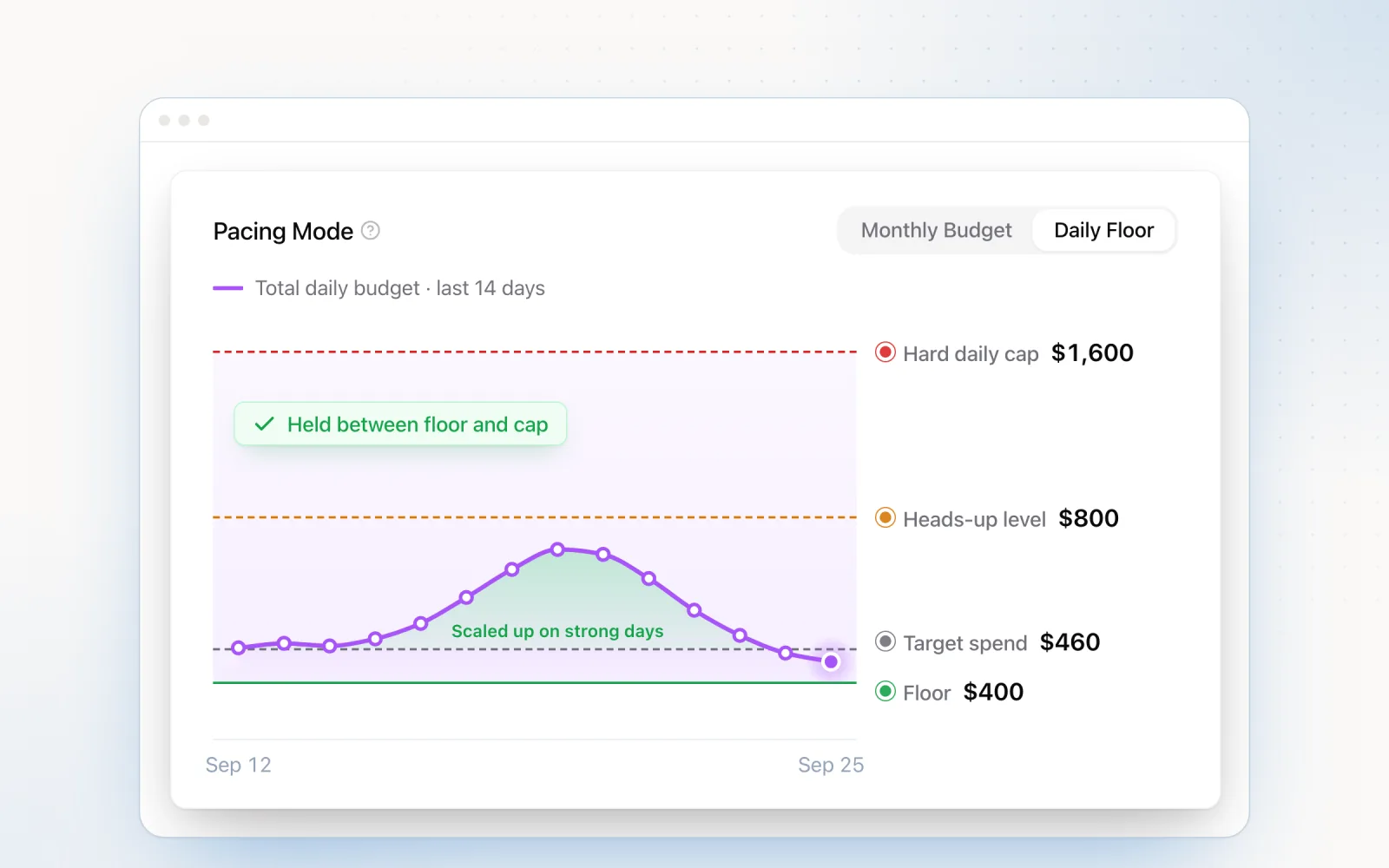
- Budget pacing: Calculating remaining budget divided by remaining days and adjusting daily caps accordingly. This is pure arithmetic, executed multiple times per day across every account. No human insight improves this calculation.
- Bid adjustments: Platform-native smart bidding (Target CPA, Target ROAS, Maximise Conversions) handles bid optimisation at a speed and granularity humans cannot match. Google processes millions of signals per auction. Manual CPC bidding made sense in 2015. In 2026, it is a competitive disadvantage for most campaign types.
- Spend alerts: Automated notifications when an account deviates from its pacing target by more than a defined threshold. Checking 25 accounts manually every morning wastes hours. An alert system checks them all in seconds and surfaces only the problems.
- Routine reporting: Pulling spend data, calculating week-over-week changes, and populating client dashboards. These are data retrieval and formatting tasks, not analytical ones.
- Negative keyword mining: Search term reports can be processed programmatically to flag irrelevant queries above a cost threshold. The review and approval should be human, but the identification can be automated.
The common thread: these tasks involve processing data, applying rules, and executing changes that follow predictable logic.
What to Keep Manual
Automation fails when the task requires context that the algorithm does not have. Several areas demand human judgment:
- Strategy and account structure: Deciding how to organise campaigns, which audiences to target, and how to allocate budget across platforms requires understanding the client's business, competitive landscape, and goals. An algorithm cannot know that a client's biggest competitor just launched a promotion, or that the client's product is seasonal in ways the data does not yet reflect.
- Creative direction: Ad copy, imagery, and video are inherently creative. While AI can generate variations, the strategic direction (what message to lead with, what pain points to address, what tone to use) requires human understanding of the brand and its audience.
- Client communication: Explaining why performance dipped, recommending budget shifts, and managing expectations are relationship tasks. Automating a report is fine. Automating the conversation around that report is not.
- Platform selection and budget allocation: Deciding whether to shift 20% of budget from Google to Meta because search volume is declining requires cross-platform strategic thinking that no single platform's algorithm can provide.
The common thread here: these tasks involve judgment, context, and nuance that cannot be reduced to a formula.
The "Vibe Coding" Trend in PPC
A growing trend in 2026 is what some in the industry call "vibe coding" for PPC: using AI coding assistants to write custom Google Ads scripts, build automated rules, and create bespoke automation pipelines. Tools like Google Ads Scripts have been around for years, but the barrier to writing them has dropped dramatically with AI assistance.
This approach has merit for agencies with specific needs that off-the-shelf tools do not address. A custom script that pauses campaigns when conversion rates drop below a threshold, or one that reallocates budget between campaigns based on intraday performance, can solve real problems.
The risk is maintenance. Custom scripts break when platforms update their APIs. They lack error handling unless explicitly built. And they create single points of failure if the person who wrote them leaves the team. For most agencies, purpose-built third-party tools provide better reliability than bespoke scripts, even if they are slightly less customisable.
The Risk of Over-Reliance on Platform AI
Google and Meta both have a vested interest in advertisers spending more. Their algorithms are optimised for platform revenue, not your client's profit margins. This misalignment means that blindly trusting platform automation can lead to overspend, poor budget pacing, and inefficient allocation. I covered this tension in depth in AI in ad management: what it actually does vs. hype.
Performance Max is the clearest example. Google controls where your ads appear, what creative is shown, and how budget is distributed across Search, Display, YouTube, Gmail, and Discover. The reporting is opaque. You cannot see which channels are driving results or where budget is being wasted. For many advertisers, PMax delivers strong aggregate numbers while masking inefficiency in individual channels.
The solution is not to reject platform AI. It is to add an oversight layer. Use smart bidding, but monitor pacing independently. Use CBO on Meta, but set monthly budget guardrails externally. Let the algorithms optimise within boundaries you define.
Best PPC Automation Tools for 2026
The right PPC automation tools handle the repetitive operational work while giving your team clear oversight and control. Here are the top PPC tools that agencies are using to automate effectively in 2026:
Pace Ads — Automated budget pacing across Google, Meta, TikTok, LinkedIn, Microsoft, Reddit, X Ads, and Amazon Ads. AI-driven daily budget adjustments with full audit trails. Best for agencies that need cross-platform budget automation with transparent change reports. See our full tool comparison.
Optmyzr — The most established PPC automation platform. Strong rule-based automation, custom scripts, and optimisation layering for Google and Microsoft Ads. Best for agencies with deep Google Ads expertise that want granular control over automation rules.
Marin Software — Enterprise-grade cross-channel automation covering Google, Meta, Amazon, and more. Includes automated bidding, budget allocation, and attribution. Best for large agencies managing significant monthly spend across many platforms.
Adalysis — Focused on Google Ads auditing and automated recommendations. Strong A/B testing automation and quality score monitoring. Best for agencies that want automated audit alerts without fully automated execution.
Google Ads Scripts — Free, built-in scripting for custom automation within Google Ads. Can automate bid adjustments, budget pacing, reporting, and alerts. Best for technically capable teams that need bespoke automation logic.
Revealbot — Automated rules and budget management for Meta and Google Ads. Visual rule builder with conditional logic. Best for agencies heavy on Meta spend that need automated scaling and cost controls.
Each tool fits a different layer of the automation stack. The best approach is choosing tools that complement each other rather than trying to find one tool that does everything.
Building an Automation Stack That Works
The best agencies I have worked with use a layered approach:
- Layer 1: Platform-native automation. Smart bidding, automated rules, and campaign-level optimisation features. These handle the real-time, auction-level decisions.
- Layer 2: Third-party tools. Budget pacing platforms, cross-channel dashboards, and alerting systems that sit above the individual platforms. These provide the oversight and coordination that platform tools cannot.
- Layer 3: Human oversight. Strategy, creative, client relationships, and exception handling. The human layer intervenes when the automated layers flag issues, makes directional decisions, and ensures alignment with business goals.
Each layer handles what it does best. The platform handles auctions. The tools handle coordination and monitoring. The humans handle judgment and relationships.
This is the model we are building Pace around: a Layer 2 tool that automates the operational overhead of budget management while giving your team clear visibility and control. Automation should make your team more effective, not replace the thinking that makes them valuable. If that approach resonates with how you run your agency, try Pace free to see it in action.

Jordan Parrello
Founder of Pace. Ran an agency pacing sheet by hand for years before building the thing that checks it every 5 minutes. About Pace or LinkedIn