Every media buyer has a version of the same story. You are running a handful of accounts, hitting targets, feeling in control. The client list doubles. The same manual process that worked at five accounts becomes a liability at twenty-five. By fifty, you are not optimising anymore. You are triaging.
Agencies that scale without losing performance are not hiring ten times more people. They are building systems. Repeatable frameworks for testing, bidding, and allocation that produce the same results at ten campaigns or a thousand. This piece is about what those systems actually look like.
Why most ad optimisation strategies break at scale
Strategies that depend on a single person's attention do not survive when that attention is split too many ways. A buyer who manually checks pacing across five accounts every morning catches problems early. The same buyer at fifty accounts starts missing things by account twelve. That is not a discipline issue. It is arithmetic.
Manual A/B testing is the obvious example. Two headline variants on one campaign, easy. Structured tests across two hundred ad sets on multiple platforms with different budgets and audiences? The manual approach collapses. You forget which tests are running. You miss the significance threshold on half of them. You never circle back to implement the winners.
Strategies that scale push the per-account cognitive load close to zero for routine work, so human attention goes where it actually matters. That means frameworks, naming conventions, automated result analysis, and tools that surface exceptions instead of asking you to watch everything.
A/B testing frameworks that actually scale
"Structured testing at scale" gets thrown around without much substance, so here is what it actually means in practice.
Creative testing. At scale, every test follows the same template: a control, one or two challengers, a defined success metric (CPA or ROAS), a minimum sample size, a fixed window. The naming convention does the work for you. Something like [Client]_[Platform]_[TestType]_[Variable]_[Variant]_[Date], so anyone on the team can read a campaign name and know what is being tested without opening a spreadsheet.
Test headline and image variants independently, not at the same time. A new headline against a new image tells you which combination won, not which variable did the work. At five campaigns you can hold all of that in your head. At fifty you need a written protocol everyone follows.
Audience testing. The argument between layered targeting (stacking interest, demographic, behavioural signals) and broad targeting has shifted since Advantage+ and Performance Max pushed advertisers toward less granular controls. Agencies still need to test audience strategy at the campaign level. Segmented testing is the version that scales: broad alongside layered, equal budget, same KPI, same window, declare a winner per campaign type. Do not test audience strategy on your biggest account and assume the result transfers everywhere else.
Bid strategy testing. This one gets skipped because switching bid strategies mid-flight feels risky. It is risky, without a framework. Run parallel campaigns instead. One on the existing strategy, one on the challenger, budget split proportionally. Give the challenger at least two to three weeks to clear the learning phase before you call it. On Google, that means waiting for "Eligible" status and enough conversion data for the algorithm to stabilise.
The thread running through all three: testing at scale is a system, not a string of one-off experiments. The system defines what gets tested, how results are measured, and who acts on the outcomes.
The bid management spectrum
Bid management runs from fully manual to fully automated. Every step trades direct control for efficiency. Knowing where each of your accounts should sit on that spectrum is one of the higher-leverage decisions you make.
Manual CPC. You set the max cost-per-click for each keyword or ad group. Complete control, only viable for small accounts with low keyword counts. At scale, manual CPC is a time sink that gets you worse results than the algorithm, because you cannot process auction-time signals the way it can.
Enhanced CPC (eCPC). The platform adjusts your manual bids up or down based on conversion likelihood. A transitional strategy, useful when you want some automation without fully handing over the wheel. Google has been deprioritising eCPC in favour of Smart Bidding, so expect it to be deprecated soon.
Target CPA / Target ROAS. You define the outcome (a target cost per acquisition or return on ad spend) and the algorithm adjusts bids to hit it. This is where most agencies should be for campaigns with enough conversion volume. The threshold that matters: Smart Bidding needs roughly 30+ conversions per month to learn properly. Below that, the algorithm is guessing and spend goes erratic. For low-volume campaigns, feed it a higher-funnel action ("Add to Cart" instead of "Purchase") to give it more data to work with.
Maximize Conversions / Maximize Conversion Value. These push for the most conversions or highest conversion value inside your budget, no specific CPA or ROAS target. Aggressive by design. They spend budgets fast. Good for volume plays, dangerous for accounts with strict pacing requirements, because landing your ad spend exactly on target needs tighter controls than these strategies give you.
Portfolio bid strategies. One bid strategy across multiple campaigns, with Google redistributing budget and bids to hit an aggregate target. A portfolio Target CPA of $50 might mean one campaign runs at $35 and another at $65, as long as the average lands at $50. Powerful at scale because it mirrors how agencies actually think about performance, at the account or client level. The trade-off is opacity. When one campaign subsidises another, you need to know which ones are pulling their weight.
Pick a strategy based on conversion volume, budget flexibility, and how tightly you need to control spend. Most agencies running diverse portfolios use a mix: Target CPA for high-volume campaigns, manual or eCPC for low-volume or new ones, and portfolio strategies for accounts with enough campaigns to benefit from cross-campaign optimisation.
Advanced budget allocation: beyond fixed monthly budgets
Fixed monthly budgets are the default in most agencies. The client says "$10,000 on Google, $5,000 on Meta," and that is what gets spent. Static allocation is inefficient. It ignores the fact that campaign performance fluctuates daily, and so does the right distribution of spend.
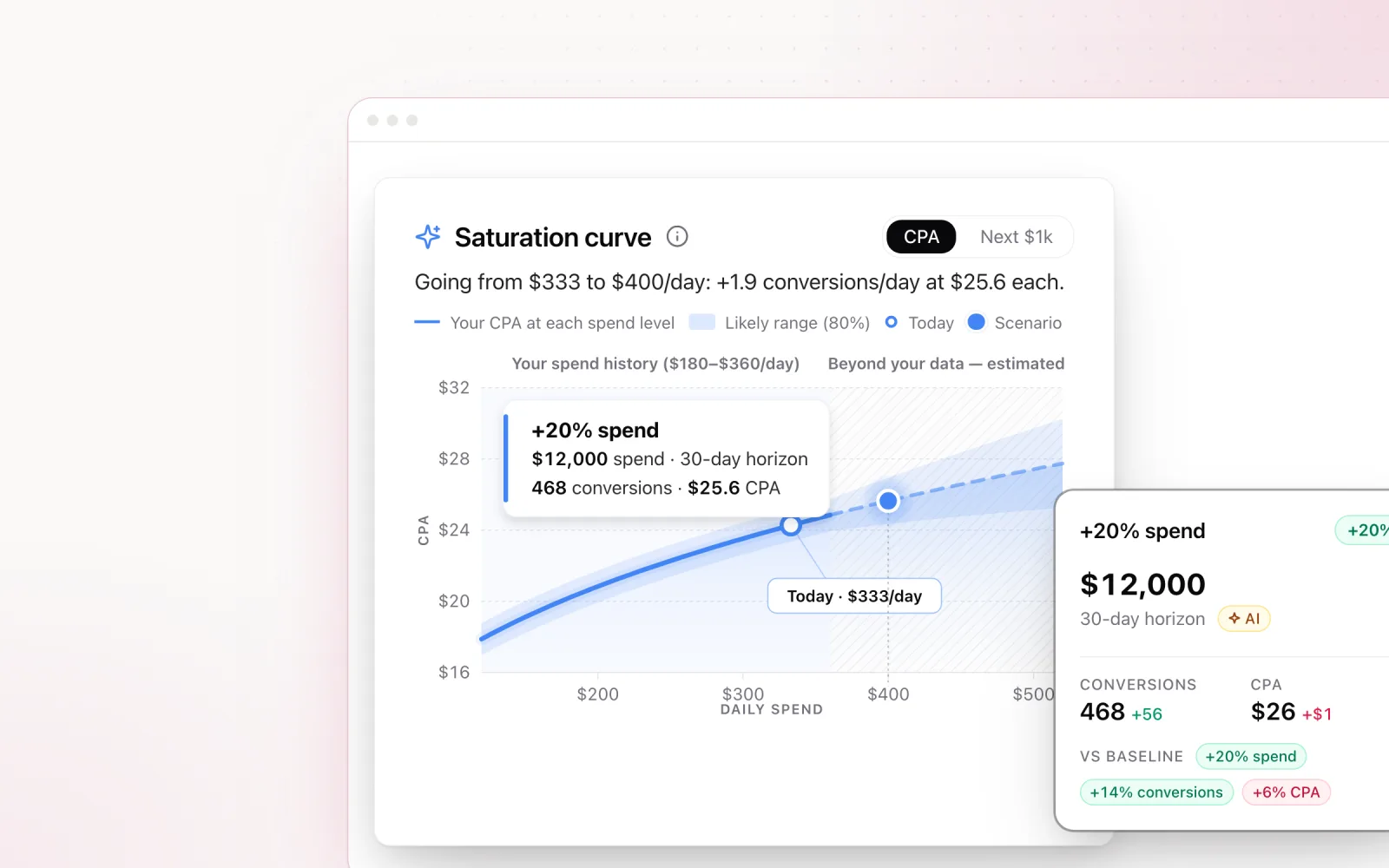
Dynamic budget allocation means shifting spend toward campaigns that are beating their CPA or ROAS targets, and pulling back from ones that are not. Google Search converting at $30 CPA against a $50 target while Display runs at $70? The rational move is to shift budget from Display to Search. Today, not next month.
The problem is visibility. To reallocate dynamically, you need real-time cross-campaign performance data in one place. Checking Google Ads, then Meta Business Manager, then LinkedIn Campaign Manager, that loop alone burns the window where the action would have mattered. This is where a unified management layer stops being a nice-to-have.
Dynamic allocation also needs guardrails. You cannot drain a prospecting campaign to zero just because retargeting has a better CPA today. Prospecting feeds the funnel that retargeting converts. The allocation framework has to respect minimum spend thresholds per campaign type, funnel-stage constraints, and any client-specific rules about platform mix.
Segmentation strategies for multi-account PPC optimisation
Not every account deserves the same optimisation intensity. Uncomfortable to say, operationally true. An agency running forty clients needs a prioritisation framework, otherwise every account ends up with the same shallow attention.
Margin-based segmentation. Organise accounts into tiers based on the revenue or margin they generate for your agency. Tier 1 (your biggest contracts) gets aggressive optimisation: frequent bid adjustments, weekly creative testing, proactive reallocation. Tier 3 (smaller retainers) gets systematic but less hands-on management: automated pacing, monthly creative refreshes, exception-based intervention.
Funnel-stage segmentation. Group campaigns by where they sit in the customer journey. Top-of-funnel awareness has different KPIs and optimisation levers than bottom-of-funnel conversion. Running the same playbook on both wastes effort and skews how you read performance.
Risk-based segmentation. Some accounts have tight budgets and low tolerance for variance. Others have flexible budgets and care about growth. High-risk, low-tolerance accounts get conservative pacing with wider safety margins and more frequent monitoring. Growth-oriented accounts get more aggressive testing and bigger allocation shifts.
This is not about neglecting small accounts. It is about putting optimisation effort where it actually moves things. The framework prevents the common failure mode where buyers spend equal time on a $2,000/month account and a $200,000/month one.
One-click actions vs. AI suggestions
There is a real difference between a tool that says "apply all recommendations" and one that says "here are recommendations with context, you decide which to apply." Google's auto-apply is the cautionary tale.
Google Ads gives every account an optimisation score and a set of recommendations. Plenty of them are useful: adding responsive search ad variants, adjusting bid targets to recent performance, expanding keyword lists. Google also recommends actions that increase spend without matching returns, like broadening targeting or raising budgets. With auto-apply on, those changes happen with no review.
Agencies have learned this the hard way. Auto-applied recommendation broadens match types, spend spikes, CPA jumps, and the client calls asking what happened. The recommendation itself was not the problem. The problem was that it was applied without context. A human reviewer would have known the account had strict CPA targets, or that the client was in a budget-sensitive quarter.
The better model is "assisted optimisation": the tool identifies opportunities, gives you the data and reasoning behind each suggestion, and lets the buyer decide. You keep the efficiency (the tool does the analysis) without giving up the judgement call. For agencies that have to justify every change to clients, as covered in what AI actually does in ad management, that transparency is the floor.
Performance scoring: quantifying account health
When you manage many accounts, you need a fast answer to one question: which accounts need my attention right now? Scrolling through dashboards for every account does not scale. Performance scoring does.
A performance score is a composite metric that quantifies account health across multiple dimensions. A useful scoring model looks at:
- Pacing accuracy: How close is actual spend to target pace? An account at 95% of target scores higher than one at 72%.
- CPA or ROAS trend: Is the cost per acquisition improving, stable, or getting worse over the past 7 and 30 days? Trend matters more than the absolute number, because a CPA moving in the right direction tells you the optimisation is working.
- Impression share: Are campaigns capturing available demand, or are they budget-constrained or rank-constrained? Low impression share on high-intent campaigns is missed money.
- Quality Score distribution: What percentage of keywords sit above a 7/10 quality score? Low quality scores point to ad relevance or landing page issues that drag down everything else.
- Change velocity: How many changes were made recently, and did they help? Lots of changes plus declining performance usually means an account is being over-tinkered with.
The score itself matters less than what it enables: triage. The buyer starts their day with the lowest-scoring accounts and works up. Optimisation time goes where the data says it is needed, not where habit or anxiety pulls them.
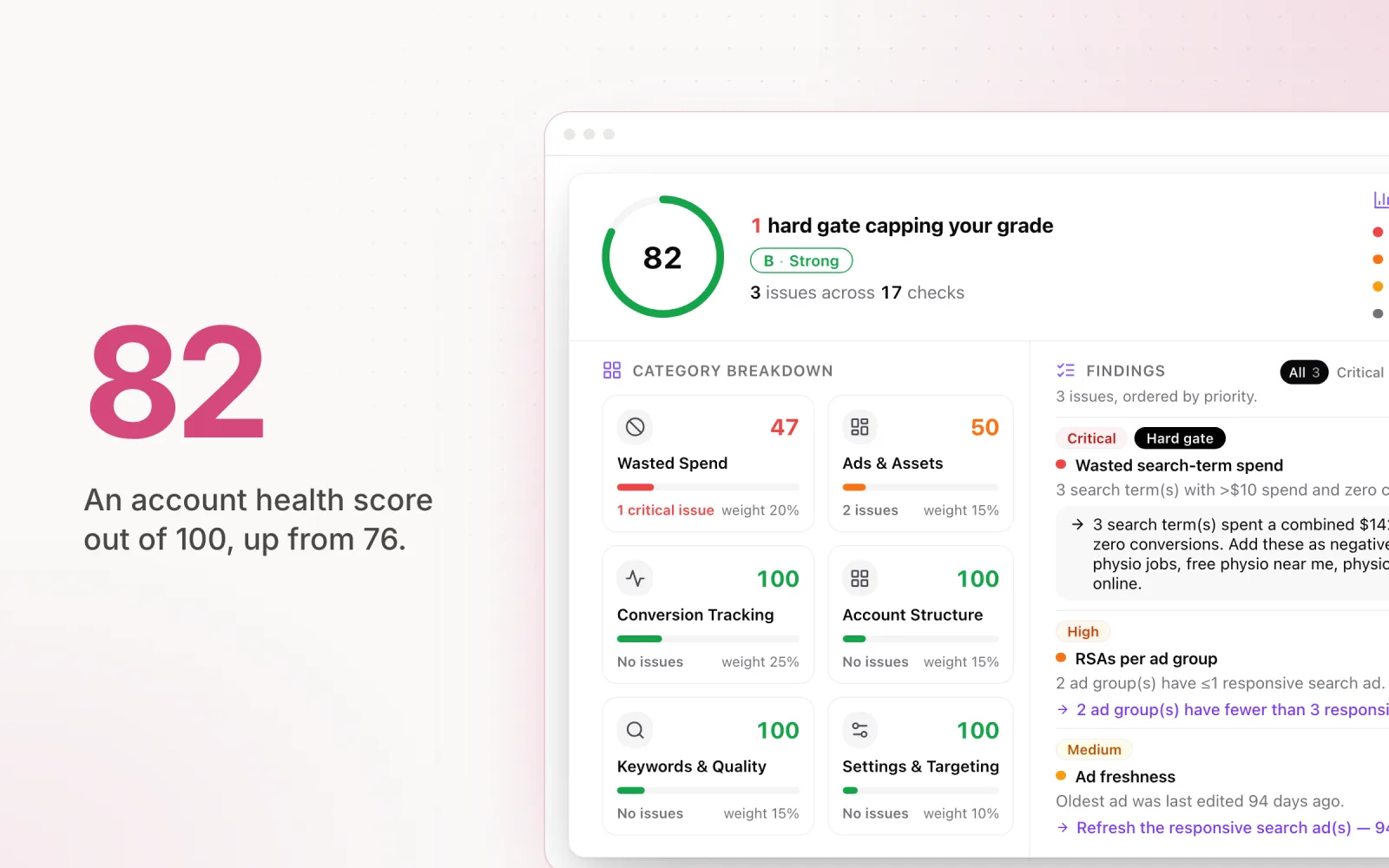
Performance scoring also makes client reporting better. Instead of dropping raw data and hoping the client interprets it, you give them a health score with context: "Your account scored 82 out of 100 this month, up from 76 last month. Pacing improved, CPA trend is stable, and we resolved the impression share issue on the brand campaign." A client without a PPC background can follow that.
Google Ads optimisation: platform-specific tactics
The frameworks above apply across platforms, but Google Ads has specific levers worth calling out. At scale, these are the areas where PPC optimisation techniques have the highest payoff.
Optimisation score. Google gives every account a score from 0 to 100. Use it as a directional signal, do not chase it. Some recommendations actually improve performance (adding negative keywords, fixing conversion tracking). Others primarily lift your spend (raising budgets, broadening match types). Evaluate each one on its own merits. An account at 75% with tight CPA control will often beat one at 95% that accepted every spend-increasing recommendation.
Quality Score management. Quality Score directly affects CPC and ad position. At scale, start with the lowest-QS keywords in your highest-spend campaigns. The three components to fix are ad relevance (align ad copy to the keyword), expected CTR (test headlines that lift it), and landing page experience (match content to search intent). Working through your top 100 keywords by spend will reduce CPCs more than broad sweeps across thousands.
Ad strength and RSA optimisation. Google rates RSA combinations from "Poor" to "Excellent." Ad strength is not a direct ranking factor, but higher-strength ads tend to enter more auctions. The practical version: every ad group should have at least one RSA at "Good" or "Excellent" with distinct headline and description variants covering different angles (feature, benefit, social proof, urgency). Pin your strongest headline to position 1 if Google's automatic rotation is not surfacing it consistently. For a deeper breakdown of headline structure, pinning logic, and ad-strength tactics, see our guide to responsive search ad best practices.
How Pace approaches optimisation at scale
At Pace, we built the optimisation layer specifically for agencies managing campaigns at scale. Every feature follows the same principle: tools should surface insights and suggest actions, not make decisions unilaterally.
AI-powered budget optimisation. Pace’s core engine uses frontier language models to analyse campaign performance across three data packets (45 days of trend data, 15 days of deep-dive diagnostics, and yesterday’s pulse), then automatically adjusts daily budgets to hit monthly targets. The system carries a running strategy memory (persona and hypothesis) for each account, so every decision considers what was done before and why. Every change is logged with the full reasoning and the data points analysed.
Pacing status indicators. Every connected account gets a spend progress bar with colour-coded pacing variance: green (0–4%), yellow (4–10%), orange (10–15%), red (>15%). A goal performance badge shows the account’s chosen success metric (Conversions, CPA, ROAS, CTR, or CPC) with a week-over-week trend indicator. Buyers see at a glance which accounts need them. As explored in Performance Max budget pacing, this matters most for campaign types where the platform controls spend distribution.
Findings: automated anomaly detection. Pace runs cross-platform analysis that only surfaces high-signal anomalies. 90% of the time it returns nothing. When Findings fire, something actually shifted: CPA spiked more than 30%, ROAS dropped more than 25%, a conversion campaign is spending with zero results, Meta or TikTok creative fatigue is setting in. Each finding is a severity-coded card (critical, warning, success, info) with the data that triggered it and a recommended action. Slack and email notifications make sure the right people see it immediately.
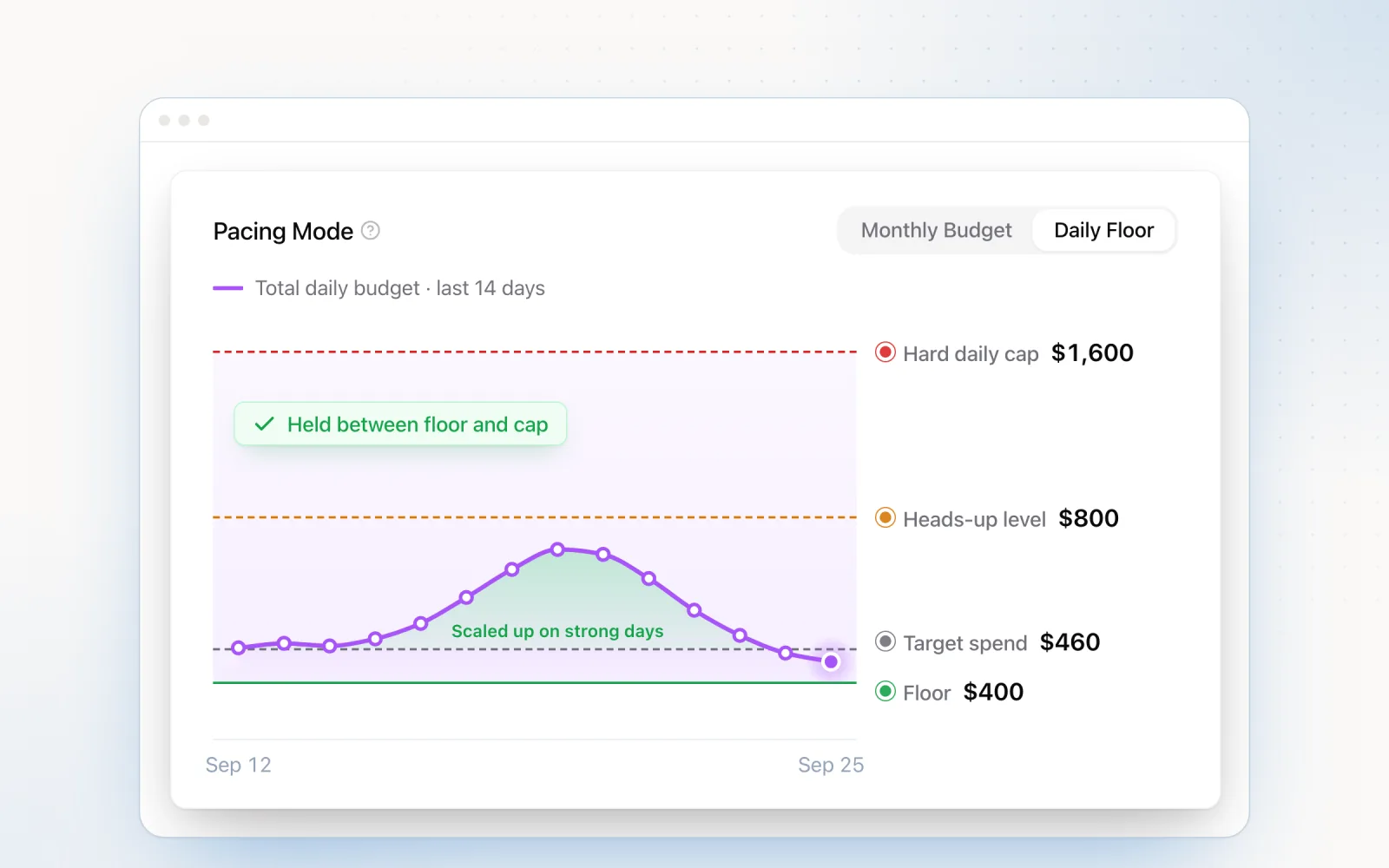
Automated adjustments with guardrails. Pace moves budgets gradually, with hard day-over-day limits so nothing lurches. An independent overspend protection system checks spend every 5 minutes. The monthly budget is the cap: once an account reaches it, Pace drops each campaign to $1 a day by default (a trickle that keeps campaigns live and learning), or pauses them if you choose. On the 1st of the month, Pace restores only what it changed or paused itself. Anything you paused manually stays paused. Every change is logged with full context. No black-box decisions.
The result is an optimisation workflow that scales with your account list without scaling your headcount. Buyers spend less time on calculations and data gathering, and more time on the strategic work that actually differentiates the agency.
Putting it into practice
Scaling optimisation is about a system of interlocking practices, not one perfect strategy. Structured testing, the right bid strategy for each campaign's maturity, dynamic allocation with guardrails, segmentation of effort, performance scoring that drives triage. Each piece earns its place by what it removes from the buyer's plate.
The agencies that get this right are not working harder per account. They are working smarter across accounts, with tools that make a systematic approach sustainable. If you are hitting the ceiling of manual optimisation, more hours will not fix it. Better systems will.
Try Pace free and see how structured optimisation scales from five accounts to five hundred.

Jordan Parrello
Founder of Pace. Ran an agency pacing sheet by hand for years before building the thing that checks it every 5 minutes. About Pace or LinkedIn