Organic search vs. paid search: the basics
Organic and paid search are two ways to appear on a search engine results page (SERP). Both chase the same intent (someone actively searching for information, a product, or a service), but they get there through different mechanisms.
Organic results are the listings Google's algorithm decides to surface. You earn them through SEO: relevant content, authoritative backlinks, a technically sound site. There is no per-click cost. The cost is indirect, the time and expertise invested in building content and authority over months or years.
Paid results are the listings marked with a "Sponsored" label at the top and bottom of the SERP. You buy them through PPC platforms like Google Ads and Microsoft Ads. Bid on keywords, write ad copy, pay per click. Visibility is immediate once the campaign launches. It disappears the moment you stop paying.
On a typical SERP, paid ads occupy the top three or four positions, followed by organic. For many queries a local pack, featured snippet, or shopping carousel sits between them. The user sees one page. The two channels run on completely different rules, and knowing those rules is what separates a budget that works from one that bleeds.
How organic search works
Organic search runs on Google's ranking algorithm, which weighs hundreds of signals to decide which pages appear for a given query. The signals that matter most fall into content relevance, authority, and technical health.
Content relevance means your page answers the searcher's question properly. Google looks at topical depth, keyword alignment, structure, and how well the page satisfies the intent behind the query. A page targeting "how to train for a marathon" has to deliver an actual training framework, not just sprinkle the phrase across a headline. Google is good now at telling the difference between content that helps and content that's just chasing keywords.
Authority is mostly measured through backlinks, links from other sites pointing to yours. Each quality backlink is a vote of confidence. A link from a respected publication carries far more weight than one from a low-traffic blog. Authority is the slowest part of SEO to build because it depends on other people deciding your content is worth referencing. It's why established sites with strong backlink profiles rank more easily than new sites, even when the new site's content is excellent.
Technical health covers site speed, mobile-friendliness, crawlability, structured data, and Core Web Vitals. These rarely push a mediocre page to the top, but poor technical health can stop a great page from ranking at all. If Google can't crawl efficiently, or the page loads slowly on mobile, rankings suffer regardless of content quality.
The timeline matters most for planning. New content targeting moderately competitive keywords usually takes 3 to 6 months to reach page one. For highly competitive terms, 6 to 12 months is more realistic. Some queries dominated by established brands with decades of backlink equity may take years to crack, or may never be realistically achievable through SEO alone. That slow ramp-up is organic search's biggest constraint, and it's the reason most businesses can't rely on SEO exclusively.
How paid search works
Paid search runs on a real-time auction. Every time a user enters a query that matches a keyword an advertiser is bidding on, Google runs an instant auction to decide which ads appear and in what order.
The auction outcome is set by Ad Rank, calculated from two main factors: your bid (the most you're willing to pay per click) and your Quality Score (Google's read on your ad's relevance and landing page experience). Ad Rank = Bid x Quality Score. A lower bid can still win a higher position if the ad is meaningfully more relevant than a competitor's.
Quality Score itself has three components: expected click-through rate, ad relevance, and landing page experience. Each is rated above average, average, or below average. The combined assessment produces a score from 1 to 10.
The practical side is simple. Pick keywords, write ad copy, set a budget, and ads start appearing within hours. You pay only when someone clicks. You control which search queries trigger your ads (through keyword match types and negative keywords), what the ad says, and where the click lands. Pause the campaign and traffic stops immediately.
That control and immediacy is what makes paid search non-negotiable for time-sensitive work. The trade-off is structural: every click costs, and CPCs have been rising for years. Average CPC on Google Ads ranges from $1 to $5 for most B2C industries and $2 to $15 for B2B. Legal, insurance, and SaaS regularly push past $20 a click.
Organic vs. paid search: key differences
The decision between organic and paid (or how to balance both) comes down to how they differ across a few dimensions that matter.
Cost structure. Organic search needs upfront and ongoing investment in content, technical SEO, and link building. No per-click cost. Once a page ranks, traffic flows without incremental spend. Paid search has a direct per-click cost as long as you want traffic. Over 12 months, a page ranking organically for a high-volume keyword can generate traffic worth tens of thousands of dollars in equivalent paid clicks, at a fraction of the cost.
Speed to results. Paid search delivers traffic within hours. Organic takes months. If you need leads this week, SEO can't help. If you're planning for the next 12 months, organic is almost always the more cost-effective investment.
Click-through rates. Organic results receive roughly 60% to 70% of all search clicks, with the top three positions taking the lion's share. Paid ads pick up the remaining 30% to 40%. The ratio shifts with commercial intent. For transactional queries like "buy project management software," paid takes a higher share because users expect and accept ads on purchase searches. For informational queries like "what is project management," organic dominates.
Trust and credibility. Users tend to trust organic over paid. Research consistently shows searchers view organic listings as more credible because they know the result wasn't bought. The gap is narrowing as Google's ad labelling gets subtler, but it still exists, especially among B2B buyers who tend to be more ad-sceptical.
Data access. Paid search gives immediate, granular keyword-level data: which queries triggered ads, which converted, at what cost. Available from day one. Organic keyword data is limited by Google's encryption. Search Console provides impression and click data, with a delay and without the conversion-level detail Google Ads offers. That data asymmetry is one reason paid search is worth running even if SEO is your main investment.
Control. Paid search gives you control over messaging, targeting, scheduling, and budget. You can test headlines, pause underperforming keywords, adjust bids in real time. Organic offers no such control. You can optimise a page, but Google decides where it ranks. Algorithm updates can drop rankings overnight with no warning and no recourse.
Scalability. Paid scales linearly. More budget means more clicks, up to the point where you've captured all available impression share. Organic scales exponentially but slowly. A site that builds topical authority can rank for hundreds or thousands of related keywords from a single content investment. That authority takes time.
Sustainability. Organic rankings, once established, tend to persist for months or years with modest maintenance. A well-written blog post can generate traffic for 3 to 5 years. Paid traffic is a rental. It exists only as long as you're paying. That makes organic the better long-term investment for any query with stable, recurring search volume.
When to use paid search
Paid is the right channel when speed, control, or precision outweighs long-term cost efficiency. Here's where PPC pays off.
Competitive keywords where organic isn't realistic short term. If the SERP for your target keyword is dominated by sites with domain ratings above 70 and thousands of backlinks, ranking organically could take a year or more. Paid lets you appear on that same SERP today while you build organic authority in the background.
Product or service launches. New products have no organic footprint. No content indexed, no backlinks earned, no rankings to speak of. Paid gives you immediate visibility for launch keywords and drives early traffic and conversions while SEO begins the slow build.
Seasonal and time-sensitive promotions. Black Friday sales, end-of-quarter offers, event-driven campaigns. Fixed timelines. Organic can't be accelerated to match a promotional calendar. Paid turns on the day a promotion starts and pauses the day it ends, with precise budget control.
Testing messaging and keyword viability before SEO investment. A serious SEO content piece is 20 to 40 hours of work. Before committing, run a paid campaign targeting the same keywords to see if the traffic actually converts. If a keyword generates clicks but no conversions via PPC, it probably won't convert from organic either. Cheap insurance against a heavy content investment that goes nowhere.
High-intent commercial queries. When the searcher is ready to buy ("enterprise CRM pricing," "hire digital marketing agency Sydney"), paid captures demand at its peak. Conversion rates on these often justify the per-click cost, and the ad format lets you include specific offers, pricing, and CTAs that organic listings can't match.
When you need measurable results this month. Paid delivers data within days. If you or a client need to show ROI inside a 30-day window, PPC is the only search channel that reliably can.
When to use organic search
Organic is the right investment when you're building for compounding returns rather than instant gratification. These are the scenarios where SEO outperforms PPC.
Informational queries with long-term traffic potential. "How to write a marketing plan," "what is CRM software," "best practices for email marketing." Thousands of searches a month, year after year. Ranking for these creates a traffic stream that needs minimal ongoing investment. Paying for every click on informational queries via PPC is rarely cost-effective because the intent is low. Users are researching, not buying.
Building topical authority. Search engines reward sites that demonstrate real expertise in a subject. Publishing a cluster of related content (a pillar page with detailed subtopic support) signals to Google that your site is an authority on that topic. The lift applies across your entire content library, not just individual pages. PPC can't replicate that compounding effect.
Brand awareness through thought leadership. Showing up in organic results for industry questions positions your brand as a trusted source. When a CMO searches "how to reduce customer acquisition cost" and finds your guide, that builds credibility no paid ad can match. Thought leadership content shapes purchase decisions weeks or months later.
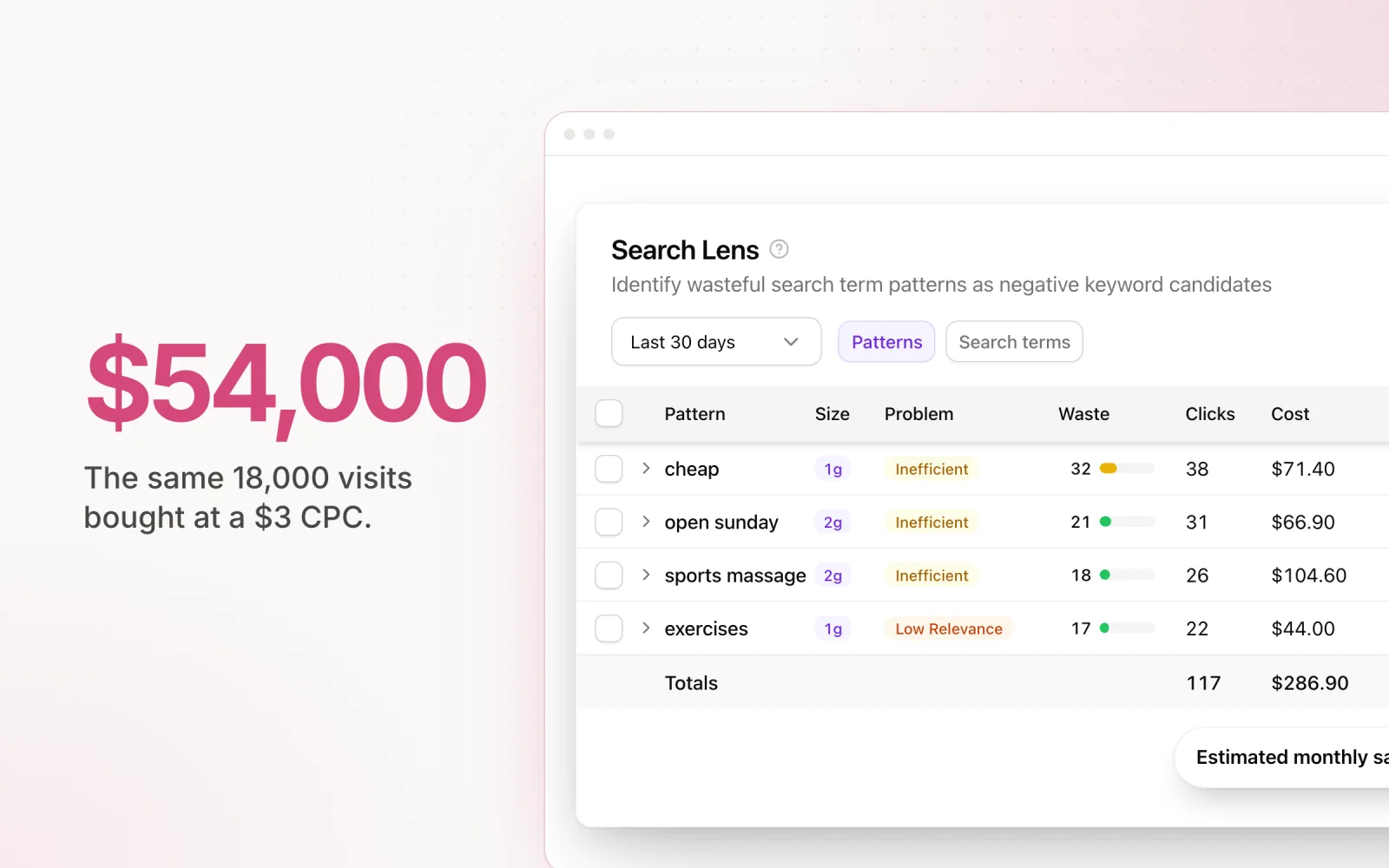
Reducing long-term cost per acquisition. The economics of organic improve over time. A blog post that costs $2,000 to produce and generates 500 visits per month for three years delivers 18,000 visits at $0.11 a visit. The same 18,000 visits via paid search at an average $3 CPC would cost $54,000. For any keyword with stable search volume, organic is dramatically more cost-effective over a multi-year horizon.
Queries where paid ads have low click-through. For certain informational and navigational queries, users scroll right past ads. If your paid campaigns for a keyword show CTR below 1%, users are telling you they don't want ads for that search. Organic presence is the only way to capture that traffic.
How paid and organic search work together
The strongest search strategies don't treat organic and paid as competing channels. They treat them as complementary, each filling gaps the other can't.
Use paid data to inform SEO keyword strategy. One of the most useful applications of PPC is keyword discovery. Run paid campaigns across a broad keyword set for 30 to 60 days, then analyse which keywords drove conversions at an acceptable cost. Those are your SEO priorities. The approach takes the guesswork out and points content investment at queries that drive actual business results, not just traffic.
Use SEO to reduce paid dependency on branded terms. Many advertisers burn significant budget bidding on their own brand name to fend off competitors. If your organic listing already ranks first for your brand, the incremental value of a paid brand ad is limited. Cutting brand PPC spend (or pausing it entirely when competitors aren't actively bidding) frees up budget for non-brand campaigns where paid has a higher marginal return.
Dominate SERPs with dual presence. When your brand appears in both paid and organic for the same query, combined CTR beats either channel alone. Research from Google found that incremental ad clicks (clicks that wouldn't have gone to the organic listing) account for roughly 50% of ad clicks when both listings are present. Dual presence also pushes competitors further down the page.
Use paid to fill gaps while organic catches up. When you publish new content targeting a competitive keyword, it can take 6 months to reach page one organically. During that ramp-up, run a paid campaign on the same keyword to capture traffic now. As organic ranking climbs, gradually reduce paid spend on that keyword. The phased approach means you're never waiting for traffic. You're always capturing demand.
Share conversion data across channels. Paid landing pages with high conversion rates show you what messaging and page structure resonates. Apply those insights to your organic landing pages. The reverse holds too: organic content that ranks well but doesn't convert tells you the content satisfies the query but the CTAs or page flow need work, and you can test improvements faster through paid landing page variants.
Attribution considerations. Running both organic and paid for the same keywords makes attribution more complex. A user might click a paid ad on Monday, come back via organic on Wednesday, and convert on Friday. Understanding those multi-touch journeys matters for allocating budget. Google Analytics 4 uses data-driven attribution by default, which spreads credit across touchpoints. Review assisted conversions and path analysis to see how organic and paid interact in your funnel before reallocating budget.
Frequently asked questions
Is organic search better than paid search?
Neither is inherently better. The right choice depends on your goals, timeline, and budget. Organic delivers higher long-term ROI and earns more total clicks, but takes months to build momentum. Paid delivers instant visibility and precise targeting, but stops generating traffic the moment you pause spend. Most businesses perform best running both, with paid driving immediate results while organic builds sustainable traffic.
What percentage of clicks go to organic vs. paid results?
Organic results receive roughly 60% to 70% of all search clicks. Paid ads pick up the remaining 30% to 40%. The ratio shifts significantly by query type. High-commercial-intent searches like "buy running shoes online" send a larger share to paid, while informational queries like "how to train for a marathon" skew heavily toward organic. Click distribution also varies by device. Mobile users click paid results more often because ads take up a larger share of the visible screen.
Should I invest in SEO or PPC first?
If you need revenue or leads in the next 30 to 90 days, start with PPC. It generates immediate traffic and gives you keyword data to shape your SEO strategy. If you have a longer timeline and want sustainable traffic that compounds, start with SEO. The ideal approach for most businesses is launching PPC for immediate results while simultaneously investing in SEO for the long term. As organic rankings improve, you can gradually shift budget away from paid campaigns targeting the same keywords.
Does paid search help organic rankings?
Paid search does not directly influence organic rankings. Google has confirmed that running ads does not boost your position in organic results. Paid can indirectly support SEO though: it drives brand awareness (users who see your ads may later search for your brand organically), provides keyword performance data that informs your content strategy, and the additional site traffic from paid can lead to more backlinks and social sharing if the landing page content is genuinely useful.

Jordan Parrello
Founder of Pace. Ran an agency pacing sheet by hand for years before building the thing that checks it every 5 minutes. About Pace or LinkedIn