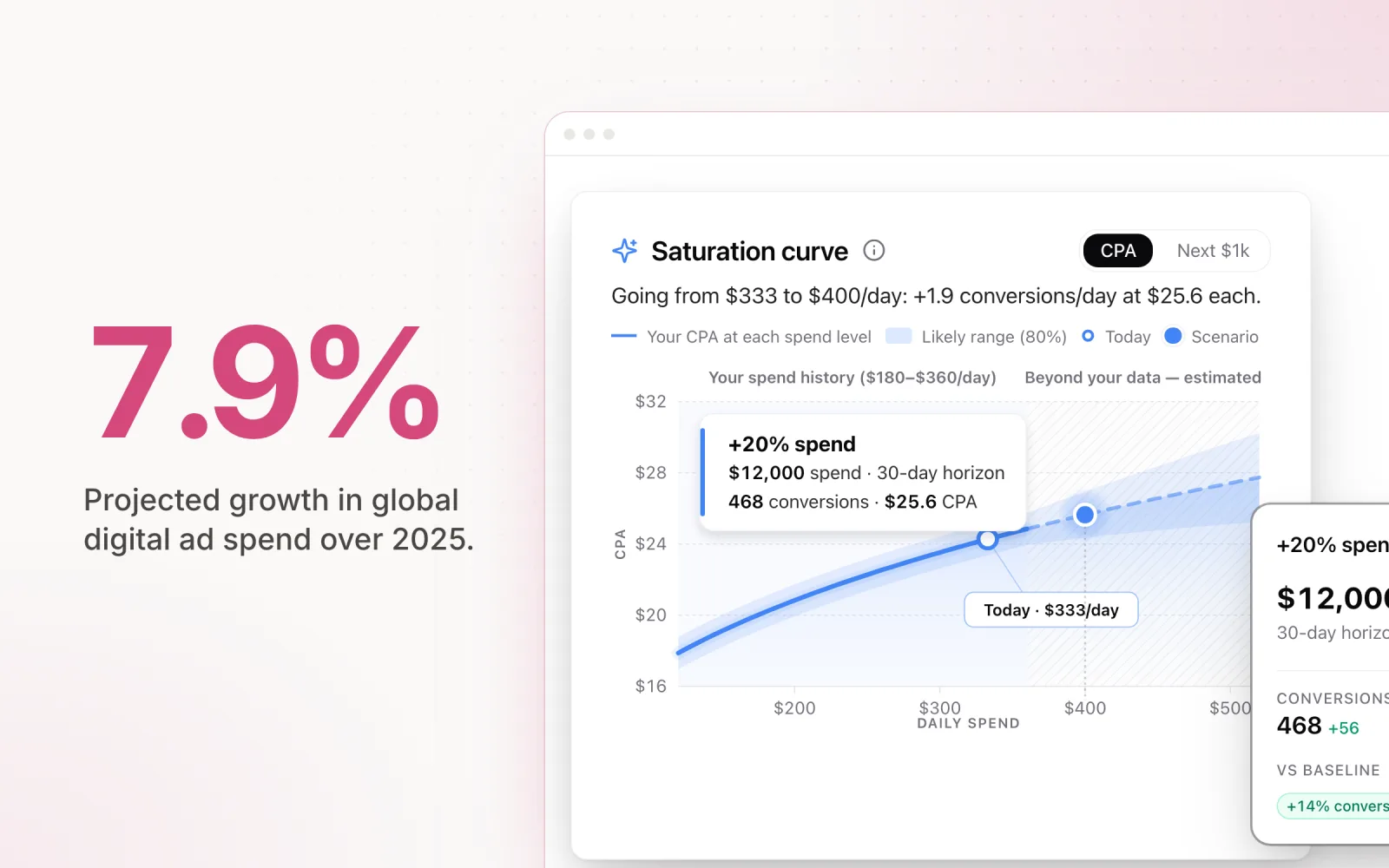
The 2026 state of ad spend tells a story of consolidation, channel migration, and rising expectations. According to projections from eMarketer and Statista, global digital advertising spend will reach approximately $870 billion this year, representing a 7.9% increase over 2025. For agencies managing client budgets across multiple platforms, these macro trends translate directly into how you plan, pace, and report on spend.
The Big Number: $870 Billion and Where It Is Going
The overall growth rate of 7.9% masks significant variation across channels. Search advertising remains the largest category, but its growth rate has slowed to around 5% year over year. Social advertising, by contrast, grew 11% in 2025 and is maintaining that momentum into 2026. Display advertising (traditional banner and programmatic display) declined nearly 40% as budgets shifted toward video and social formats.
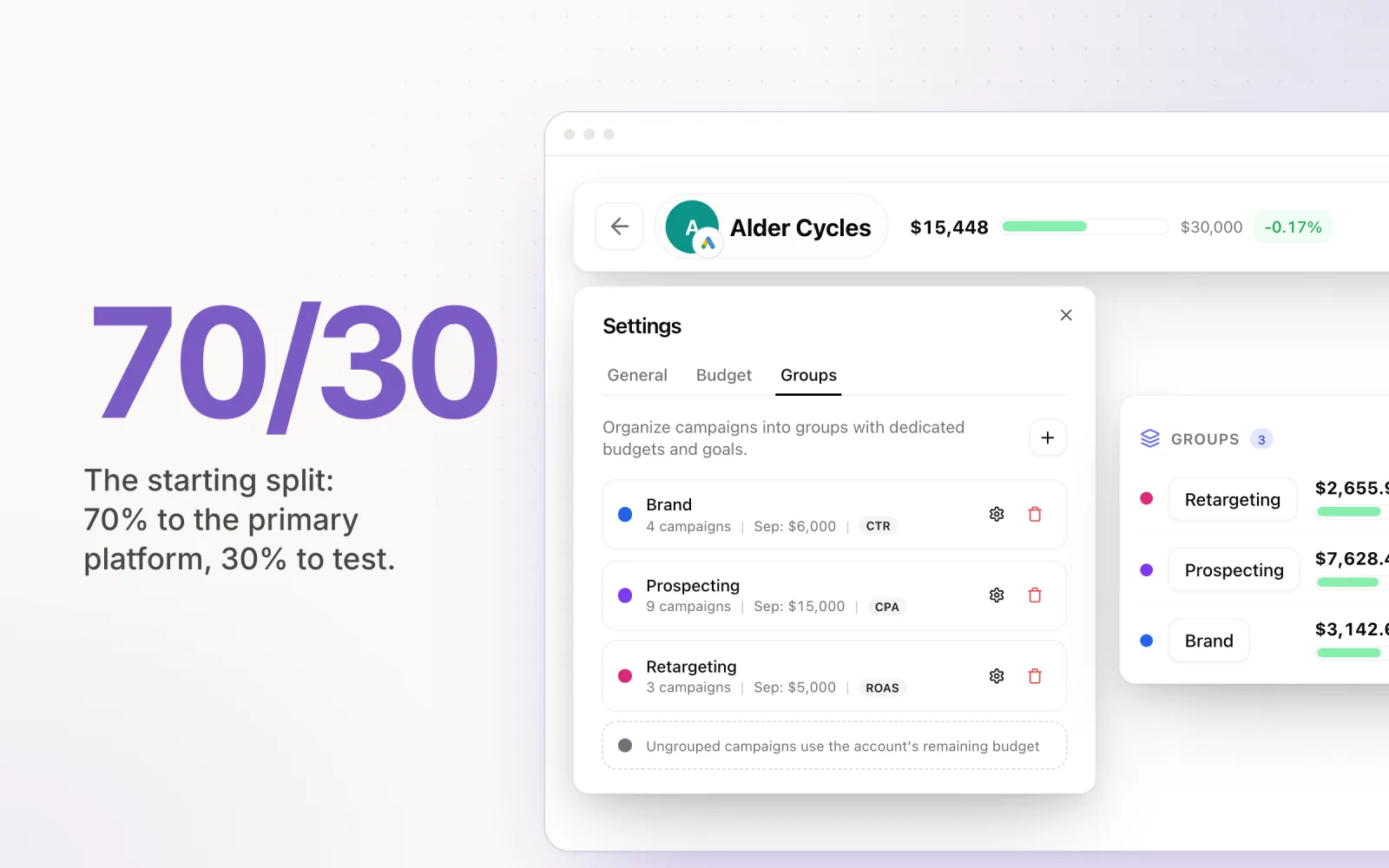
For agencies, this means the budget conversations with clients are changing. Clients who historically allocated 70% to search and 30% to social are increasingly moving toward a 55/45 or even 50/50 split. Allocating budget between Google and Meta requires a more nuanced approach than simply mirroring last year's ratios.
Channel Shifts: Social Up, Display Down
The migration away from traditional display toward social video and short-form content is accelerating. Meta's Reels inventory expanded significantly in 2025, and CPMs on Reels placements are still 20-30% lower than in-feed on average. Agencies that shifted budget early captured lower-cost impressions before the market catches up.
LinkedIn's ad business grew 18% in fiscal year 2025, driven primarily by B2B advertisers moving budget from Google Display Network to LinkedIn's audience targeting. The trade-off is higher CPCs (LinkedIn's average CPC sits around $5-8 AUD, compared to $1-3 on Google Search for similar B2B terms), but conversion quality tends to compensate. For agencies managing mixed B2B portfolios, LinkedIn's share of total spend is trending upward.
Microsoft Ads also deserves attention. Its integration of LinkedIn audience data into the search network creates a targeting combination that no other search platform offers. Agencies that dismiss Microsoft as "just Bing" are overlooking a channel where CPCs run 20-40% lower than Google with access to professional demographic targeting.
The AI Impact on Ad Spend Trends in 2026
Google's push toward Performance Max and consolidated campaign types is reshaping how budgets are structured. Performance Max campaigns absorb spend across Search, Display, YouTube, Discover, and Maps. The result is less granular control over where each dollar goes, which makes budget pacing more difficult at the campaign level.
Meta is moving in a similar direction. Advantage+ campaigns encourage advertisers to consolidate audiences and let the algorithm distribute budget. Fewer, broader campaigns mean fewer levers to pull manually, and a greater reliance on the platform's own pacing logic (which, as many agencies have learned, does not always align with your monthly target).
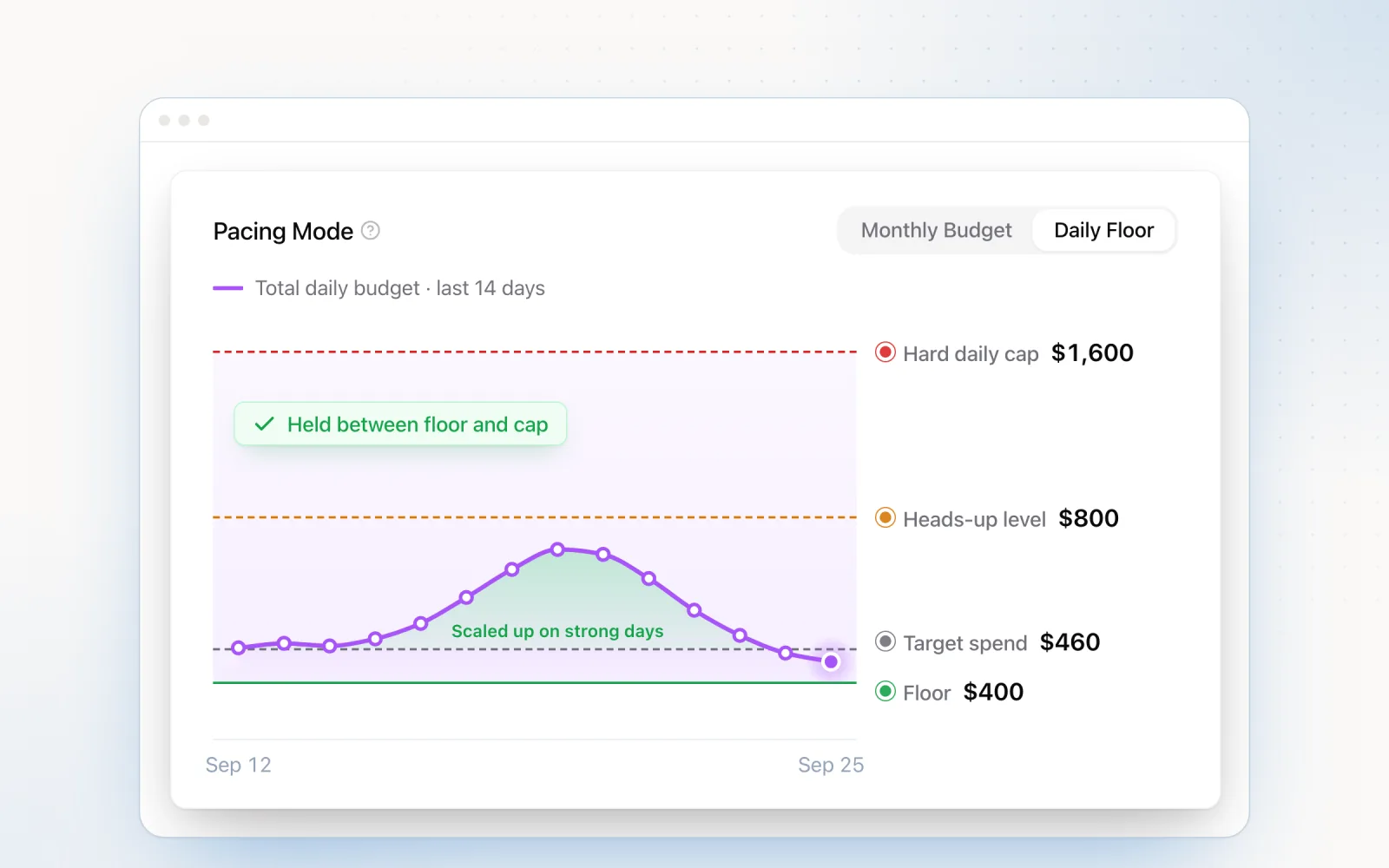
The practical implication: agencies need external pacing and monitoring tools more than ever. When the platforms themselves are consolidating campaign structures, the ability to set a monthly budget target and have an independent system track and adjust pacing becomes critical. Relying on Google or Meta to pace your budget correctly is a bet that does not always pay off.
Platform-Specific Trends Worth Watching
Google Ads. The March 2026 update to Google's ad scheduling and budget distribution changed how daily budgets are spent across time zones. Agencies running campaigns across multiple regions need to account for this in their pacing calculations, and any team still using dayparting to throttle spend should revisit their schedules now that the old assumptions no longer hold. Google also increased the daily overspend allowance from 2x to 2.5x on standard delivery campaigns, making monthly budget management trickier.
Meta Ads. Meta's API rate limits tightened in Q1 2026, affecting third-party tools that rely on frequent data pulls. The shift toward Conversions API (CAPI) as the primary measurement signal continues to complicate attribution. Agencies that have not fully implemented CAPI are seeing increasing data gaps in their reporting.
LinkedIn Ads. CPCs rose approximately 12% year over year, reflecting increased competition in the B2B space. LinkedIn's new Predictive Audiences feature (similar to Meta's Lookalike Audiences) is showing early promise for expanding reach without sacrificing lead quality. Budget management on LinkedIn remains less sophisticated than Google or Meta, making third-party pacing tools valuable.
What This Means for Agency Operations
Clients are spending more but expecting greater efficiency. The era of "we will manage your Google Ads" is giving way to "we manage your cross-platform ad portfolio." This shift has direct operational implications.
First, automation is table stakes. Agencies that still manually pace budgets across platforms are spending operational hours on work that produces no strategic value. Knowing what to automate and what to keep manual is the key distinction between agencies that scale and those that stall.
Second, transparent reporting is a competitive advantage. Clients have access to their own platform dashboards. The value an agency provides is not access to data but the interpretation, context, and proof of intelligent budget management. Change logs, audit trails, and clear explanations of pacing decisions differentiate professional management from expensive hand-holding.
How Forward-Thinking Agencies Are Adapting
The agencies I see thriving in 2026 share three traits. They have centralised their budget management into a single platform that covers Google, Meta, LinkedIn, and Microsoft. They use AI-assisted optimisation for pacing and daily budget adjustments, freeing their teams to focus on strategy and creative. And they provide clients with transparent, automated reporting that shows exactly how budgets are being managed.
The $870 billion figure is not just a market size number. It represents the total pool of budget that agencies are competing to manage well. The agencies that invest in the operational infrastructure to manage it efficiently, across platforms, with transparency, are the ones that will capture a larger share of that pool. If you are building that infrastructure now, try Pace free to see how automated cross-platform pacing fits into the picture.

Jordan Parrello
Founder of Pace. Ran an agency pacing sheet by hand for years before building the thing that checks it every 5 minutes. About Pace or LinkedIn