Deciding how to allocate budget between Google Ads and Meta Ads is one of the first strategic decisions every advertiser faces, and one of the most frequently revisited. The two platforms serve fundamentally different roles in the marketing funnel, and the right split depends on your client's industry, audience behaviour, and campaign objectives.
Over the years, I have managed multi-platform budgets across dozens of clients in different verticals. There is no universal answer, but there is a sound framework for making the decision. Here is how I approach it. (For the broader picture beyond just Google and Meta, our guide on cross-channel advertising strategy and management covers how to add LinkedIn, Microsoft, and other platforms into the same plan.)
The Fundamentals: Intent vs. Demand Creation
Google Ads captures existing intent. Someone searches for "best running shoes" or "plumber near me," and your ad appears at the moment of highest purchase intent. The user has already identified a need. Google's role is to connect them with a solution.
Meta Ads creates demand. A user scrolling Instagram sees an ad for running shoes they were not actively shopping for. The ad introduces a product, builds interest, and drives a purchase that would not have happened otherwise. Meta's role is to generate awareness and consideration that did not previously exist.
This distinction should drive your initial budget allocation. If your client's product or service has strong search demand (high monthly search volume for relevant keywords), Google should receive a larger share. If the product relies on discovery, visual appeal, or impulse purchasing, Meta should receive more.
Industry Benchmarks: Where the Data Points
Benchmarks vary by industry, but general patterns are consistent. E-commerce brands selling visually appealing, impulse-friendly products (fashion, beauty, home goods) tend to see stronger returns on Meta, with average ROAS figures around 6:1 for well-optimised campaigns. This makes sense: these products benefit from visual storytelling and emotional triggers that social platforms deliver well.
High-consideration products and services (B2B software, professional services, financial products) tend to perform better on Google Search, where average ROAS sits around 4:1 but with higher-quality leads. The cost per click is typically higher on Google, but so is the conversion quality because the user arrived with intent.
These benchmarks are starting points, not prescriptions. For a broader look at where industry spend is heading, our breakdown of key ad spend trends in 2026 provides useful context for allocation decisions. Your client's actual performance data should override any industry average within the first 60 to 90 days of running campaigns on both platforms.
The 70/30 Starting Framework
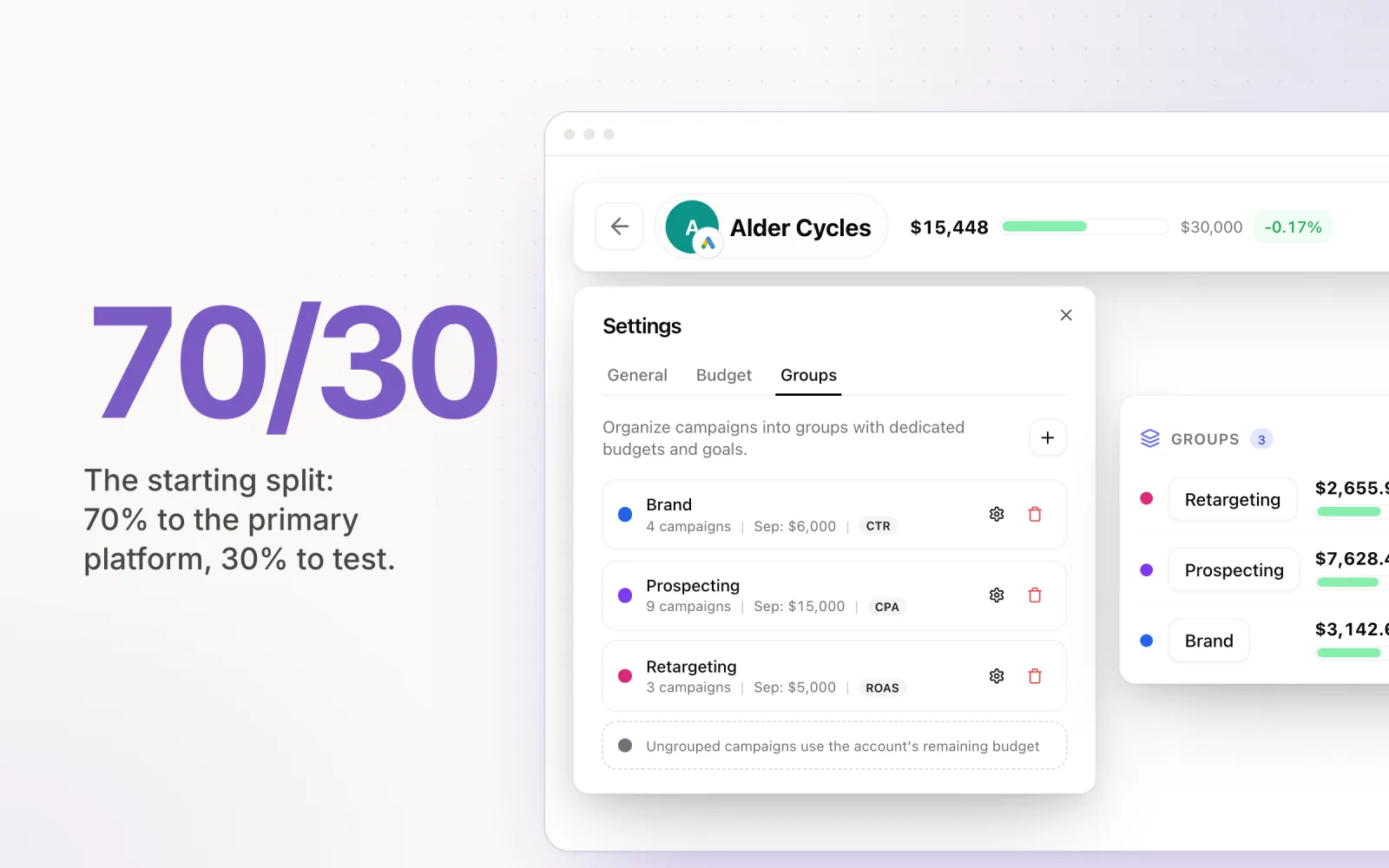
When launching on both platforms simultaneously, I recommend a 70/30 split as a starting point. Allocate 70% of budget to the platform that aligns with your client's primary buying behaviour, and 30% to the other for testing and diversification.
For a local service business with strong search intent (think accountants, dentists, home repair), this might mean 70% on Google Search and 30% on Meta for brand awareness and retargeting. For a direct-to-consumer fashion brand, it might mean 70% on Meta and 30% on Google (primarily brand search and Shopping campaigns). And if your client operates in B2B, do not overlook LinkedIn as a third allocation channel — our guide to LinkedIn Ads budget pacing covers how to work it into your platform mix.
The 70/30 split is deliberately imprecise. Its purpose is to avoid two common mistakes: going all-in on one platform and missing the other's potential, or splitting 50/50 and underfunding both. After 4 to 6 weeks of data, you refine the split based on actual performance.
When to Shift Budget Between Platforms
The initial allocation is not permanent. Several signals should trigger a rebalance:
- Search volume changes: If Google Trends shows declining search volume for your core keywords, the available inventory on Google is shrinking. CPCs will rise as more advertisers compete for fewer searches. This is a signal to shift some budget to Meta, where reach is less constrained by search demand.
- Cost per lead divergence: If your Google CPL has risen 30% over two months while Meta's has stayed stable, the relative efficiency has changed. Reallocating 10 to 15% of Google budget to Meta may yield better overall results.
- Audience saturation on Meta: Rising frequency and declining click-through rates on Meta indicate you are reaching the same people too often. Rather than increasing Meta budget to fight saturation, shift spend to Google where fresh intent-based traffic is available daily. For more on this, see our piece on forecasting ad spend across platforms.
- Seasonal patterns: Some businesses see intent spikes on Google during certain periods (tax season for accountants, summer for travel). During these windows, temporarily increasing Google's share captures high-intent traffic that would otherwise go to competitors.
The key is to make allocation decisions based on data, not habit. Many agencies set a split at the start of an engagement and never revisit it. That is a missed opportunity.
Cross-Platform Attribution: The Measurement Challenge
One of the biggest obstacles to smart budget allocation is attribution. Most agencies still rely on last-click attribution in Google Analytics, which systematically undervalues Meta's contribution.
Meta typically operates higher in the funnel. A user sees a Meta ad, becomes aware of the product, and then later searches the brand name on Google and converts. Under last-click attribution, Google gets 100% of the credit. Meta gets none. The logical (but wrong) conclusion is that Meta is not working, so budget should shift to Google.
In reality, Meta generated the awareness that led to the search. Without Meta, that branded search would not have happened. The true contribution of each platform is obscured by the measurement model.
Addressing this requires either a multi-touch attribution model, incrementality testing (running geo-based holdout tests to measure Meta's true lift), or simply recognising the limitation and factoring it into your allocation decisions. If Meta's view-through conversions and assisted conversions are strong, the platform is likely contributing more than last-click data suggests.
As discussed in managing ads across platforms, having a unified view of cross-platform performance is a prerequisite for making informed allocation decisions.
Using Automated Tools to Rebalance Dynamically
The manual approach to budget allocation works at small scale: review performance monthly, make adjustments, and move on. At 10 or more clients running on both platforms, this becomes a significant time investment. Each client requires pulling data from two platforms, normalising metrics, comparing performance, and calculating optimal shifts.
Automated pacing tools can handle the operational side of this. By connecting to both Google and Meta accounts, a tool like Pace can track actual spend against monthly targets across platforms, identify where performance is strongest, and flag when allocation shifts would improve overall efficiency.
The strategic decision (whether to shift budget) still belongs to the media buyer. But the data gathering, calculation, and monitoring can be automated, turning a multi-hour monthly exercise into a 15-minute review.
The right budget allocation between Google and Meta is not a formula you set once. It is an ongoing calibration based on performance data, market conditions, and client objectives. Pace tracks pacing and performance across both platforms in real time, making reallocation decisions faster and more data-driven — try it free. Start with a clear framework, measure rigorously, and adjust frequently. The agencies that treat allocation as a living decision, rather than a fixed one, consistently deliver better results across both platforms.

Jordan Parrello
Founder of Pace. Ran an agency pacing sheet by hand for years before building the thing that checks it every 5 minutes. About Pace or LinkedIn