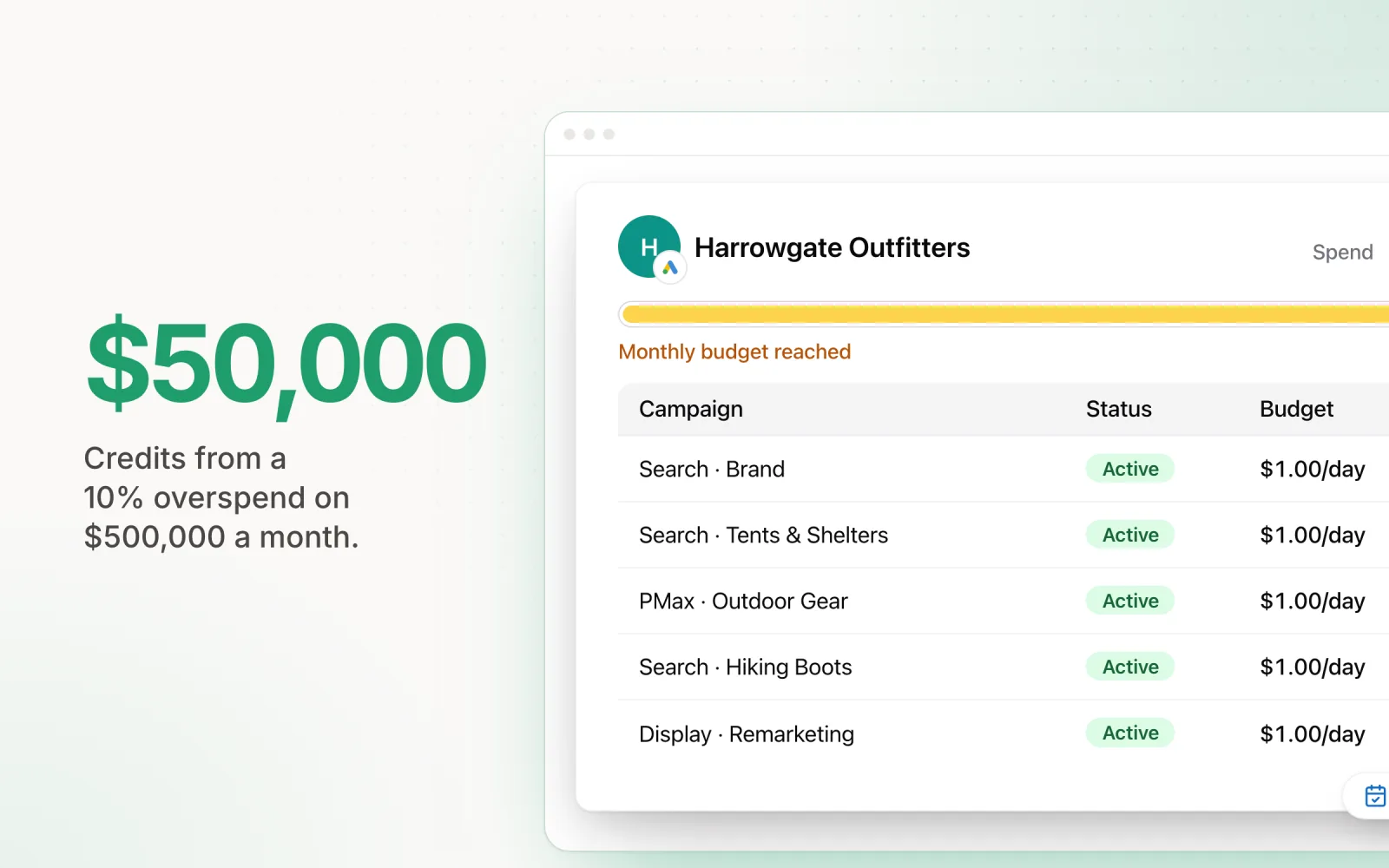
The real cost of overspending and underspending on ads extends far beyond the immediate budget variance. An agency that consistently overshoots budgets issues credits and absorbs the loss. An agency that consistently undershoots fails to deliver the results the client is paying for. Both outcomes damage the relationship, and over time, both cost you the account.
I have managed enough client budgets to know that pacing errors are rarely one-off events. They are systemic. An agency that overspends by 12% one month will likely overspend the next month, because the underlying process (manual pacing, infrequent checks, reactive adjustments) has not changed. The financial and relational damage compounds quietly until the client starts looking for a new agency.
Quantifying the Cost of Overspending
When a campaign overspends its monthly budget, the agency faces an immediate decision: absorb the cost or pass it to the client. Neither option is good.
Absorbing the cost means issuing a credit on next month's invoice. For an agency managing $500,000 in monthly ad spend across all clients, a 10% average overspend represents $50,000 in credits. That comes directly off the agency's margin. On a 15% management fee, that overspend wipes out profit on multiple accounts.
Passing the overspend to the client is worse. Most client contracts specify a monthly budget, and exceeding it without approval is a breach of the agreement. Even if the client accepts the overspend once, their trust erodes. They start watching the numbers more closely, questioning other line items, and wondering whether the agency has adequate controls in place.
The hidden cost is opportunity cost. Every hour spent explaining overspend, calculating credits, and managing the fallout is an hour not spent on strategy, creative, or new business development.
Platform Overspend Mechanics
Each ad platform handles daily budgets differently, and these mechanics contribute directly to monthly overspend when not accounted for.
Google Ads allows campaigns to spend up to twice the daily budget on any given day. Google promises to keep monthly spend within 30.4 times the daily budget, but this only holds if you do not change the budget mid-month. Every budget adjustment resets the monthly averaging calculation, which can result in spend exceeding the intended monthly cap. Agencies that adjust budgets frequently (as good pacing requires) are especially vulnerable to this behaviour.
LinkedIn Ads can overshoot daily budgets by up to 50%. On a $200 daily budget, LinkedIn might spend $300 on a high-demand day. For campaigns with small monthly budgets, a few days of overshooting can push total spend well past target. LinkedIn does not offer the same monthly averaging guarantee that Google provides.
Meta Ads has its own pacing quirks. When a campaign exits the learning phase, Meta often accelerates spend to make up for the suppressed delivery during learning. This "catch-up" behaviour can push spend 20 to 30% above the daily average for several days. If you are not monitoring closely during these transitions, the monthly budget takes a hit.
The Cost of Underspending on Ads
Underspending receives less attention than overspending, but it can be equally damaging. When an agency consistently underspends client budgets by 15 to 20%, the client is not getting the results they are paying for.
Consider a client with a $30,000 monthly budget and a target of 300 leads at $100 CPA. If the agency only spends $25,000, the client gets roughly 250 leads instead of 300. That is 50 missed opportunities per month, or 600 per year. For a B2B client with a $10,000 average deal value and a 5% close rate, those 600 missed leads represent $300,000 in lost revenue.
Underspending also signals a lack of confidence in the campaign. Clients notice when their approved budget is not being used. It raises concerns about whether the agency understands the platform, whether the targeting is too narrow, or whether the team is simply not paying attention. The conversation shifts from "how do we optimise performance" to "are you actually running our campaigns."
Conservative pacing strategies often cause underspend. Agencies that are afraid of overshooting set daily budgets too low, especially in the first half of the month. By the time they realise they are behind pace, there are not enough days left to spend the remaining budget efficiently. Cramming spend into the last five days of the month typically results in higher CPAs and lower quality traffic.
Client Impact: Trust Erosion in Both Directions
The relational damage from pacing errors follows a predictable pattern. The first miss generates a conversation. The second miss generates concern. The third miss generates a review of the agency relationship.
Overspending erodes trust through the lens of financial stewardship. The client asks: "Can I trust this agency with my money?" Every overspend incident reinforces the answer "no," regardless of how strong the campaign performance is. An agency can deliver a 5x ROAS while overspending by 15%, and the client will still focus on the budget miss.
Underspending erodes trust through the lens of competence. The client asks: "Does this agency know what they are doing?" Consistently leaving budget on the table suggests either a lack of capability or a lack of effort. Neither interpretation benefits the agency.
The agencies that retain clients long-term are the ones that land within a tight range of the target every month. The performance numbers matter, but budget accuracy is the foundation of trust. Without it, even strong results get questioned. One of the most effective ways to break the cycle is to include a change log in your PPC reports, so budget adjustments are documented and patterns of overspend or underspend become visible before they erode the relationship.
The Pacing Sweet Spot: Landing Within 2-5%
The target for monthly budget accuracy should be within 2 to 5% of the approved amount. This range accounts for the inherent variability in platform delivery while demonstrating that the agency has strong controls in place.
Hitting this range consistently requires daily monitoring and adjustment. The formula is straightforward: remaining budget divided by remaining days equals the ideal daily budget. But executing this formula across 15 or 20 accounts, each running on multiple platforms, is where manual processes break down.
On a $10,000 monthly budget, a 2 to 5% variance means landing between $9,500 and $10,500. That is a reasonable range that clients accept without concern. Compare this to a 15% variance ($8,500 to $11,500), where every month requires an explanation and the relationship carries constant tension.
The difference between these two ranges is not strategy or skill. It is frequency of monitoring and speed of adjustment. Agencies that check pacing once a week will land in the wider range. Agencies that check daily, or use automated systems that check multiple times per day, land in the tighter range.
Technology Solutions for Pacing Accuracy
Three categories of technology address pacing accuracy, each with different levels of automation and reliability.
Real-time monitoring. Tools that connect to ad platform APIs and pull spend data throughout the day. This gives agencies current visibility into pacing status without logging into each platform manually. Monitoring alone does not prevent pacing errors, but it reduces the time between a deviation occurring and someone noticing.
Automated daily adjustments. Systems that calculate the ideal daily budget based on remaining budget and remaining days, then apply the adjustment directly through the API. This removes the manual step where most errors occur: the media buyer who checks pacing, calculates the adjustment, but gets pulled into another task before applying it.
Predictive pacing algorithms. Machine learning models that forecast where spend will land based on current trajectory, historical patterns, and known variables (weekday vs. weekend, seasonal trends, auction dynamics). Predictive pacing makes smaller adjustments earlier, which keeps spend on a smoother path toward the target instead of requiring large corrections late in the month.
Pace combines all three approaches. The system monitors spend in real time, calculates and applies daily budget adjustments automatically, and uses predictive models to anticipate pacing deviations before they happen. Every change is logged with full transparency, so agencies can show clients exactly what was adjusted and why.
If you want the detail on how each layer behaves, the help centre covers how budgets and pacing fit together, overspend protection (a spend check every five minutes; at the monthly budget, campaigns drop to $1 a day or pause, and Pace restores them on the 1st), and the daily spend floor that stops an account from drifting into chronic underspend.
Budget accuracy is not a secondary metric. It is the foundation of client trust, agency profitability, and campaign performance. The agencies that invest in pacing accuracy protect their margins and keep their clients longer than those that treat budget targets as approximate goals.
Pace is built to keep your ad spend within that 2-5% target range automatically, across every platform. Start a free trial to see how it works.

Jordan Parrello
Founder of Pace. Ran an agency pacing sheet by hand for years before building the thing that checks it every 5 minutes. About Pace or LinkedIn