Paid social is no longer the experimental line item it was five years ago. For most agencies I talk to, Meta alone is 30% to 50% of total managed ad spend. Add LinkedIn for B2B clients, TikTok for younger audiences, the occasional Pinterest or Snapchat campaign, and social is now the dominant channel in the portfolio. The tooling has not caught up. Most agencies are still managing every platform inside its native interface, flipping between tabs, reconciling budgets in spreadsheets, and stitching reports together from four different data sources at the end of the month.
This guide compares the major social ad platforms, walks through the third-party tools built on top of them, and looks at the operational mess of running paid social at scale. If you need the strategy primer rather than the tooling layer, start with our complete guide to paid social advertising.
The Major Social Media Advertising Platforms
Every social platform has its own ad infrastructure, auction logic, and audience. Knowing what each one is actually good at, and where it falls over, is the starting point for any multi-platform social plan.
Meta (Facebook + Instagram) is still the biggest social ad platform by revenue and reach. Advantage+, CBO, broad targeting, and deep retargeting are why it is the default for B2C, ecommerce, and app installs. The targeting engine is mature, the pixel ecosystem is huge, and creative formats run from static images to Reels. The trade-off: rising CPMs, and a learning phase that will eat real budget before things stabilise.
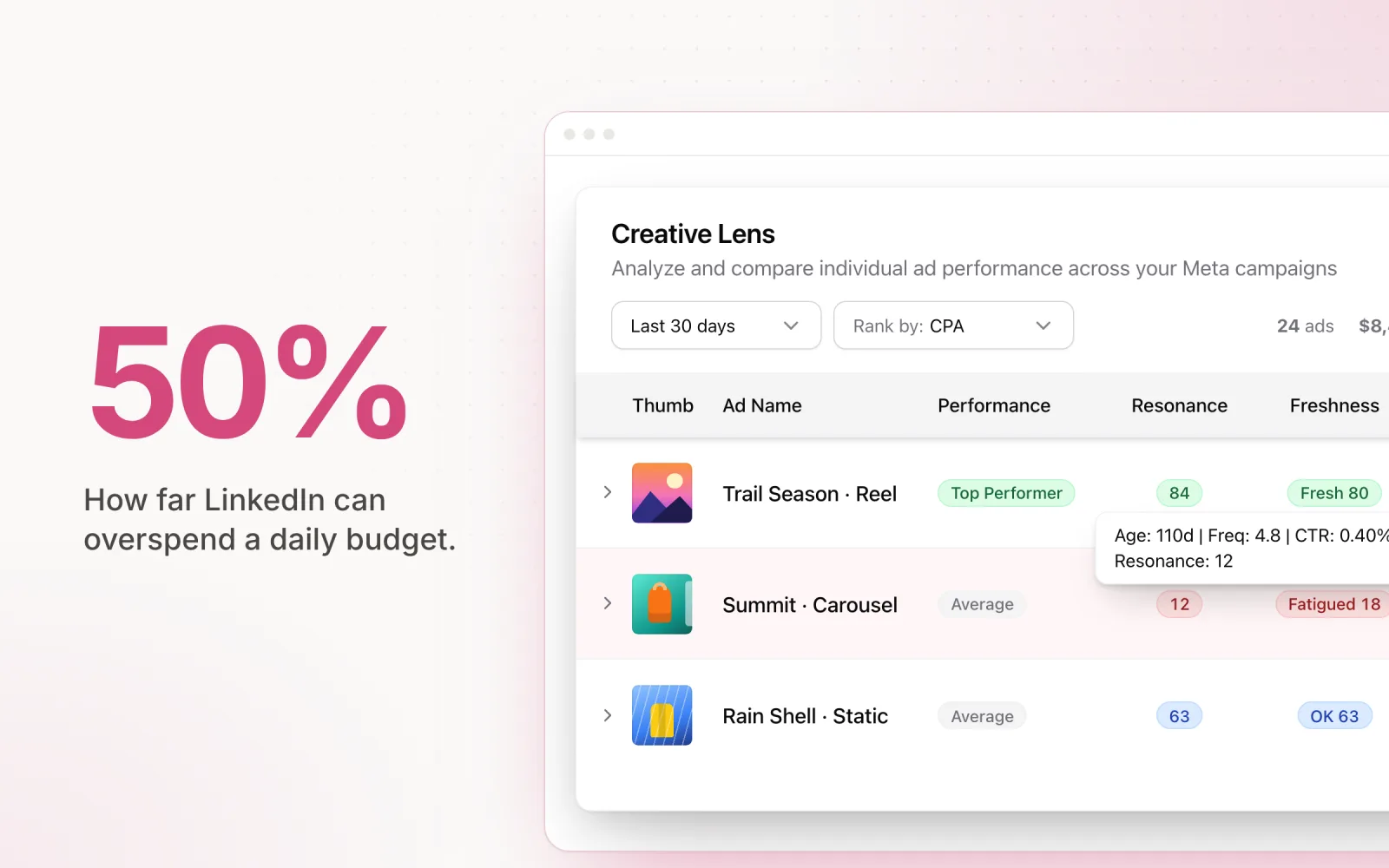
LinkedIn is the leader for B2B by a wide margin. Sponsored Content, Message Ads, and Lead Gen Forms put you in front of professional audiences sliced by job title, company size, industry, and seniority. CPCs are much higher than other social platforms, usually $5 to $12, but the audience intent and lead quality justify the premium for most B2B clients. The catch is pacing. LinkedIn routinely overspends daily budgets by up to 50%, and at scale that hurts.
TikTok is the fastest-growing platform in social ads. Short-form video, Spark Ads (paid boosts on organic posts), and strong performance with Gen Z and Millennials have made it a priority channel for consumer brands. The learning phase needs roughly 50 conversions per week per ad group, so smaller budgets struggle to ever exit it.
X (formerly Twitter) has rebuilt its ad platform after the ownership change. CPMs are lower than Meta or LinkedIn, which makes it viable for real-time engagement campaigns and niche communities. The ad product is less mature than Meta's, but the cost efficiency holds up for brand awareness and conversation-driven work.
Pinterest is a visual discovery platform, and the audience behaves differently from other social networks. Product Pins and Shopping ads perform well in home decor, fashion, food, and wedding verticals. People come to Pinterest to plan purchases, which gives advertisers an edge over platforms where ads interrupt entertainment.
Snapchat offers AR ads, Story ads, and Collection ads aimed at a younger audience. CPMs tend to run lower than Meta, and the AR formats create engagement other platforms cannot match. The audience skews heavily under 35, which limits its usefulness for some client verticals.
Reddit sells community-based advertising through Promoted Posts and Conversation Ads. Engagement can be strong, but the audience is hostile to anything that smells like traditional advertising. Creative has to feel native to the subreddit, which is more production work per campaign than most other platforms.
Social Media Advertising Tools for Agencies
Native platform interfaces are built for individual advertisers running a handful of campaigns. Agencies running dozens of clients across multiple platforms need third-party tools that pick up where the native dashboards stop. Here are the ones worth evaluating.
Revealbot automates rules and budget management mostly for Meta and Google. Its visual rule builder lets agencies write conditional logic (if ROAS drops below X, reduce budget by Y%) without scripts. The strength is automated scaling: Revealbot pushes budget to winning ad sets and pauses losers based on real-time data. The catch is coverage. It is strongest on Meta and thinner on LinkedIn or TikTok.
Smartly.io is an enterprise-grade creative and campaign management platform for Meta, TikTok, Pinterest, and Snapchat. Its dynamic creative optimisation engine spins up ad variations from templates, tests them, and reallocates budget to the winners. Smartly is built for advertisers spending six or seven figures a month, which puts it out of reach for most small and mid-sized agencies on price alone.
Madgicx takes an AI-driven angle on Meta ads management. Its Audience Launcher builds targeting segments from platform data, automated budget allocation shifts spend between ad sets based on performance, and the creative analytics view tells you which visual elements actually drive results. It is heavily Meta-focused, so it is strong as a single-platform tool but limited if you need cross-platform coverage.
AdEspresso simplifies Meta and Google ads management with a focus on A/B testing and campaign creation. It suits smaller agencies and freelancers who want a cleaner interface than Meta Business Manager without an enterprise price tag. Reporting is straightforward and client-friendly, but it does not have the automation depth of Revealbot or Smartly.
Pace Ads comes at social ad management from the budget pacing and monitoring angle. Pace does not replace native campaign creation. It connects to Meta, TikTok, LinkedIn, Reddit, Google, Microsoft, X Ads, and Amazon Ads, and manages spend targets across all of them from one dashboard. AI-powered anomaly detection flags pacing problems before they become budget problems. If your main pain is landing on budget across multiple platforms and clients, Pace fills a gap that creative-focused tools do not.
Social Media Ad Management at Scale
The operational challenge of paid social is not strategy. Most experienced media buyers can build effective campaigns on every platform. The hard part is doing it across 20, 50, or 100 client accounts without operational overhead eating your margin.
Every platform has its own interface, bidding logic, budget controls, and reporting format. At five clients, logging into three or four platforms per client is annoying but workable. At 20 clients it stops working. You are spending more time navigating dashboards than optimising anything.
A few practical fixes reduce per-client overhead without sacrificing platform-specific depth.
Consolidate reporting through cross-platform tools. One reporting layer that pulls data from Meta, LinkedIn, TikTok, and Google into a single view kills the need to export CSVs from four dashboards. Whether you use a dedicated reporting tool or a pacing platform like Pace, the goal is one source of truth per client.
Standardise naming conventions across platforms. When every campaign, ad set, and ad follows the same naming structure regardless of platform, you can tell at a glance what is running where. A format like [Client]_[Platform]_[Objective]_[Audience]_[Date] makes cross-platform analysis possible without a translation layer.
Build shared creative libraries per client. A central repository of approved creative, copy variants, and brand guidelines per client prevents the usual recreate-assets-for-every-platform tax. Most social platforms accept the same image dimensions and video formats anyway, so the duplication is pointless.
Automate budget pacing externally. This is where most agencies break. Every platform paces budgets differently. Meta distributes spend through CBO unevenly across ad sets. LinkedIn overspends daily caps. TikTok's learning phase needs minimum conversion volume. Without an external pacing layer, agencies burn hours each week calculating remaining budgets and adjusting daily caps across every platform for every client.
Native Platform Tools vs. Third-Party Software
Not every agency needs third-party social ad tools. The call depends on scale, complexity, and where your operational bottlenecks actually sit.
Native tools are enough when: you run a single platform (Meta-only or LinkedIn-only), you manage fewer than five clients, your campaign structures are relatively simple, and your reporting needs are basic. Meta Business Manager and LinkedIn Campaign Manager are good tools in isolation. Granular targeting, deep auction controls, detailed performance data. If your entire social practice lives in one ecosystem, the native tools will do the job.
Third-party tools become necessary when: you run campaigns across multiple social platforms, you have 10 or more active clients, you need automated rules to manage budgets at scale, your clients expect white-label reporting, or you need to track budget pacing across platforms against a single monthly target per client.
The honest read: Meta Business Manager and LinkedIn Campaign Manager are good tools that happen to be completely siloed. The minute you need a unified view of total client social spend, or you have to reconcile what Meta spent against what LinkedIn spent against what the client's monthly budget allows, the native tools stop being enough. That gap is where third-party software earns its money.
Social Ad Budgeting and Pacing Challenges
Budget pacing is the single most painful operational part of running social ads at scale. Every platform handles it differently, and the inconsistencies compound across a large client portfolio.
Meta's CBO distributes budget unevenly across ad sets. The algorithm prioritises whichever ad sets it thinks will deliver the best results, which usually means one ad set hoovers up 80% of the budget while others starve. That is by design, but it creates reporting headaches when clients expect even distribution across audiences or creative themes. The learning phase adds extra unpredictability, burning budget fast in the first 48 to 72 hours before settling. For a deeper read on how Meta's pacing engine works, see our guide on Meta budget pacing and what the algorithm wants.
LinkedIn can overspend daily budgets by 50%. Documented behaviour, not a bug. LinkedIn's maximum delivery bidding chases impressions hard when your target audience is active, and it treats daily budgets as flexible guidelines, not caps. At $10 to $15 CPCs, that 50% overspend turns into real money quickly. Our agency guide to LinkedIn Ads budget pacing walks through the workarounds.
TikTok's learning phase needs volume. TikTok recommends 50 conversions per week per ad group to exit learning. For campaigns with high-value conversions (leads, purchases above $50), that takes serious budget. Campaigns that cannot hit it stay in perpetual learning, with inconsistent daily spend that makes monthly pacing miserable.
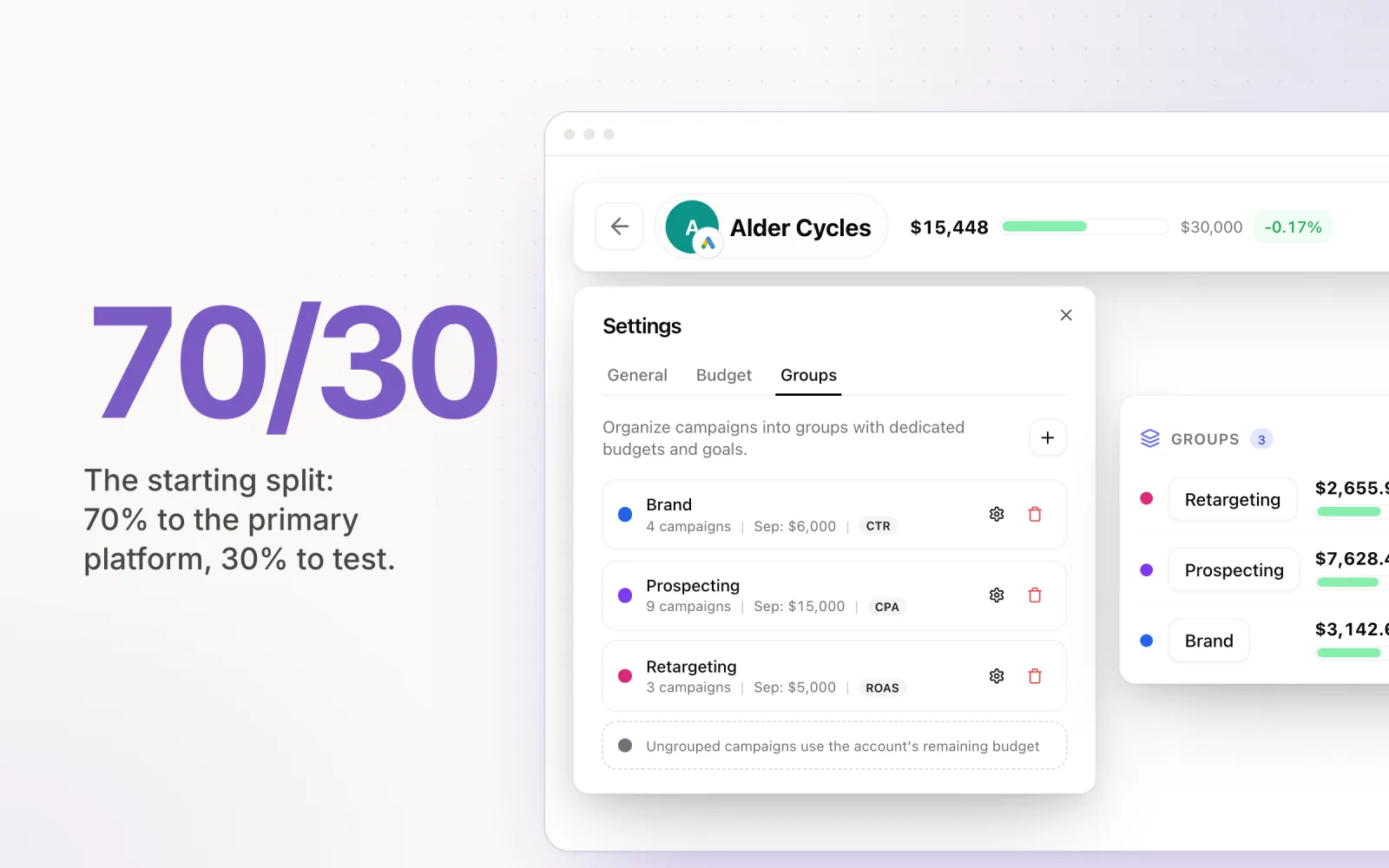
Cross-platform monthly targets get reconciled by hand. When a client has a $15,000 monthly social budget split across Meta, LinkedIn, and TikTok, someone has to work out what each platform has spent, what is left, and what the daily budgets should be for the rest of the month. Without a pacing tool, that maths lives in a spreadsheet, usually checked once a week, which means pacing problems go undetected for days at a time.
Cross-Platform Advertising: Combining Social and Search
Most agencies do not run social ads in isolation. The same clients running Meta and LinkedIn are also running Google Search, Shopping, and Performance Max. The hard part is unified budget allocation and reporting across both search and social.
The most effective approach I have seen is to allocate by funnel stage. Social platforms are good at awareness and consideration, reaching people who are not yet searching for your product. Search captures intent, reaching people who are. When budgets follow where each channel sits in the funnel, the split has a logic to it instead of being arbitrary.
Use unified pacing tools to track total client spend across all platforms. When Meta, LinkedIn, Google, and Microsoft Ads all pull from the same client budget, you need visibility into the total. A client who approved $30,000 in monthly spend does not care whether the overspend came from LinkedIn or Google. They care that you spent $33,000 instead of $30,000. Unified pacing kills that conversation. For a data-driven framework on splitting budgets between the two biggest platforms, see our guide on how to allocate budget between Google Ads and Meta Ads.
Build reports that show the full picture. Client reporting that separates social and search into different documents or dashboards is fragmentation by design. The client sees one number from Meta, another from Google, and no way to read total performance. Cross-platform reporting that aggregates spend, conversions, and cost-per-acquisition across all channels gives clients the view they need to make informed budget calls.
Any cross-channel plan that stops at social and search leaves digital audio out of the mix, and that is where a lot of attentive time actually sits. Spotify Advertising reaches what Spotify reports as 761M+ fans across music, podcasts, and audiobooks in 180+ markets, including Premium listeners through podcast ads, so the audience is not capped at a free tier.
The piece the social platforms in this comparison do not have is moment-based context. Spotify organises listening around moments like Exercise, Driving, Chill, Gaming, and Party, so a brand can reach someone by what they are doing right now, not just their demographic bucket. That is a different targeting dimension from lookalikes and interest graphs. Spotify Ads Manager handles self-serve buys and Spotify Ad Exchange covers programmatic, both with first-party and third-party measurement. Pace does not connect to Spotify today, so if you add audio to a client plan, track it as its own line against the total client budget.
Pace unifies pacing and monitoring across Google, Meta, TikTok, LinkedIn, Microsoft, Reddit, X Ads, and Amazon Ads, so agencies can manage total client spend from a single dashboard. Start a free trial to get going.

Jordan Parrello
Founder of Pace. Ran an agency pacing sheet by hand for years before building the thing that checks it every 5 minutes. About Pace or LinkedIn