
Meta Ads budget pacing is one of the most misunderstood aspects of paid social. Marketers who have spent years in Google Ads often assume that Meta's delivery system follows similar logic: set a daily budget, and the platform will spend roughly that amount each day. In practice, Meta's algorithm behaves quite differently, and those differences have a direct impact on whether you land your monthly budget targets.
Having managed significant Meta spend across dozens of accounts, I have learned that working with Meta's algorithm (rather than against it) is the key to consistent pacing. Here is what that looks like in practice.
How Meta's Pacing Differs from Google's
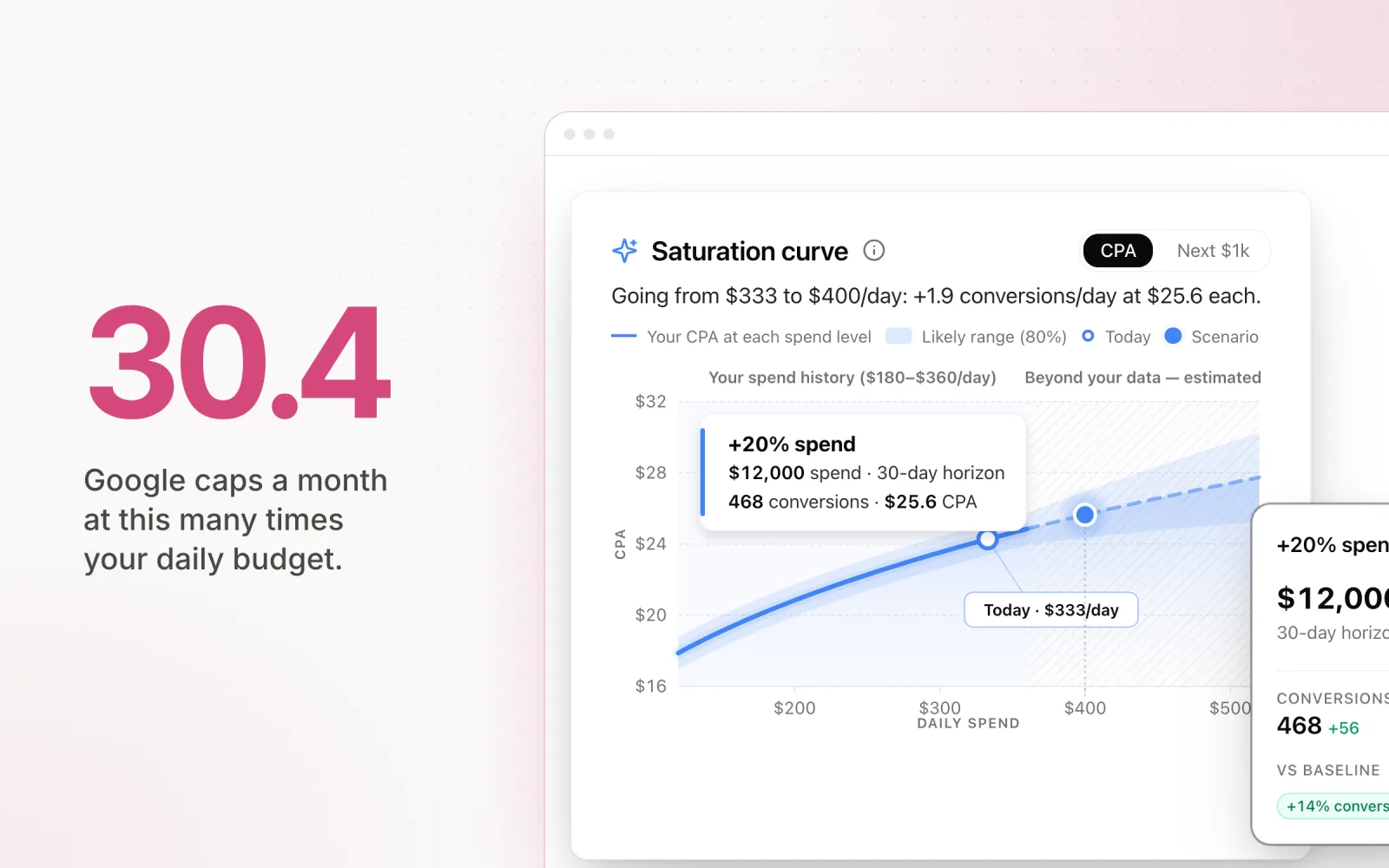
Google Ads operates primarily on an intent-based auction. Users search for something, advertisers bid on those searches, and spend follows demand. If nobody searches for your keywords on a Tuesday, your spend drops naturally. Google also enforces a daily budget with some flexibility, allowing up to 2x on high-opportunity days while capping monthly spend at 30.4 times the daily budget.
Meta works on an entirely different model. There is no search intent driving impressions. Instead, Meta's algorithm decides when and where to show your ads based on predicted outcomes. It uses impression-based bidding and optimises for the conversion event you select, whether that is a purchase, a lead, or a landing page view.
This means Meta's pacing is inherently less predictable. The algorithm front-loads spend when it finds efficient delivery opportunities and pulls back when competition increases or audience quality drops. A campaign might spend 60% of its weekly budget in the first three days, then barely deliver for the rest of the week. This is by design, not a bug. As I covered in managing ads across platforms, each channel's pacing logic requires a distinct approach.
The Learning Phase Budget Trap
Every new Meta ad set enters a learning phase. During this period, the algorithm is gathering data to optimise delivery. Meta requires approximately 50 optimisation events per ad set within a 7-day window to exit the learning phase and stabilise performance.
This creates a direct tension with budget pacing. If your daily budget is too low to generate 50 events in a week, the ad set will remain in the learning phase indefinitely. Performance will be inconsistent, costs will be higher, and your pacing predictions become unreliable.
For example, if your optimisation event is a purchase and your average cost per purchase is $25, you need to budget at least $175 per day per ad set ($25 x 50 events / 7 days) to exit learning. Set a budget of $50 per day and the ad set will struggle, spending erratically as the algorithm searches for signal in insufficient data.
The practical implication for pacing: fewer, better-funded ad sets are easier to pace than many underfunded ones. Consolidation is not just a Meta best practice for performance. It is a pacing requirement.
CBO vs. Ad Set Budgets: When Each Helps Pacing
Campaign Budget Optimisation (CBO) lets Meta distribute budget across ad sets within a campaign based on performance. In theory, this is efficient. In practice, it introduces pacing variability that can catch agencies off guard.
With CBO, Meta shifts spend dynamically. An ad set that performs well on Monday might receive 80% of the campaign budget. By Wednesday, a different ad set might dominate. This redistribution means individual ad set pacing becomes unpredictable, even if the campaign-level spend is consistent.
CBO works well when all ad sets within a campaign target similar audiences and have comparable performance potential. It works poorly when you mix broad prospecting ad sets with narrow retargeting audiences. The algorithm will almost always favour the cheapest conversions, which typically come from retargeting, leaving your prospecting efforts underfunded.
For tighter pacing control, ad set level budgets give you more predictability. You trade some of Meta's automated optimisation for more granular spend control. The right choice depends on your priority: performance flexibility or budget precision.
Audience Saturation and CPM Spikes
One of the most common reasons Meta campaigns blow through budgets unexpectedly is audience saturation. When your frequency climbs (the average number of times a user sees your ad), CPMs increase and conversion rates decline. The algorithm compensates by increasing spend to maintain the same conversion volume, which accelerates budget depletion.
This pattern is especially pronounced with smaller audiences. A retargeting audience of 50,000 users can saturate within a week of heavy spend. Once frequency passes 3 to 4 for a cold audience (or 8 to 10 for retargeting), you are paying more for diminishing returns.
Monitoring frequency alongside spend is critical for pacing accuracy. If frequency is climbing and CPMs are rising, your remaining budget will deplete faster than your linear pacing model predicts. The financial impact of this kind of uncontrolled overspend is significant — as we detail in the real cost of overspending and underspending on ads, even a few days of unchecked pacing drift can erode a meaningful share of your monthly budget. The fix is either refreshing creative, expanding the audience, or reducing daily budgets proactively.
Meta's 2026 Guidance: Consolidate and Simplify
Meta's own guidance in 2026 pushes advertisers toward fewer campaigns, broader targeting, and consolidated budgets. The recommended minimum daily budget is now $50 per ad set for most objectives, up from previous thresholds. Meta has also expanded Advantage+ campaign budget features, which are essentially an evolution of CBO with more automation.
The rationale is that Meta's machine learning models perform better with more data per campaign. Splitting $3,000 per month across 10 ad sets gives each one $10 per day, well below the learning phase threshold. Consolidating into 2 to 3 ad sets gives the algorithm enough data to optimise effectively.
For agencies managing pacing across multiple clients, this consolidation trend is helpful. Fewer ad sets means fewer variables to track and fewer points where pacing can go wrong. It is worth noting how different this approach is from LinkedIn, where audience targeting is inherently narrow and pacing challenges stem from limited inventory rather than algorithmic aggression — our guide to LinkedIn Ads budget pacing covers those nuances.
Setting Monthly Guardrails While Letting Meta Optimise
The challenge with Meta's pacing is that daily budgets are suggestions, not hard limits. Meta can (and will) overspend on any given day if it identifies high-value delivery opportunities. Over the course of a week, this usually averages out, but over a month, the variance can be significant.
External pacing tools solve this by sitting above the platform level. Instead of relying on Meta's internal daily pacing, you set a monthly target and let a tool calculate the required daily budget based on actual spend to date. If Meta overspends on Monday, the tool reduces Tuesday's budget to compensate. This approach respects Meta's algorithm (letting it optimise within each day) while maintaining the monthly guardrail your clients care about.
This is the approach we are building at Pace: platform-level intelligence combined with cross-platform budget discipline. You get the benefits of Meta's optimisation engine without the risk of landing 15% over budget at month end. For a broader look at how this works across channels, see our guide on forecasting ad spend across Google, Meta, and LinkedIn.
Understanding what Meta's algorithm wants is not about surrendering control. It is about knowing where to apply control and where to step back. Get this balance right, and Meta becomes one of the most efficient channels in your media mix. Get it wrong, and you spend the last week of every month scrambling to explain why the budget is off target. Pace sits above Meta's native pacing and enforces monthly guardrails automatically — start a free trial to see how it works. When Meta is part of a broader spend strategy, managing all platforms in one place makes that balance far easier to maintain.