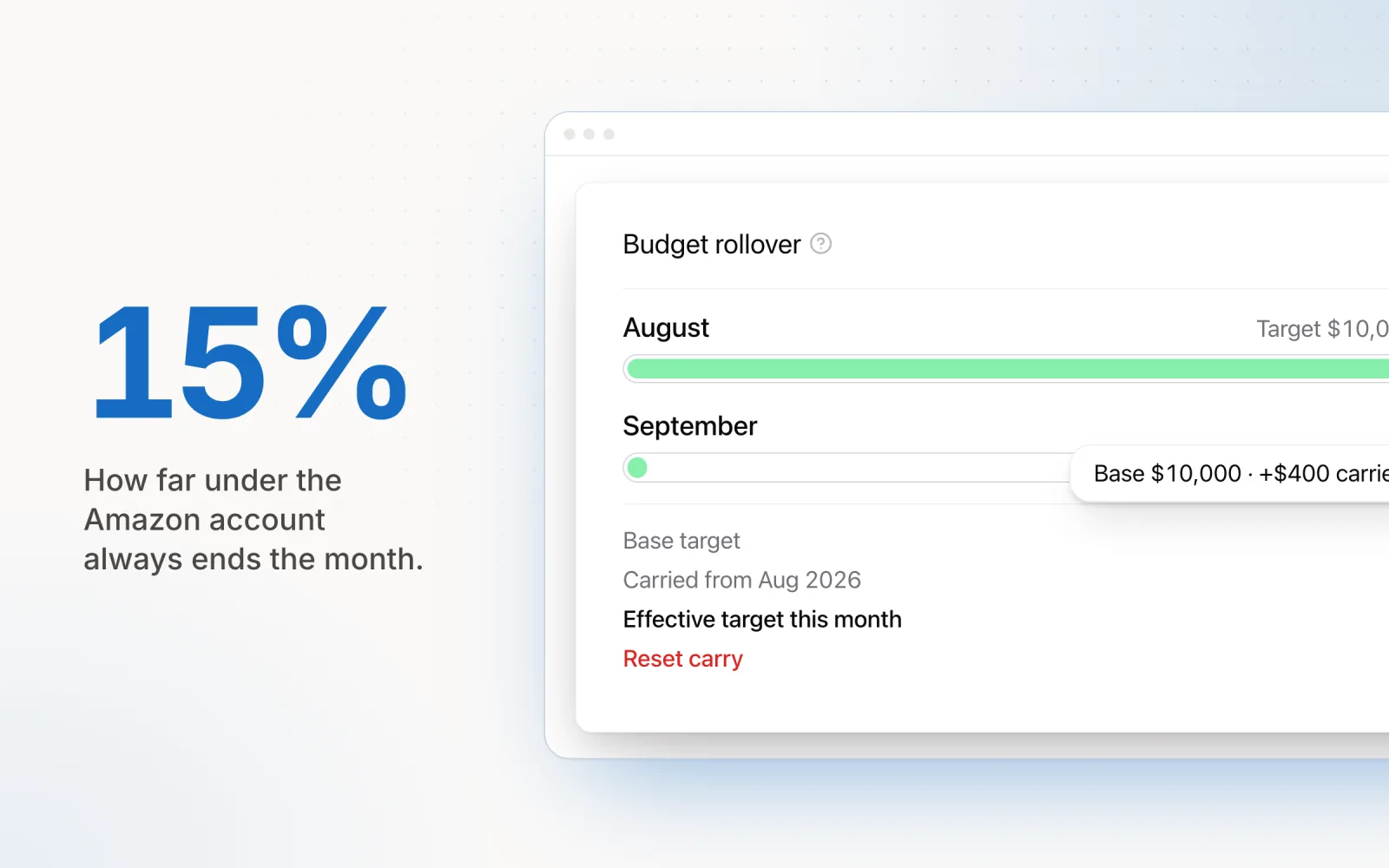
Most agencies bolt Amazon onto a media plan that was designed around Google and Meta, then wonder why it's the account that always ends the month 15% under. The pacing habits that work on the other platforms don't transfer, and the reason is a single rule in how Amazon handles budgets.
Unspent budget doesn't come back
Amazon daily budgets reset at midnight. Whatever a campaign didn't spend that day is gone. Amazon will overspend a daily budget on a busy day and settle it against quieter days inside the same calendar month, so there's some smoothing on the upside, but there's no mechanism that returns money you never used. If you're new to the concept, start with our guide to budget pacing and come back.
Compare that to Google, where a slow Tuesday is partly recoverable because the monthly charging limit gives the system room to catch up later. On Amazon, a slow Tuesday is just a slow Tuesday, permanently. Run seven of those in a month on a $30,000 budget and you finish at $25,000 with no way to recover the difference except by lifting daily budgets for the remaining days, which nobody does unless they're watching.
This flips the usual anxiety. On Meta, teams worry about overspend. On Amazon, the common failure is quiet under-delivery, and it's much harder to spot because nothing goes wrong. No alert fires. The campaigns look healthy. They just stopped serving at 3pm.
Budget-capped campaigns are the main leak
When a Sponsored Products campaign exhausts its daily budget, it stops competing for the rest of the day. Amazon's peak conversion hours skew toward evenings, so a campaign that caps out mid-afternoon hands the highest-intent part of the day to competitors and still reports a perfectly reasonable ACoS on the traffic it did buy.
That's the trap. Budget-capped campaigns often look like your best performers, because they only ever bought the cheap early-day clicks. Efficiency looks great, volume is capped, and the monthly budget quietly under-delivers.
Two things are worth checking weekly. The first is what time of day each campaign runs dry: anything hitting its cap before the evening peak is under-budgeted, whatever the monthly maths says. The second is Amazon's recommended-budget flags in the console. They're aggressive and shouldn't be followed blindly, but as a shortlist of which campaigns are constrained, they save you working it out by hand.
Amazon traffic is spikier than search or social
Retail demand doesn't arrive smoothly. Prime Day, Black Friday, Cyber Monday and category-specific events concentrate a huge share of the month's available conversions into a few days, and competitors bid accordingly. CPCs on a peak day can run double a normal Tuesday.
A flat daily budget handles this badly in both directions. It under-buys on the days that matter and leaves budget on the table on the quiet ones. Anyone running Amazon through a big retail month should pace to a deliberately uneven curve, front-loading the event window and letting the shoulders run lean, rather than dividing the month into 30 equal slices.
Practically, that means picking the peak days before the month starts and reserving a share of the budget for them, then pacing the remaining days against what's left. The standard pacing formula still applies. You're just applying it to a smaller pot after the event reserve is carved out.
The reporting delay changes the decision
Amazon's spend figures for the current day update through the day, but conversion data arrives later on Amazon's own reporting schedule. Attributed sales for a given click can land days after the click itself.
Two consequences for pacing. First, don't make budget decisions on the last 48 hours of performance data, because it isn't complete yet, and campaigns will look worse than they are. Second, treat spend and performance as separate clocks: today's spend number is current enough to pace against, while the ROAS number sitting next to it is still filling in.
This catches people who are used to Google, where conversions settle relatively quickly. Cutting an Amazon campaign's budget on Wednesday because Monday looked soft is a common and expensive mistake.
What to actually do each month
| When | Check | Why |
|---|---|---|
| Month start | Reserve budget for known event days | Peak days need multiples of a normal day, not an average |
| Daily | Recalculate daily budgets from remaining budget and remaining days | Unspent budget never returns, so drift has to be corrected while there's month left |
| Weekly | Find campaigns hitting their cap before the evening | Capped campaigns look efficient and under-deliver |
| Weekly | Check marketplace minimum budgets on new campaigns | Minimums vary by country and will reject a budget that's too low |
| Never | Judge performance on the last two days of data | Conversions are still landing on Amazon's delay |
Doing it alongside everything else
The awkward part isn't Amazon on its own. It's Amazon as the seventh tab. An account manager already moving between Google, Meta, LinkedIn, Microsoft and TikTok now has another console with different budget rules, a different reporting cadence and a different peak-day calendar, and it's the one where nothing visibly breaks when it goes wrong.
Pace added Amazon Ads as a fully paced platform in August 2026. Set a monthly budget, choose the campaigns you want managed, and Pace works out each campaign's daily budget and writes it to Amazon on schedule or on demand, respecting marketplace minimums. Automated pacing covers Sponsored Products and Sponsored Brands; Sponsored Display is reporting for now, with budget control rolling out. Spend for today refreshes every 15 minutes; historical conversion data arrives on Amazon's own reporting delay rather than instantly. Amazon accounts also appear in campaign groups, Findings, client reports and the weekly summary email alongside every other platform. Forecasting and bulk budget editing don't cover Amazon yet.
If you're pacing Amazon by hand today, the highest-value change isn't a tool. It's switching from a fixed daily budget to a daily recalculation, and checking which campaigns are running dry before dinner.
Frequently asked questions
Does Amazon Ads roll unspent budget over to the next day?
No. Daily budgets reset and unspent money is gone. Amazon can overspend on a busy day and settle it against quieter days in the same calendar month, but it never returns budget you didn't use.
Why does my Amazon Ads spend drift off a monthly budget?
Usually budget-capped campaigns stopping mid-afternoon, spiky retail demand around event days, and decisions made on conversion data that hasn't finished landing. Under-spend is the most common of the three.
Can you set a monthly budget in Amazon Ads?
Not at the campaign level. Amazon works in daily budgets, with portfolio caps acting as a ceiling rather than a pacing target. Landing on a monthly figure means recalculating daily budgets as the month goes.
What is a good daily budget for Amazon Sponsored Products?
Whatever remaining budget divided by remaining days gives you, sanity-checked against when campaigns run dry. If a campaign caps before the evening, the number is too low no matter what the monthly maths says.

Jordan Parrello
Founder of Pace. Ran an agency pacing sheet by hand for years before building the thing that checks it every 5 minutes. About Pace or LinkedIn