Forecasting ad spend across Google, Meta, and LinkedIn is harder than forecasting on any single platform. Each platform uses different pacing algorithms, billing cycles, and overspend rules. A forecast that works perfectly for Google Ads will be inaccurate for Meta, and completely wrong for LinkedIn. Understanding these differences is the foundation of a reliable multi-platform forecast.
After years of building forecasts for agency clients spending across all three platforms, I have landed on a framework that consistently produces forecasts within 5% of actual spend. It is not complicated, but it requires respecting the quirks of each platform rather than treating them as interchangeable.
Why Multi-Platform Ad Spend Forecasting Is Harder
Single-platform forecasting is relatively straightforward. You have one set of rules, one pacing algorithm, and one billing cycle to account for. Multi-platform forecasting introduces compounding variables.
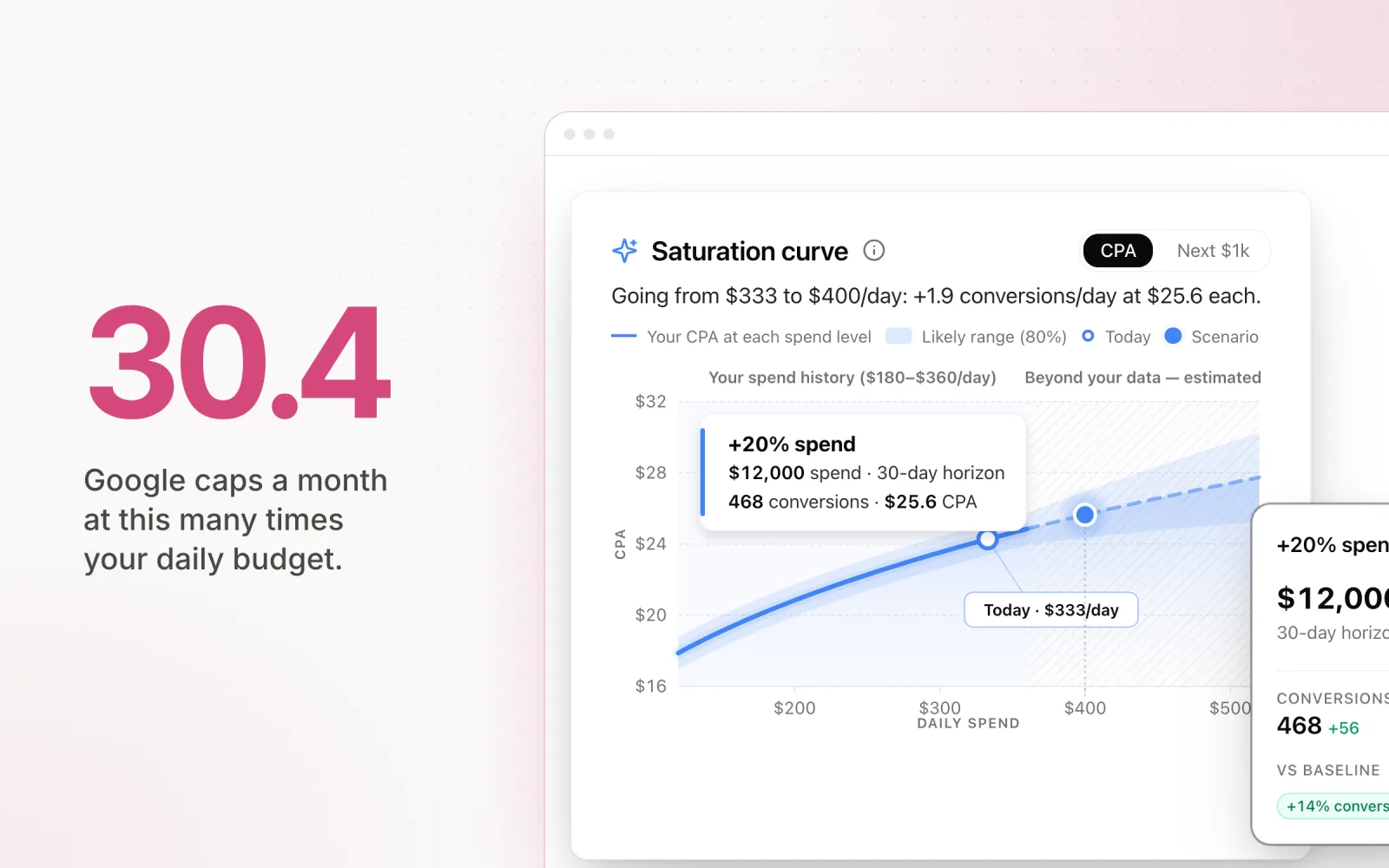
Google calculates monthly spend caps using a 30.4-day average. Meta uses Campaign Budget Optimisation (CBO) with learning phases that affect spend velocity. LinkedIn uses lifetime budgets with its own pacing logic that can deliver unevenly across the flight. When you combine all three into a single client budget, the margin of error grows with each platform you add.
The typical agency response is to forecast each platform independently and sum the results. This works in theory but fails in practice because it does not account for cross-platform budget reallocation, which is often the whole point of managing multiple platforms together.
Platform-Specific Pacing Behaviours You Must Account For
Google Ads: the 30.4-day cycle. Google allows daily spend to exceed your daily budget by up to 2x on any given day, but caps monthly spend at your daily budget multiplied by 30.4. Your forecast needs to use this 30.4x figure as the ceiling, not a simple daily budget times calendar days calculation. For months with 31 days, Google's cap is slightly below what you might expect. For February, it is slightly above.
Meta Ads: CBO and learning phases. Meta's CBO distributes budget across ad sets based on performance signals. During the learning phase (typically the first 50 conversions), spend can be volatile, sometimes spending heavily on day one and then slowing dramatically. Your forecast should include a "learning phase buffer" for any new campaigns or ad sets launched mid-month. I typically add 10 to 15% variance for the first week of a new Meta campaign.
LinkedIn Ads: lifetime pacing. LinkedIn's daily budget pacing can overshoot by up to 50% on any given day. LinkedIn's approach to pacing is less predictable than Google's or Meta's, particularly for small budgets. Campaigns with daily budgets under $100 often experience lumpy delivery, with some days spending almost nothing and others hitting the maximum. Factor this volatility into your forecast by widening your confidence interval for LinkedIn.
The Basic Forecasting Formula
The core formula for multi-platform ad spend forecasting is:
Forecast = Historical Spend + Seasonality Adjustment + Planned Changes
Here is how to apply each component:
- Historical spend. Pull the last three months of actual spend per platform. Average them to establish a baseline. If spend has been trending up or down, use a weighted average that gives more weight to the most recent month.
- Seasonality adjustment. Compare this month's expected performance to the same month last year. If you do not have year-over-year data, use industry benchmarks for your vertical — our overview of 2026 ad spend trends covers the latest shifts worth factoring in. Retail accounts typically see 20 to 40% spend increases in Q4. B2B accounts often dip in December and spike in January.
- Planned changes. Account for any known changes: new campaign launches, budget increases or decreases, paused campaigns, or new platforms being added. Each of these shifts the forecast away from the historical baseline.
Apply this formula per platform, then sum the results. Add a 5% contingency buffer for the cross-platform variance that accumulates when multiple pacing algorithms interact.
Advanced Forecasting: Using Conversion Data and CPL Trends
The basic formula works for budget-based forecasting, but it does not account for performance-based budget decisions. Most agencies adjust spend based on results, not just on a pre-set plan.
To build a performance-aware forecast, layer conversion data on top of your spend forecast:
- Calculate trailing CPL (cost per lead) or CPA (cost per acquisition) for each platform over the last 30 days.
- Multiply target conversions by current CPL/CPA to get the budget required to hit performance targets.
- Compare this figure against the allocated budget. If the performance-required budget exceeds the allocated budget, flag this to the client as a potential shortfall. If it is below, there may be an opportunity to scale.
This approach shifts the conversation from "how much will we spend" to "how much should we spend to hit our goals," which is a more valuable forecast for clients. For the mechanics of landing spend on target once the forecast is set, daily pacing adjustments are essential.
Common Forecasting Mistakes
Ignoring platform overspend rules. Google's 2x daily overspend and 30.4x monthly cap, Meta's CBO redistribution, and LinkedIn's 50% daily overshoot all create scenarios where actual spend deviates from your forecast. If your forecast assumes perfectly even daily delivery, it will be wrong.
Not accounting for learning phases. Every time you launch a new campaign, create a new ad set, or make significant changes to targeting, the platform enters a learning phase. During this period, delivery is erratic and cost per result is higher. A forecast that does not include learning phase buffers will underestimate cost for months with multiple campaign changes.
Treating all platforms as equal. A dollar on Google does not pace the same as a dollar on Meta. Google is auction-driven with keyword-level control. Meta is algorithm-driven with audience-level signals. LinkedIn is a premium inventory marketplace with limited supply. Your forecast model should reflect these differences, not average them away.
Forecasting spend in isolation. Spend does not exist in a vacuum. Seasonal events, competitor activity, creative refreshes, and landing page changes all influence how efficiently platforms spend your budget. A forecast that only looks at historical spend without considering the context around it will miss important signals.
How AI-Powered Tools Automate Forecasting
Manual forecasting works for a small number of accounts, but the effort scales linearly with every account you add. At 20+ accounts across three platforms, building accurate monthly forecasts becomes a full day of work.
AI-powered tools automate the most time-consuming parts of the process. They pull real-time spend data from all connected accounts via API, calculate pacing trajectories based on current velocity, and project end-of-month spend without requiring manual data entry.
The advantage of automated forecasting is frequency. A manual forecast is typically done once per month. An automated system recalculates the projection daily (or more frequently), which means it catches pacing deviations earlier and gives you more time to respond.
Pace connects to Google, Meta, TikTok, LinkedIn, Microsoft, and Reddit Ads and produces real-time spend projections per account and per platform. The system factors in each platform's pacing rules when calculating projections, which eliminates the most common source of manual forecasting error. When the forecast shows a likely overspend or underspend, Pace can adjust the daily budget automatically to correct course.
The result is a forecast that updates itself and acts on its own predictions, turning budgeting from a monthly planning exercise into a continuous, automated process. If you want to see what automated multi-platform forecasting looks like in practice, try Pace free.

Jordan Parrello
Founder of Pace. Ran an agency pacing sheet by hand for years before building the thing that checks it every 5 minutes. About Pace or LinkedIn