On paper, retargeting should be the easiest money in digital advertising. Someone visited your site, poked around, then left. Bring them back with a follow-up ad. Done. In practice, most retargeting campaigns are quietly mediocre, because they treat every visitor the same way. The person who bounced off your homepage in three seconds gets the exact ad that goes to the shopper who abandoned a full cart at checkout. That is not retargeting. It is just paying to remarket to people who would have come back anyway.
The campaigns that genuinely work in 2026 separate audiences by where they are in the funnel, fire on specific behaviours, coordinate across platforms, and stop battering the same people with the same ad. The rest of this piece walks through each of those layers, with the goal of turning your remarketing spend into actual incremental revenue instead of background noise.
Why Most Retargeting Campaigns Fail
If you open most ad accounts and look at how retargeting is actually configured, you find one audience: "all website visitors in the last 30 days." One ad runs to all of them. It does not matter whether the visitor read a single blog post or got to the checkout page. They all see the same thing. There are a few reasons this falls over.
The first is signal dilution. When cart abandoners, pricing-page visitors, and free trial starters share an audience with people who bounced off your homepage in two seconds, the algorithm optimises toward whatever converts cheapest. Usually that means retargeting people who were going to come back regardless, while the visitors who actually needed a nudge get under-served.
The second is creative irrelevance. A generic "we miss you" ad does not address why anyone left. The cart abandoner is probably worried about shipping. The pricing-page visitor wants to know how you stack up against the competitor they were also evaluating. The blog reader has barely heard of you. One ad cannot speak to all three of those people, and the CTR data tends to confirm it.
The third is frequency. Left to its own devices, every ad platform will happily show your retargeting ad to your most engaged visitors fifteen times a week. That stops persuading anyone roughly five impressions in. After that, the only thing climbing is mild resentment.
The fix for all of this is the same: stop running retargeting as one campaign. Run it as a system, with distinct audiences, creative built for each, and a real cap on how often anyone has to look at you.
Funnel-Stage Retargeting: TOF, MOF, and BOF
The framework I keep coming back to is segmenting retargeting audiences by funnel stage. Each stage gets different messaging and a different definition of "good."
Top-of-funnel (TOF) retargeting. These are people with minimal engagement. They read one blog post, or bounced off the homepage, or arrived from a social link and looked at exactly one page. They know you exist. They have not expressed any commercial intent. Hitting them with a hard-sell ad is premature and a waste of money.
TOF retargeting is for educational or brand-led content. Case studies, guides, comparison content, the occasional founder story. You are not trying to close anyone here. You are trying to get a second visit with more depth. Measure it on CTR and return-visit rate. Do not chase ROAS at this stage; you will not find any.
Middle-of-funnel (MOF) retargeting. These visitors have shown commercial interest without acting on it. They opened the pricing page, lingered on feature pages, downloaded a resource. They are comparing options, and they need the specific piece of information that pushes them off the fence.
This is where social proof earns its keep. Testimonials, real case study numbers, named client logos, head-to-head comparisons against the alternatives they are probably also evaluating. If your tracking is good enough to know which product or feature page the visitor saw, dynamic retargeting against that specific page outperforms generic messaging by a noticeable margin. Measure this stage on assisted conversions and progression into BOF audiences, not direct conversions.
Bottom-of-funnel (BOF) retargeting. Cart abandoners, free trial starters who did not convert, checkout initiators, anyone who hit the final conversion page and did not finish. This is where most advertisers concentrate retargeting spend, and honestly, that is correct. The per-impression ROI here is the highest in the channel.
BOF creative should be direct. Show them what they left behind. Tackle the most common reason people abandon (almost always unexpected cost, so lead with shipping or pricing transparency). Time-limited offers work here because the intent is already in the room. Measure on direct conversions and CPA.
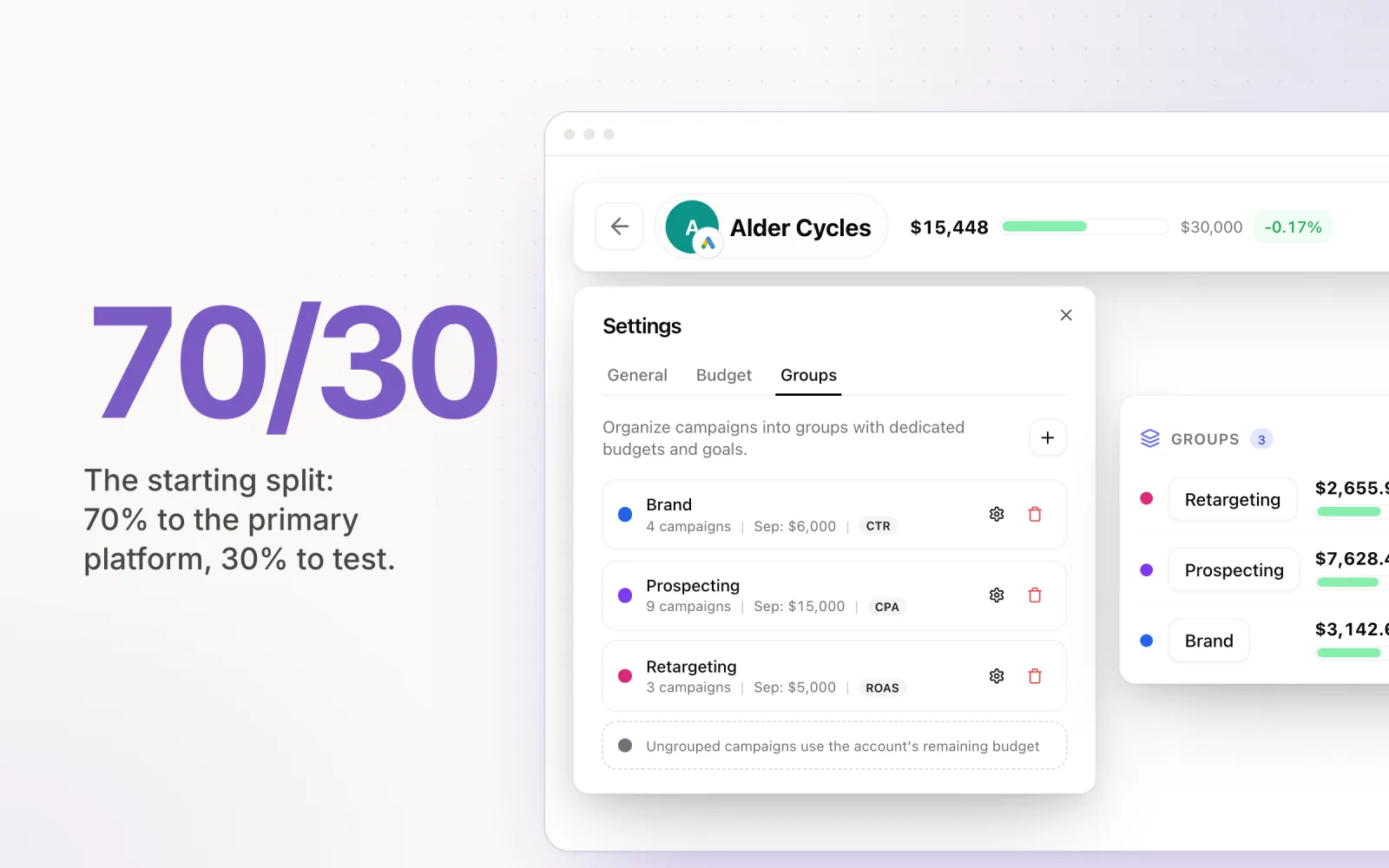
For budget split, a reasonable starting point is 20% TOF, 30% MOF, 50% BOF. Adjust from there based on your funnel and how much new traffic you are bringing in. For where this sits inside your broader platform allocation, our guide on allocating budget between Google Ads and Meta Ads covers the layer above this.
Remarketing Triggers That Drive Action
Funnel stage is the first cut. The next layer is what specific behaviour triggered the audience in the first place. "Visited the site" is an audience. "Looked at the pricing page twice" is a trigger, and the difference matters.
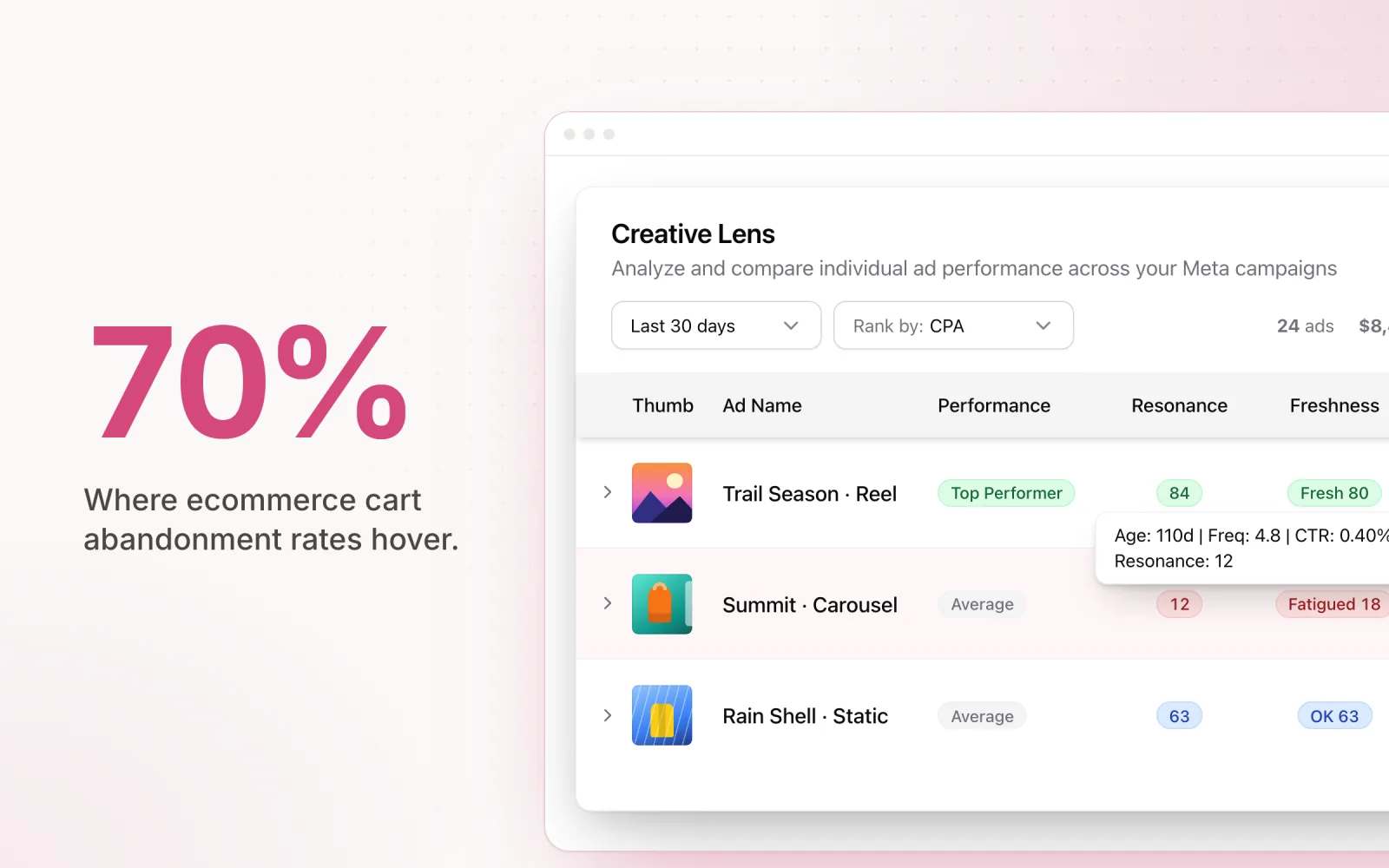
Cart abandonment. The classic, and still the workhorse. Cart abandonment rates hover around 70% in ecommerce, which is a huge pool of people who already had their wallet halfway out. The sequences that work are multi-step. A reminder ad showing the actual abandoned items within 1 to 4 hours. A social proof ad at 24 to 48 hours, ideally with reviews of the products in their cart. An incentive (discount or free shipping) at 72 hours for the holdouts. The escalation matches the cooling intent.
Pricing page visitors. Anyone who lands on pricing is doing maths in their head. They are comparing you to two or three alternatives and trying to justify the cost. Retargeting that audience with ROI calculators, comparison content, or specific benefit framing speaks to the actual decision they are making. For SaaS and B2B in particular, this is one of the cleanest commercial-intent signals you can build an audience on.
Video completion. On Meta and YouTube, you can build audiences from people who watched 50%, 75%, or 100% of a video ad. That gives you a built-in funnel: a broad video as TOF, then anyone who watches past 75% drops into a MOF audience that gets more detailed product messaging. Especially useful if your product benefits from a demo or a story rather than a screenshot.
Cross-platform engagement sequences. The fancier setups use engagement on one platform to trigger retargeting on another. A user opens a LinkedIn lead gen ad and does not submit, you retarget them on Meta with a different angle. Someone watches a YouTube ad to completion, you follow up on Meta with a direct response variant. This needs shared audience data (CRM or a customer data platform), and it is not trivial to set up. But when it works, it produces results that single-platform retargeting cannot, because the same person is hearing a sequenced argument across the channels they actually use.
Page depth and time on site. Not every page view is equal. The visitor who scrolls 80% of a long product page and spends three minutes reading is a different prospect from the one who bounced after five seconds. Build audiences off scroll depth or session duration (Google Analytics events handle both) and you end up with smaller pools, but the conversion rates more than make up for the size.
Retargeting Across Google, Meta, LinkedIn, and YouTube
Every platform has its own retargeting personality. Use each one for what it is actually good at instead of running identical campaigns across all four.
Google Display and Discovery. Reach is the headline. The Display Network covers more than 90% of internet users and follows people around news sites, apps, and Gmail. The downside is creative quality and engagement; Display is not where you tell a story. Use it for BOF recall ("you were looking at this, here it is again, click") and for the broad remarketing lists where scale matters more than craft. Responsive display ads automate the creative work but they also limit how much control you have over the output.
Meta (Facebook and Instagram). Meta is the opposite trade-off. The reach is fine and the creative formats are excellent. Video, carousel, collection, instant experience, the whole catalogue. The algorithm is also unusually good at finding the converters inside a retargeting audience if you give it room to optimise. This is where I run MOF retargeting, dynamic product retargeting for ecommerce, and any video-based sequences. As we covered in what Meta's algorithm wants for budget pacing, the system needs enough budget flexibility inside the retargeting campaign to actually optimise. Starve it and you get worse results, not cheaper ones.
LinkedIn. For B2B, LinkedIn retargeting is genuinely useful because you can stack professional targeting on top of website visit data. A website visitor who happens to be a VP of Marketing at a 500-plus headcount company is a very different prospect from a website visitor who is a university student. Matched Audiences handles website retargeting, CRM list uploads, and company or contact targeting. CPCs are several times higher than Meta or Display, so save LinkedIn retargeting for high-value B2B conversions where the precision is worth the price.
YouTube. YouTube sits between Display and Meta on creative richness. Pre-roll and in-feed video give you room for storytelling and demos, and the targeting can pull from both Google remarketing lists and YouTube-specific signals (channel subscribers, prior video viewers). Best used for TOF and MOF, where video content earns its production cost. Skip it for audiences too small to justify shooting video for.
The thing that breaks across platforms is duplication. If a cart abandoner sees your ad on Display, Meta, and YouTube at the same time with three different messages and no shared frequency management, the experience is disjointed and you are paying three times to confuse the same person. Cross-platform retargeting only works if you have a unified view of who is seeing what.
Frequency Capping and Ad Fatigue Management
Frequency is the part of retargeting that quietly destroys campaigns even after the segmentation work is done. The platforms are not your friend here. They make money on impressions, so by default they will serve your ads as often as your budget allows. Without deliberate caps, every well-segmented audience eventually gets battered.
Setting frequency caps. The right number depends on the funnel stage and the platform. As a working baseline, TOF caps at 3 to 5 impressions per user per week. MOF can run a bit hotter, 5 to 8 per week, because these people are already paying attention. BOF, especially time-sensitive sequences like cart abandonment, tolerates more in the first 48 hours (up to 3 per day) and then needs to taper off fast. After that window, you are not closing anyone you were going to close.
Google Display allows hard frequency caps at the campaign level. Meta does not, for most objectives. You manage frequency on Meta through budget size and audience size, which is annoying but workable. LinkedIn has very limited frequency controls, so audience size is again your main lever. Because the platforms behave so differently here, you have to watch the frequency report and pull budget back when it creeps above your threshold.
Recognising ad fatigue. Fatigue shows up the same way every time. CTR drops, CPC rises, conversion rate plateaus or slides, and frequency keeps climbing. The rule of thumb I use: when CTR falls to half of its early peak while frequency keeps growing, the creative is done. Anything you spend after that point is wasted.
Creative rotation. The simplest defence is to stop running one ad forever. Prepare three to five variants per segment and rotate on a schedule, every 7 to 14 days for high-frequency BOF, every 3 to 4 weeks for lower-tempo TOF. Make the variants meaningfully different, not the same ad in a different background colour. Different value propositions, different social proof, different visual angles. Each new variant buys you more productive runway on the same audience.
Audience refreshment. Creative rotation only goes so far. The audience itself ages out. Someone who has been in the retargeting pool for 90 days without converting is not going to convert from impression 91. Set recency windows: 30 to 60 days for most products, 7 to 14 days for impulse buys. And exclude converters the moment they convert. Showing retargeting ads to someone who already paid you is the most common waste in this channel, and it is also the easiest to fix.
Measuring Retargeting Performance: Incrementality Over Attribution
Standard attribution flatters retargeting. That is not a hot take, it is just maths. By definition, retargeting audiences already know your brand. A real percentage of them would have converted with no retargeting ad at all. Last-click attribution hands the channel full credit for those conversions and makes retargeting look more effective than it actually is.
Incrementality testing. The honest way to measure retargeting is a lift test. Split the retargeting audience randomly into a test group (sees ads) and a holdout (does not). Run for 2 to 4 weeks, compare conversion rates, and the gap is your real incremental lift. That is the number that tells you what retargeting is actually buying you.
Meta runs built-in conversion lift studies once you are spending enough to qualify. Google has similar tooling inside its experiments framework. For cross-platform lift, you usually have to run a geo holdout: pause retargeting in some regions, leave it on in others, and compare conversion rates between them. It is clunky but it works.
What lift tests usually show. Retargeting is genuinely effective, just less effective than the last-click number says. A campaign that reads as 10:1 ROAS under last-click often comes back as 4:1 or 5:1 incremental once you strip out the conversions that would have happened anyway. Still a good return. But it does change how much retargeting deserves relative to prospecting.
Day-to-day metrics. Between proper lift tests, four numbers tell you whether retargeting is healthy: frequency (are you over-serving?), incremental reach into the pool (are new visitors entering faster than old ones convert or expire?), the creative CTR trend, and the cost per incremental conversion (apply your lift percentage to reported conversions). Watch those weekly and you will see problems before they show up in the ROAS report.
Prospecting versus retargeting. The most common budget mistake I see is shifting too much money into retargeting because the reported ROAS looks great. Retargeting converts people who are already in the funnel. Prospecting is what puts them there. Tilt too far toward retargeting and the audiences gradually starve, because nobody new is arriving. Returns drop, then the whole thing stalls. A healthy ratio for most businesses is 60 to 75% on prospecting and 25 to 40% on retargeting, adjusted to how fast your funnel actually refills.
Putting It Into Practice
Retargeting in 2026 is not about reaching every visitor. It is about reaching the right ones, with a message that fits where they actually are, on the platform that suits the format, without showing up so often you become a punchline. That means funnel-stage segmentation, behaviour-triggered audiences, cross-platform coordination, real frequency caps, and a periodic lift test to keep yourself honest.
The advertisers who treat retargeting as a system instead of a campaign consistently outperform the ones who do not. The gap is not subtle either. Well-segmented retargeting routinely delivers two to three times the incremental ROAS of the unsegmented version, and spends less doing it, because the waste on low-intent audiences and over-served impressions is no longer in the budget.
Start with an audit of what you have running today. If your retargeting is one "all visitors" audience, one creative, and no frequency cap, you have a lot of upside to recover. Split the audience by funnel stage. Build trigger-based audiences for the behaviours that matter most. Set caps per stage. Line up creative variants for rotation. Then run a lift test to find out what your real baseline looks like, not what the last-click report claims.
Try Pace free to manage retargeting budgets and pacing across Google, Meta, TikTok, and LinkedIn from a single platform.

Jordan Parrello
Founder of Pace. Ran an agency pacing sheet by hand for years before building the thing that checks it every 5 minutes. About Pace or LinkedIn