The PPC agency model isn't dead, it has just changed shape. Five years ago you could build a viable agency on the back of knowing how to set up campaigns and adjust bids. That was enough, because most businesses had no idea how to navigate Google Ads or Meta Business Suite on their own. Today the platforms handle most of that mechanical work for you. Smart Bidding adjusts bids. Broad match has become genuinely usable. Performance Max builds entire campaigns from a handful of assets.
So what does a PPC agency actually sell in 2026? Not button-clicking. What you sell is strategy and oversight, plus the willingness to coordinate across platforms and own the result when something stops working. Setup costs are lower than they have ever been. The bar for delivering real value is higher.
Is Starting a PPC Agency Still Viable in 2026?
Yes, if you understand where the value has actually moved. The agencies doing well right now aren't the ones competing on who can set up a search campaign faster. They are competing on interpretation, on strategic decisions, on managing complexity across half a dozen platforms and a dozen clients at once.
Global digital ad spend crossed $850 billion in 2026. Businesses are spending more on paid media than ever, and most of them still need help. The difference is that "help" no longer means "someone to log in and change bids." It means someone who can look across Google, Meta, LinkedIn and Microsoft Ads, make coherent decisions about where money should go, and explain why performance is trending the way it is.
The agencies that struggle are the ones still selling execution as their core offering. The ones that do well sell clarity. They take messy multi-platform ad data and turn it into a story the client can act on. If that is what you plan to build, the opportunity is real.
What You Need Before Your First Client
Before you pitch a single prospect, sort out credibility, a niche (or a working theory of one), and a service offering you can describe in a sentence.
Credibility starts with certifications and goes well past them. Google Ads certification is table stakes. Every serious agency owner has it. What actually sets you apart is being able to point at a result. If you have managed campaigns before, even for your own projects or a past employer, document what happened. If you are starting completely fresh, run a small campaign for a local business at cost and turn it into a case study. One real result is worth more than ten certifications.
A defined niche is optional but it is a serious lever. Generalist agencies can work, but you are competing with everyone. An agency that specialises in PPC for dental practices, or SaaS, or e-commerce brands can charge more and close faster, because the prospect sees relevance the moment you introduce yourself. You do not have to niche on day one. Having a direction helps.
Your service offering has to be specific enough that a prospect understands what they are buying. "We manage your Google Ads" is vague. "We manage your Google and Meta campaigns, send monthly pacing reports, and optimise towards your target CPA with weekly strategy reviews" is concrete. Specificity builds trust before the first meeting even starts.
You will also want the legal basics covered: a business entity, a contract template, and professional indemnity insurance if you are operating in Australia or the UK. None of this is fun, but it protects you the first time a client disputes results or a campaign goes sideways.
Pricing Models: How to Charge for PPC Services
Pricing is where most new agency owners spin their wheels. There are three standard models, and each has its place depending on your client type and how confident you are in the result you can deliver.
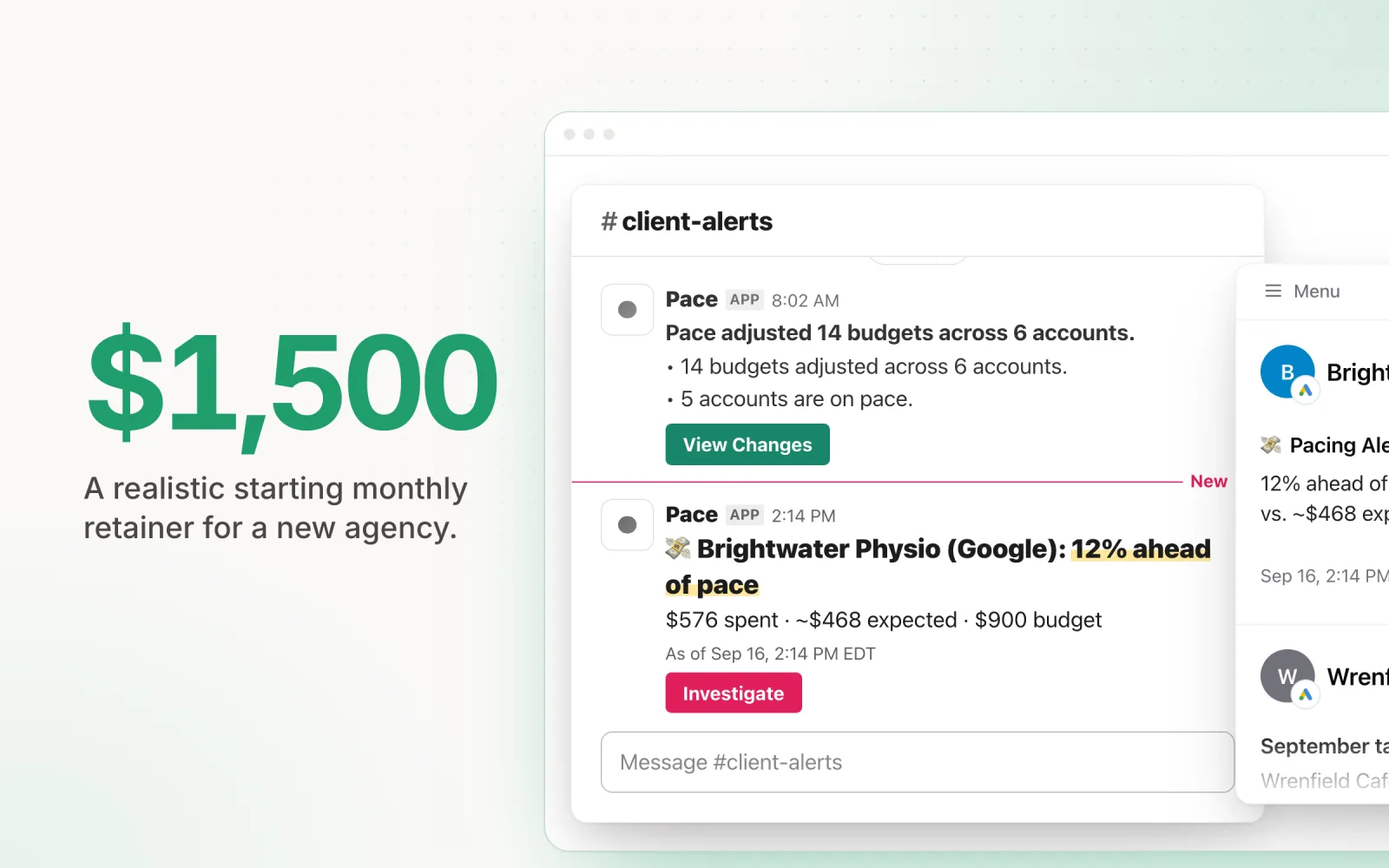
Flat monthly retainer ($1,500 to $5,000): The most common model for agencies running small to mid-sized accounts. The client pays a fixed fee regardless of ad spend. It is predictable for both sides, simple to invoice, and easy to scope. For new agencies, $1,500 to $2,000 per month is realistic for accounts spending $5,000 to $20,000 a month on ads. As you build a track record, you move towards the higher end.
Percentage of ad spend (10% to 20%): More common on larger accounts. If a client is spending $50,000 a month, a 10% management fee is $5,000. The model scales as the client spends more. The risk is that clients cut budgets in slow periods and your revenue drops with them. It also creates an uncomfortable incentive. You earn more when the client spends more, which can feel misaligned even when your intentions are clean.
Performance-based pricing: Your fee is tied to specific outcomes like leads generated, revenue attributed, or hitting a CPA target. It sounds attractive to clients. It is hard to execute cleanly. Attribution is messy, conversion tracking is imperfect, and things outside your control (landing page quality, sales team follow-up, market conditions) end up affecting your income. I would only recommend this once you have enough experience to know exactly which clients and industries you can deliver for, consistently.
Most new agencies start with flat retainers and move to hybrid models (base retainer plus a percentage of spend above some threshold) once they have a few years under their belt. One thing to remember: price on the value you deliver, not the hours you work. If your management saves a client $10,000 in wasted spend per month, a $3,000 fee is a bargain.
Essential Tools for a New PPC Agency
Your tool stack does not need to be expensive. It does need to be intentional. At a minimum you want campaign management, reporting, and a way to keep budgets on pace.
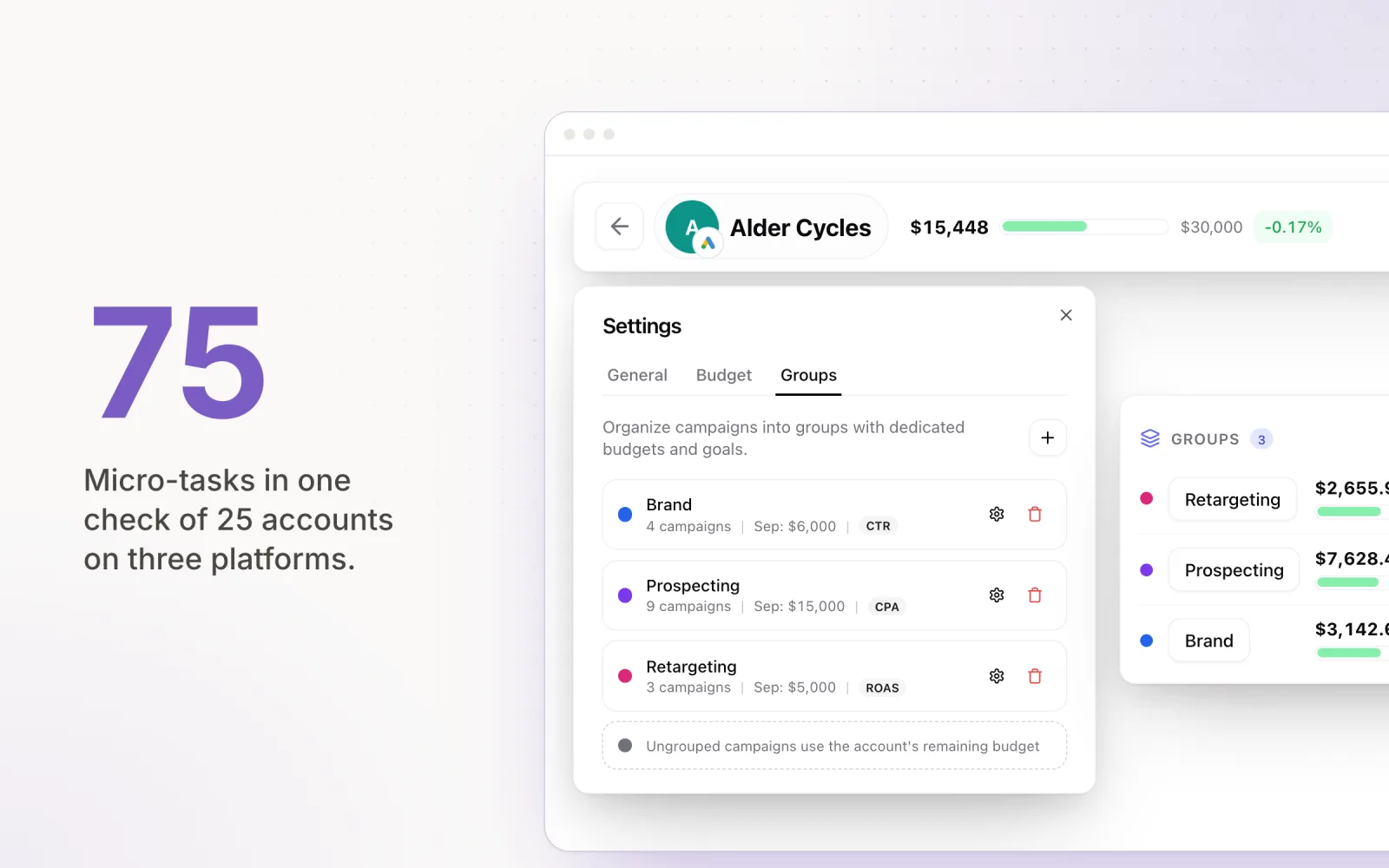
Campaign management happens mostly inside the native platforms: Google Ads Editor, Meta Business Suite, LinkedIn Campaign Manager. They are free and they are enough for the first 5 to 10 clients. Past that, you will want a layer on top that lets you see everything in one view instead of logging into three separate dashboards.
Reporting is where new agencies quietly bleed time. Custom reports in Looker Studio or Google Sheets work in the early days. They do not scale. Once you are managing 10+ clients, you will spend hours each week pulling data and formatting reports rather than reading them. Dedicated reporting tools like AgencyAnalytics or Supermetrics help, but they add cost.
Budget pacing is the operational backbone most new agencies underestimate. Keeping every client's monthly budget on target across multiple platforms takes daily attention. The formula is simple (remaining budget divided by remaining days). Doing it by hand across dozens of accounts is where the wheels come off. I have written a longer breakdown of the best budget pacing tools for agencies in 2026 if you want to compare options. Short version: automate pacing from day one. It is the single highest-leverage thing you can do operationally.
You will also need project management (Notion, Asana, or even a well-organised spreadsheet), a CRM for tracking prospects and clients, and invoicing software. Keep the stack lean. Every tool you add is another subscription, another login, another thing that can break.
Scaling Past 10 Clients Without Breaking
The first 10 clients feel like a milestone, and they are. They are also a trap. The workflows that got you to 10 will stop you reaching 20. At 10 clients across two or three platforms, you are managing 20 to 30 individual budget lines. At 20 clients that doubles, and suddenly your entire day is consumed by operational busywork.
I have covered this in more depth in how to manage ad budgets for 20+ clients without burnout, but the core principle is worth restating: move from account-by-account management to exception-based management. Instead of checking every account every day, build systems that only call you in when something is off track.
In practice that means centralised dashboards, automated pacing, and clear escalation thresholds. If an account is within 5% of its pacing target, it does not need your attention today. If it is 20% over, it does. That single filter can cut your daily operational time by 70% or more.
Hiring helps, but only after the systems are in place. Adding a second media buyer to a broken workflow just means two people are struggling instead of one. Build the infrastructure first, then hire into it.
Building an Agency That Lasts
The PPC agencies that last share a few traits. They are transparent with clients, they run on repeatable systems, and the tools they use grow with them rather than against them.
Transparency is the biggest retention tool you have. Clients leave agencies because they feel in the dark. They do not know what you are doing, why you are doing it, or whether their money is being well spent. The fix is unsexy: show your work. Every budget adjustment, every strategic call, every performance shift should be documented and shared. As I argued in the hidden cost of manual pacing, the agencies that still rely on opaque spreadsheets and gut-feel reporting are losing clients to competitors who can produce a clear, auditable record of every change.
Repeatable systems mean your quality does not depend on any one person's memory. Onboarding checklists, campaign launch processes, monthly review templates, escalation procedures, all of it written down. When you hire your second or third team member, they should be able to deliver the same standard of service you would, because the process is not trapped in your head.
Tools that scale means picking technology that grows with your client base rather than fighting it. A spreadsheet-based pacing system works for 5 clients. It collapses at 15. A reporting tool that needs 30 minutes of manual setup per report works at 8 clients. It eats entire days at 25. Every tool decision you make in the early days should be tested against one question: will this still work when I have three times as many clients?
Starting a PPC agency in 2026 is not about being the best at pushing buttons inside Google Ads. It is about building a business that delivers strategy and earns trust by being honest about what is actually happening inside each account. The technology to support that kind of agency already exists. The real question is whether you will invest in the systems from the start, or bolt them on later, after something has already started to break.
If you are building an agency and want pacing, monitoring, and cross-platform budget management handled from day one, try Pace free and see how it fits into your stack.

Jordan Parrello
Founder of Pace. Ran an agency pacing sheet by hand for years before building the thing that checks it every 5 minutes. About Pace or LinkedIn