Every pacing tool claims it lands budgets on target. We wanted to see how close one actually gets over a long stretch, so we took an Australian agency that has run Pace since December 2025. It has 13 ad accounts across Google, Meta, LinkedIn and TikTok, with monthly budgets from $150 to $13,500. We checked every month that has a recorded target, 91 account-months up to October 2026, against where spend finished.
The results are below, including the nine months that missed and why they did. Client names and anything that would identify an account are left out.
The results
| Measure | Result |
|---|---|
| Account-months measured | 91, across 13 accounts |
| Finished within 2% of budget | 65 (71%) |
| Finished within 5% of budget | 82 (90%) |
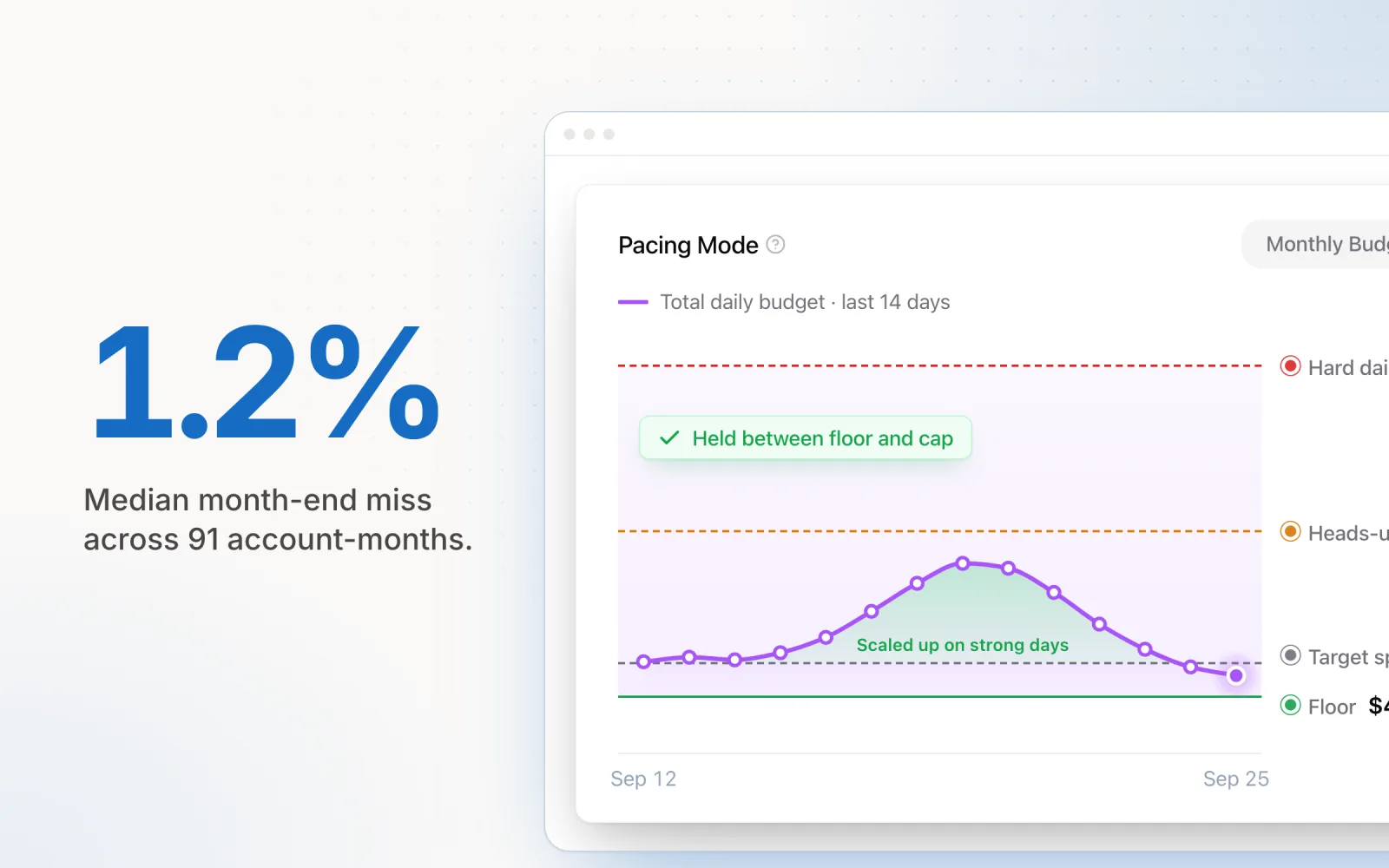
| Median miss | 1.2% |
| Finished more than 5% over | 1 |
| Finished more than 5% under | 8 |
On a $5,000 budget, a 1.2% miss is $60. For most clients that's a rounding error on the invoice, not a phone call.
Before Pace
Until December 2025, three people shared the pacing job. They worked from a spreadsheet fed by a data connector that cost the agency more than $4,000 a year and broke often. The spreadsheet was fragile too. Adding a client account or a new report meant rebuilding parts of it, so nobody wanted to touch it.
Weekends were the worst part. Unless someone logged in and checked, there was no way to know whether budgets were on track or whether a campaign had run away overnight. The team spent its time in the weeds keeping the sheet alive instead of improving the accounts.
"I used to log in on a Saturday because I didn't trust the spreadsheet. I don't do that any more," says the agency's paid media lead.
If that sounds familiar, we've written up the hidden cost of pacing in spreadsheets.
What a steady month looks like
The agency's largest Meta account went from about $3,000 a month before Pace to $9,500 a month by August 2026. In every month with a recorded target (ten of the eleven, as September wasn't recorded), it finished between 98.4% and 101.2% of budget.
Never more than 1.6% off. Month-end spend as a share of budget, largest Meta account.
| Month | Budget | Landed |
|---|---|---|
| Dec 2025 | $6,000 | 98.4% |
| Jan 2026 | $6,167 | 99.5% |
| Feb 2026 | $7,000 | 98.7% |
| Mar 2026 | $8,500 | 100.1% |
| Apr 2026 | $8,500 | 99.6% |
| May 2026 | $8,500 | 101.2% |
| Jun 2026 | $8,500 | 99.7% |
| Jul 2026 | $9,500 | 100.1% |
| Aug 2026 | $9,500 | 100.2% |
| Sep 2026 | Not recorded | – |
| Oct 2026 | $8,650 | 100.1% |
Small budgets got the same treatment. A $150-a-month Meta account landed between 98.1% and 100.3% for eleven straight months. From March 2026 it finished within 0.3% every month. Over the same stretch the large account finished within 0.4% in six of seven months, with May 1.2% over.
The tight finish from March onwards comes from the month-end setting. When an account reaches its monthly budget, Pace either pauses its campaigns or holds them at a small daily amount, whichever the agency has chosen. Spend stops close to the line instead of drifting past it.
The nine misses
Nine of the 91 months finished more than 5% off budget. Here's every one of them.
| Cause | Months | What happened |
|---|---|---|
| Target changed mid-month | 2 | One budget rose from $150 to $250 during April, and the account finished at 68% of the new figure. Another target was cut by hand on 30 October to less than the account had already spent (114%). |
| First month on Pace | 2 | A Google account finished its onboarding month at 94%. A LinkedIn account finished at 7%, because its campaigns were left out of pacing during setup. |
| Campaigns paused by the agency | 2 | One account had every campaign paused until late September (54%). Another had a campaign group paused for October (87%). |
| Auctions wouldn't take more | 2 | A Google account finished January at 89%: two campaigns were losing 69–77% of their search impression share to Ad Rank, so the budget was there but the auctions weren't. The same account finished April at 79% after five days with no recorded spend, even though Pace had raised its budgets. We couldn't find the cause. |
| Pace's stability limit | 1 | A $250 account finished September at 95%. Pace limits how far it moves a budget in one day, and that held back how much it could catch up in the last two days. |
The one overspend came from a target cut below what the account had already spent. The other eight misses are underspends. Most came from people changing things partway through the month, two came from auctions that wouldn't take more budget, and one came from Pace's own limit on daily changes.
Worth knowing: a pacing tool can only spend what the auction will take. If an account is losing most of its impression share to Ad Rank, a bigger budget won't fix it.
How we measured it
- Spend is the platform-reported total for each calendar month, read through the Pace connector.
- Targets come from Pace's own records for each month: the budget cap at which the month-end setting fired, or the monthly target in that month's pacing runs. Where an account is split into campaign groups, the target is the sum of the group budgets.
- Excluded are months with no recorded target (12) and months before an account joined Pace, since there's no recorded budget to compare them with.
- Partly managed accounts count only the campaigns Pace manages. In some months up to 49% of one account's spend came from campaigns outside Pace.
- Budget changes mid-month are measured against the budget at month end.
"We had three people and a spreadsheet keeping budgets on track, and someone still checked on weekends. Now nobody does that job. The time goes into the work clients actually pay us for," says the paid media lead.
Want to know where your own accounts will land? Run them through the budget pacing calculator, or read up on the pacing formula behind it.

Jordan Parrello
Founder of Pace. Ran an agency pacing sheet by hand for years before building the thing that checks it every 5 minutes. About Pace or LinkedIn