Most agencies and in-house teams advertise on more than one platform. Google captures search intent. Meta builds awareness and drives discovery. LinkedIn reaches professional audiences. Microsoft extends search reach into a different user base. They're complementary, and running campaigns across them is standard practice.
Standard practice is not the same as cross-channel advertising though. The distinction decides whether your platforms reinforce each other or sit in disconnected silos, each with its own budget, its own reporting, and its own version of what's working.
This guide covers what cross-channel advertising actually means, why it's harder to ignore in 2026 than ever, and how to build a strategy that treats your ad platforms as a coordinated system rather than a pile of separate tools.
What is cross-channel advertising?
Cross-channel advertising is running coordinated campaigns across multiple ad platforms with a unified strategy, shared budget allocation, and consolidated reporting. The key word is coordinated. Each platform plays a defined role in the customer journey, and the performance of one channel informs decisions on the others.
That's different from multi-channel advertising, where you're simply present on multiple platforms. In a multi-channel approach, the same message runs everywhere, each platform is managed independently, and there's little strategic connection between channels. Multi-channel answers "where should we show up?" Cross-channel answers "how should these platforms work together?"
In practice it looks like this: a prospect sees a Meta ad introducing your product, visits your site but doesn't convert, later searches a related keyword on Google, sees your search ad, clicks through, converts. Every touchpoint was deliberate. Meta was set up for awareness. Google was set up to capture the intent Meta created. The budget split reflected those roles, and the reporting tracked the full journey instead of crediting only the last click.
Coordinate the platforms this way and the whole beats the sum of its parts. Don't, and you end up with duplicated effort, conflicting messaging, and no clear picture of what's actually driving results.
Why cross-channel advertising matters
The case for cross-channel advertising is grounded in how buyers actually behave. The average B2B buyer interacts with five or more channels before making a purchase decision, according to Forrester research on the modern B2B buying journey. B2C journeys are just as fragmented. A consumer might discover a product on Instagram, research it on Google, see a retargeting ad on a news site, and finally convert through a branded search.
Each platform plays a distinct role in that journey:
- Google Search captures existing intent. Someone searching "best project management software" has already identified a need.
- Meta (Facebook and Instagram) creates demand. It reaches users who aren't actively searching but can be persuaded by strong creative and targeting.
- LinkedIn reaches professional audiences with high accuracy. Job title, company size, and industry targeting make it the default for B2B campaigns.
- Microsoft Ads extends search reach into a demographic that skews older, higher-income, and desktop-heavy. Google Search alone misses a real chunk of that audience.
Manage these platforms in isolation and a few problems emerge. Budgets get misallocated because each platform is optimised in a vacuum. Messaging conflicts when different teams or specialists run each channel without shared guidelines. Performance blind spots develop because no one has a unified view of how the channels interact.
The biggest risk is budget misallocation. If your Google campaigns are overspending while Meta is underspending, you're paying more for the same results, or missing results entirely. Without a cross-channel view, you can't see that the two are out of balance until end of month, by which point it's too late to do anything about it.
Building a cross-channel advertising strategy
A good cross-channel strategy starts with goals, not platforms. Before deciding where to advertise, define what you're trying to achieve and for whom. Generating leads for B2B SaaS? Driving e-commerce sales? Building awareness in a new market? The answer decides which platforms are worth the investment and what role each should play.
Once goals are clear, map the customer journey to channels. Identify where your audience first encounters your brand (awareness), where they research and compare options (consideration), and where they convert (decision). Then assign platforms to each stage:
- Awareness: Meta Ads (broad targeting, video, carousel), LinkedIn Ads (sponsored content for B2B), YouTube (via Google Ads)
- Consideration: Google Search (keyword targeting for active research), Microsoft Ads (extended search reach), Meta retargeting (re-engage site visitors)
- Decision: Google Search (branded and high-intent keywords), Google Shopping (product-level comparison), Meta dynamic retargeting (personalised product ads)
Platform selection should follow audience and objectives, not habit. Selling a visual consumer product? Meta and Google Shopping should take the majority of budget. Selling B2B software with a long sales cycle? LinkedIn and Google Search are the primary channels. No universal formula, but there is a framework. Our guide to allocating budget between Google and Meta covers the foundational split in detail.
Cross-channel budget allocation
Budget allocation is where strategy becomes operational. The question isn't "how much should we spend?" It's "how should we distribute spend across platforms to maximise overall performance?"
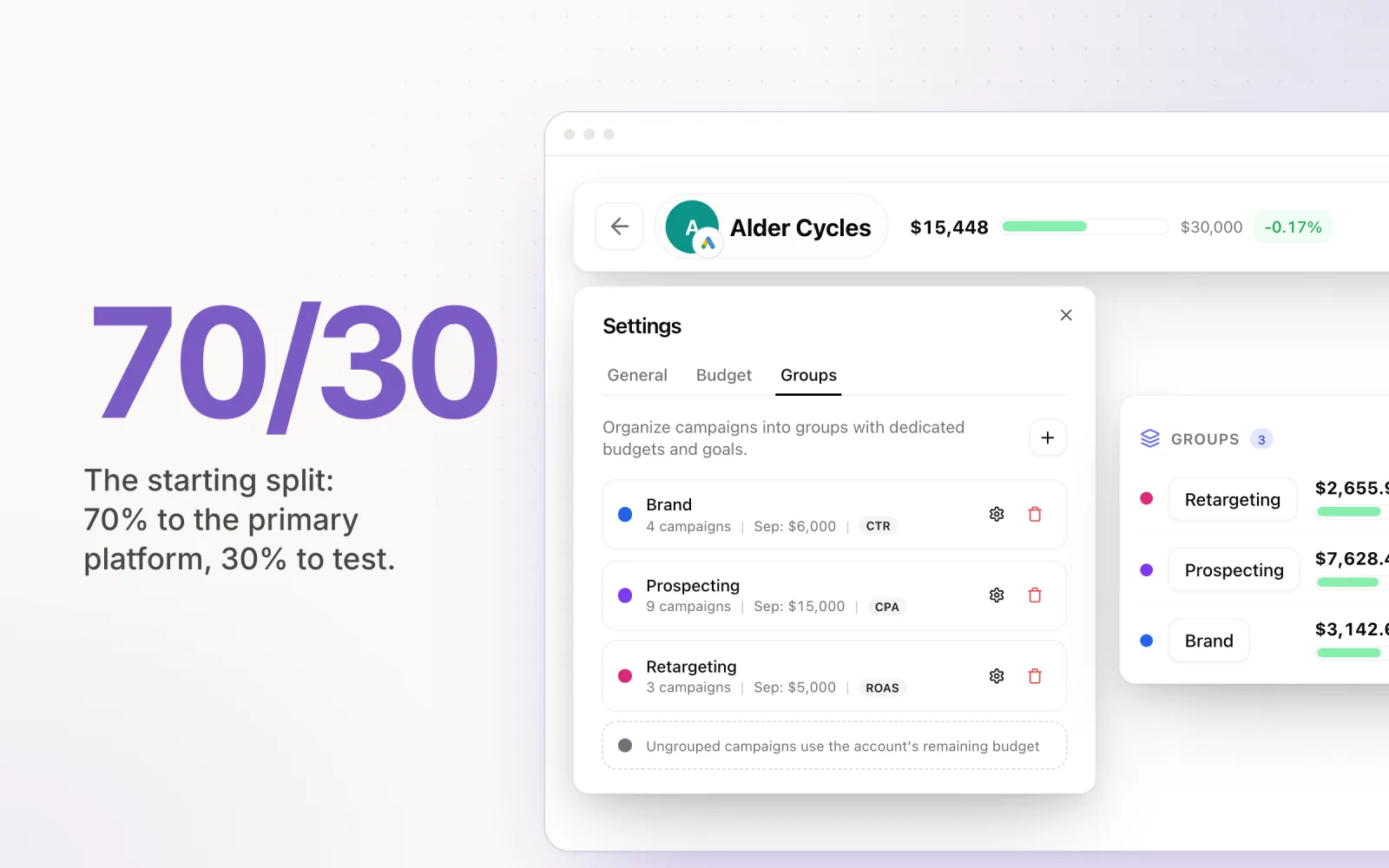
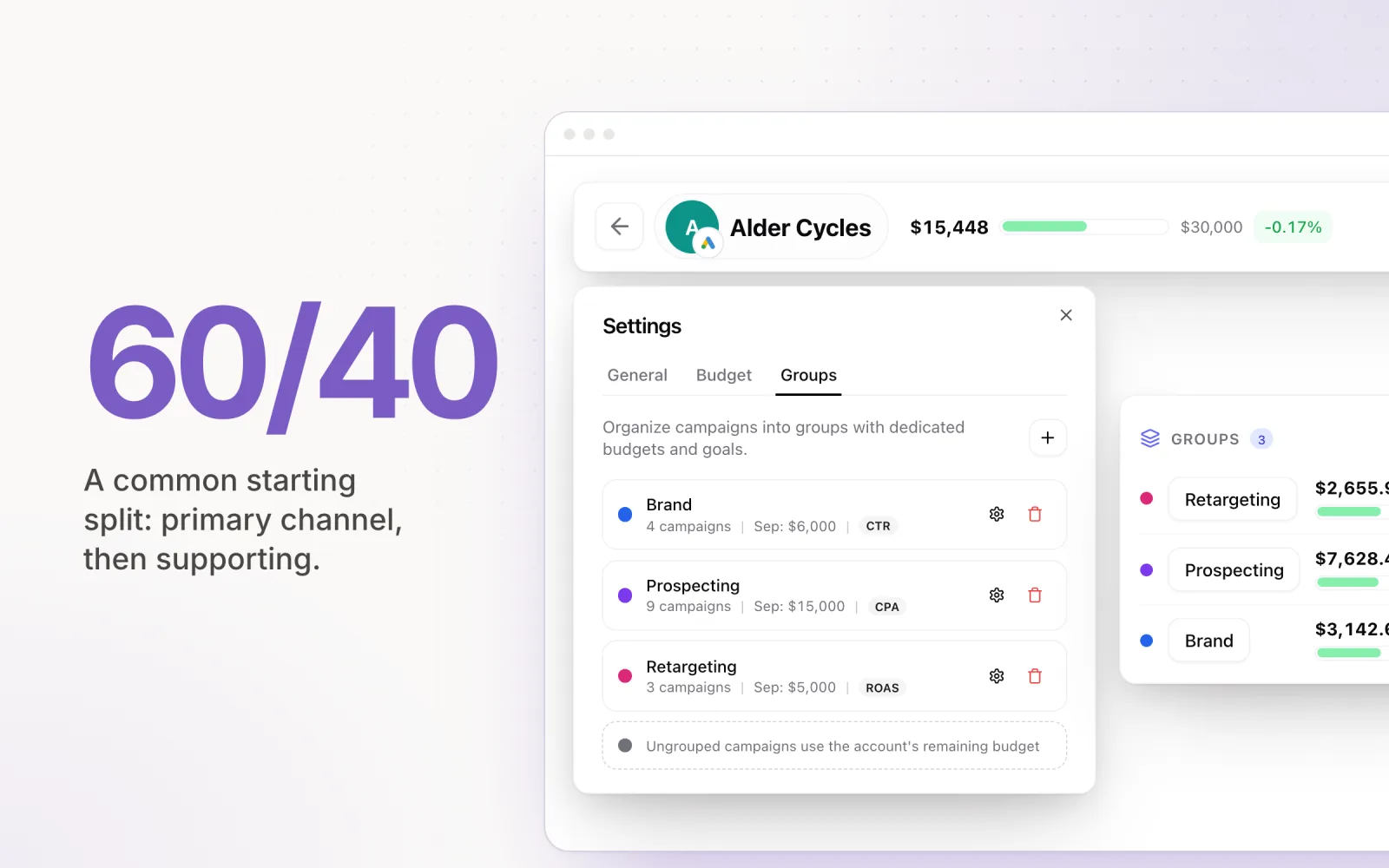
Two common starting frameworks are the 60/40 and 70/30 splits. In a 60/40 model, 60% of budget goes to the primary performance channel (usually Google Search for intent-driven businesses, or Meta for discovery-driven brands) and 40% goes to supporting channels. In a 70/30 model, the primary channel takes a bigger share and the secondary channel is used for testing and diversification.
These splits are starting points, not permanent allocations. The right ratio depends on your industry, your goals, and (most importantly) actual performance data. After four to six weeks of running campaigns on both platforms, the data should tell you where each additional dollar produces the best return.
The more important discipline is dynamic reallocation. A few signals should trigger a budget shift:
- CPA divergence: If your Google CPA rises 25% over two months while Meta’s stays flat, reallocating 10 to 15% of Google’s budget to Meta may improve overall efficiency.
- Audience saturation: Rising frequency and declining CTR on Meta suggest you're reaching the same people too often. Shifting spend to Google captures fresh intent-based traffic.
- Seasonal patterns: Some businesses see intent spikes on Google during specific periods. Temporarily increasing Google’s share during those windows captures demand that would otherwise go to competitors.
- Platform pacing gaps: If one platform consistently underspends its daily budget while another overshoots, the allocation needs adjustment. Most common cross-channel problem I see, and one of the easiest to fix with the right tooling.
The operational catch: manual budget reallocation across platforms eats hours. Pulling data from four platforms, normalising metrics, spotting imbalances, then making adjustments can take hours per client per month. For agencies running 10 or more clients, that scales poorly. Our piece on landing ad spend exactly on target covers the pacing mechanics that underpin all of this.
Cross-channel reporting and attribution
Reporting is the operational backbone. Without a unified view of performance across platforms, every allocation decision rests on incomplete data.
The core challenge: each platform claims credit for conversions using its own attribution model. Google reports conversions based on clicks and view-through windows. Meta uses a different window and counts conversions Google also claims. LinkedIn has its own model entirely. Add all the platform-reported numbers together and the total will exceed your actual conversions, sometimes by 30% or more.
That double-counting makes platform-native reporting unreliable for cross-channel decisions. Three ways to handle it:
- Last-click attribution (via Google Analytics) gives all credit to the final touchpoint before conversion. Simple, but it systematically undervalues upper-funnel channels like Meta and LinkedIn, which generate the awareness that leads to the converting click.
- Data-driven attribution (available in GA4 and some third-party tools) distributes credit across touchpoints using statistical modelling. More accurate, but it needs significant conversion volume to produce reliable results.
- Platform-level reporting with blended metrics accepts that perfect attribution isn't going to happen and focuses on cross-platform metrics: blended CPA, blended ROAS, total conversions. The question becomes "is overall performance improving?" instead of "which platform deserves credit?"
For most agencies and in-house teams, the third approach is the most practical. A single dashboard pulling spend, conversions, and key metrics from all platforms gives you what you need to make allocation decisions without disappearing into attribution modelling. For more on this, see our guide to cross-platform ad reporting without GA4.
Cross-channel advertising tools
Managing cross-channel advertising manually (logging into each platform, pulling reports, comparing metrics in spreadsheets, adjusting budgets one platform at a time) works at small scale. It stops working the moment you're managing more than a handful of accounts, or need to make budget decisions faster than a monthly review allows.
Platform-native tools are built for single-platform optimisation. Google Ads has no visibility into your Meta spend. Meta Business Suite knows nothing about your Google campaigns. LinkedIn Campaign Manager sits in its own silo. There's no native cross-platform view, full stop.
Third-party tools fill this gap. They serve different segments:
- Enterprise platforms (Marin Software, SA360): Built for large advertisers with six-figure monthly spend. Cross-channel management, bid optimisation, attribution modelling, workflow automation. Marin publishes an entry plan from $500 per month, but the cross-channel tiers that make these platforms worth buying are quoted privately on annual contracts, which prices them out for smaller agencies.
- Mid-market platforms (Pace Ads): Designed for agencies and in-house teams running campaigns across Google, Meta, TikTok, LinkedIn, Microsoft, Reddit, X Ads, and Amazon Ads. Pace focuses on automated budget pacing across all eight platforms, AI-driven budget optimisation, cross-platform dashboards, and anomaly detection. Starts lower than enterprise tools, so cross-channel management is reachable for teams without enterprise budgets.
- Data aggregation tools (Funnel.io, Supermetrics): Pull data from multiple platforms into a single location (usually a spreadsheet or data warehouse) for unified reporting. They solve the reporting problem, but they don't manage campaigns or adjust budgets. Data layer, not management layer.
When evaluating cross-channel tools, look for API connections to the platforms you use, automated budget pacing that works across platforms (not just within one), unified performance dashboards, and alerting that catches cross-platform issues like pacing imbalances or anomalous spending. For a more detailed comparison, see our ad management tools comparison.
Frequently asked questions
What is cross-channel advertising?
Cross-channel advertising is running coordinated ad campaigns across multiple platforms (Google Ads, Meta Ads, LinkedIn Ads, Microsoft Ads) with a unified strategy, shared budget allocation, and consolidated reporting. Multi-channel advertising has each platform operating independently with the same message. Cross-channel tailors messaging to each platform’s strengths while keeping strategic coherence across the customer journey.
What is the difference between multi-channel and cross-channel advertising?
Multi-channel advertising means being present on multiple platforms, often with the same message and independent management per channel. Cross-channel advertising goes further: campaigns are coordinated across platforms, with each channel assigned a specific role in the customer journey. Budget flows between channels based on performance, messaging is adapted to each platform’s context, and reporting is unified so you can see the full picture rather than isolated platform metrics.
How do you measure cross-channel advertising performance?
Measuring cross-channel performance requires a unified reporting layer that pulls data from all platforms into a single view. Key metrics include blended CPA, blended ROAS, total conversions by funnel stage, and platform-level contribution. Because each platform claims credit for conversions differently, many teams use data-driven attribution or incrementality testing alongside a consolidated dashboard to understand true cross-channel performance.
What tools help manage cross-channel advertising?
Cross-channel advertising tools range from enterprise platforms like Marin Software to mid-market solutions like Pace Ads and data aggregation tools like Funnel.io. The best tools connect to multiple ad platforms via API, provide unified budget pacing and reporting, and allow teams to manage campaigns without switching between platform-native dashboards. Key features to look for include automated budget pacing across platforms, cross-platform performance dashboards, and AI-driven optimisation.
Cross-channel advertising is not a buzzword. It's a structural advantage. Teams that run their platforms as a coordinated system make better allocation decisions, catch problems faster, and compound results across channels instead of optimising each one in isolation. Pace connects Google, Meta, TikTok, LinkedIn, Microsoft, Reddit, X Ads, and Amazon Ads in one dashboard with automated budget pacing across all platforms, so you can manage cross-channel campaigns without the manual overhead. Try it free.

Jordan Parrello
Founder of Pace. Ran an agency pacing sheet by hand for years before building the thing that checks it every 5 minutes. About Pace or LinkedIn