If you manage paid media for more than a handful of clients, you have probably searched for a digital ad management tool at least once in the past year. The problem is not a lack of options. The problem is that every tool describes itself using the same language — "automation," "optimisation," "cross-platform management" — while delivering very different capabilities under the hood.
The digital ad management market in 2026 is more fragmented than it has ever been. There are pure-play pacing tools, enterprise bid management suites, all-in-one agency platforms, and AI-powered newcomers. Some tools focus on a single platform (usually Google Ads). Others attempt to cover every channel but sacrifice depth for breadth. Choosing the wrong one costs you months of onboarding and integration work before you discover the gaps.
I have used or evaluated every tool in this comparison over the past three years while building Pace. This is not a surface-level feature list. It is a practical assessment of what each platform actually does, who it is designed for, and where its limitations become apparent in day-to-day agency work.
What "Management" Actually Means in 2026
Before comparing specific tools, it is worth defining what ad management entails beyond the basics. Most agencies need some combination of the following capabilities, and most tools only cover a subset of them.
Budget pacing is the foundation: tracking spend against monthly targets and adjusting daily budgets to land on target. But pacing alone is not management. Agencies also need optimisation (bid adjustments, audience tuning, creative rotation), automation (rules that trigger actions without manual intervention), reporting (client-facing dashboards and performance summaries), and audit trails (a log of every change, who made it, and why).
Cross-platform visibility is the capability that separates modern management tools from single-channel optimisers. When a client's budget spans Google, Meta, LinkedIn, and Microsoft Ads, the agency needs a single source of truth for total spend, not four separate dashboards. Understanding how to choose the right tool starts with understanding which of these capabilities matter most for your agency's workflow.
With that framework in mind, here is how each tool stacks up.
Optmyzr: The Google Ads Specialist
Optmyzr has built its reputation as the deepest Google Ads optimisation tool on the market. Founded by former Google engineers, the platform offers granular control over Google Ads and Microsoft Ads campaigns through rule-based automation, custom scripts, and one-click optimisations.
Strengths. Optmyzr's rule engine is genuinely powerful. You can build multi-condition rules that adjust bids, pause keywords, modify budgets, and trigger alerts based on dozens of performance signals. The scripting layer goes even further, letting technical users write custom logic that runs on a schedule. Budget projection tools estimate month-end spend based on current run rates, which gives agencies an early warning when campaigns are trending off target.
The platform's Google Ads coverage is unmatched among the tools in this comparison. Quality score monitoring, auction insights analysis, negative keyword management, ad copy testing — Optmyzr covers the full spectrum of Google Ads optimisation. The reporting templates are also strong, with white-label options that agencies can deliver directly to clients.
Weaknesses. Optmyzr's cross-platform coverage is its most significant limitation. The platform does not natively connect to Meta Ads or LinkedIn Ads for budget pacing. Optmyzr has introduced some Meta support through custom rules, but this is not the same as native integration with budget management capabilities. You cannot set a unified monthly budget that spans Google and Meta campaigns, and you cannot auto-pace Meta budgets from within Optmyzr.
The learning curve is steep. The rule engine's flexibility is a double-edged sword: powerful for experts, overwhelming for junior team members. Onboarding a new media buyer onto Optmyzr's rule system takes weeks, not days. Pricing scales per account, which can become expensive for agencies managing dozens of smaller accounts.
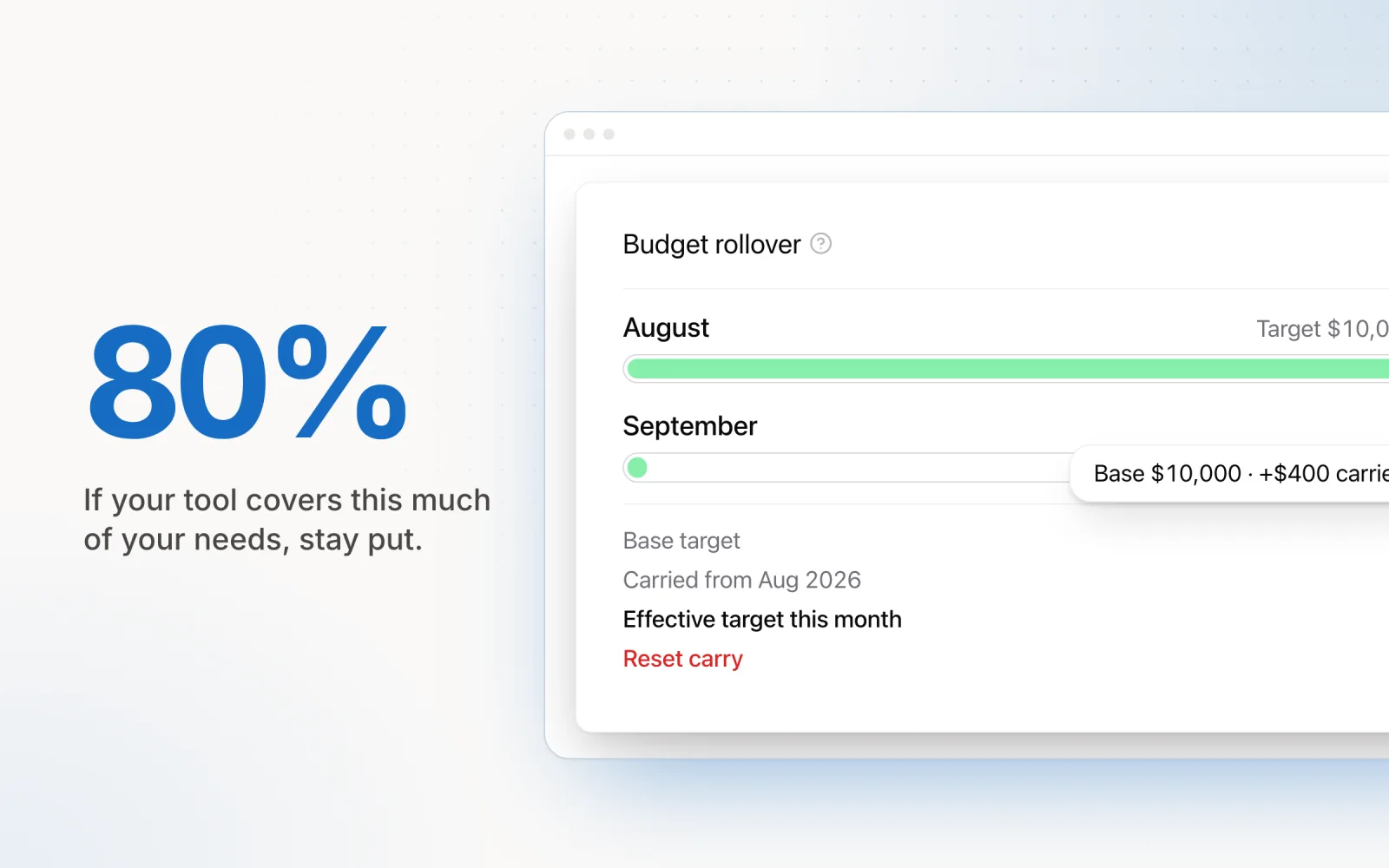
Best for: Google-heavy agencies that want granular optimisation control and are comfortable maintaining separate workflows for social platforms. If 80% or more of your managed spend is on Google and Microsoft Ads, Optmyzr remains a strong choice. For agencies with diversified media mixes, see our guide to Optmyzr alternatives for cross-platform options.
Shape.io / NinjaCat: The Legacy Pacing Authority
Shape.io was one of the first tools purpose-built for budget pacing. For years, it was the default recommendation when agencies asked how to track spend against monthly targets. That changed in 2022 when NinjaCat, a data management and reporting platform, acquired Shape.io and folded its pacing features into a broader product suite.
Strengths. Shape.io's original pacing engine was clean and focused. It connected to major ad platforms, displayed spend-to-target status in a clear visual dashboard, and sent alerts when campaigns deviated from pace. Post-merger, NinjaCat has layered in a powerful reporting suite with data warehousing, client dashboards, and AI-powered insights. For agencies that need both pacing and reporting, the combined platform offers genuine breadth.
NinjaCat connects to a wide range of data sources beyond just ad platforms — CRM systems, analytics tools, call tracking — which makes it attractive for agencies that want to consolidate client data into a single platform. The reporting capabilities are enterprise-grade, with automated delivery and multi-channel attribution.
Weaknesses. The standalone Shape.io product no longer exists. Visiting shape.io today redirects to ninjacat.io. For agencies that valued Shape.io's simplicity and focus, this is a meaningful loss. Pacing is now one feature among many within NinjaCat's broader platform, and the development roadmap prioritises AI agents, data unification, and reporting over pacing innovation.
NinjaCat's pricing reflects its enterprise positioning. Agencies that only need pacing are paying for a full reporting and data management platform to access budget tracking features. The onboarding process is more involved than standalone pacing tools because you are configuring a comprehensive data platform, not just connecting ad accounts. We covered this transition in detail in our Shape.io vs. Pace comparison, and the Shape.io migration guide maps the old workflows to their replacements one by one.
Best for: Agencies already using NinjaCat for reporting and data management, or agencies that need a combined reporting and pacing solution and are willing to commit to an enterprise platform.
EDEE: The Structured Rule-Based Optimiser
EDEE is a European-based agency management platform that includes OptiPacer, its automated budget pacing module. The platform takes a systematic, rule-driven approach to ad management, which appeals to agencies that prefer deterministic automation over AI-driven decisions.
Strengths. OptiPacer connects to Google Ads, Microsoft Ads, Meta, and LinkedIn, making it one of the few tools with genuine four-platform pacing support. The pacing engine runs on configurable schedules: you define the monthly target, set the adjustment frequency, and specify how aggressively the system should correct when campaigns deviate from pace.
EDEE's broader platform includes task management, client reporting, and workflow tools. For agencies that want to consolidate operational tools, this all-in-one approach reduces the number of logins and integrations to maintain. The rule-based automation is transparent and predictable — you can audit exactly what the system will do before it does it.
Weaknesses. EDEE's user base is smaller and more European-centric than the other tools in this comparison. Support hours are aligned with EU time zones, which can be a friction point for agencies in North America or Asia-Pacific. Documentation and community resources are less extensive than more established platforms.
The AI and machine learning capabilities are limited compared to tools like Marin or Pace. EDEE's automation is rule-based rather than predictive, meaning the system reacts to deviations rather than anticipating them. For straightforward pacing, this works fine. For agencies that want the system to factor in day-of-week spend patterns, platform-specific learning phases, or seasonal trends, rule-based automation may not be sufficient.
Best for: Agencies that want structured, predictable automation across four platforms and value transparency in how the system makes decisions. Particularly strong for teams that prefer rules over AI and want an integrated agency management suite.
Marin Software: The Enterprise Cross-Channel Platform
Marin Software is the longest-established tool in this comparison, with roots in the early days of paid search management. The platform has evolved into a comprehensive cross-channel solution that covers search, social, display, and ecommerce advertising at enterprise scale.
Strengths. Marin's cross-platform support is the broadest in this group. The platform connects to Google Ads, Meta, Amazon Ads, Apple Search Ads, LinkedIn, Microsoft Ads, and several additional channels. Budget allocation and pacing features allow portfolio-level budgets that span multiple platforms and campaigns, with automated redistribution based on performance.
The bid management engine uses machine learning models trained on historical performance data to optimise bids across channels. Revenue attribution connects ad spend to conversion data, which enables budget decisions based on actual return rather than just spend targets. For agencies or brands managing complex media mixes with large budgets, Marin provides a level of sophistication that simpler tools cannot match.
Weaknesses. Marin is built for large operations. The platform requires dedicated resources to configure, maintain, and operate effectively. Onboarding typically takes weeks to months, depending on the complexity of the account structure and the number of integrations required. The interface reflects this complexity — it is not a tool you hand to a junior media buyer on their first day.
Pricing is enterprise-tier, typically based on a percentage of managed spend. For agencies spending less than $500,000 per month across all clients, the cost-to-value ratio becomes difficult to justify. Marin's feature depth is a genuine advantage at scale, but it is overkill for agencies managing 10 to 30 accounts with straightforward pacing needs.
Best for: Large agencies or in-house brand teams spending $500K or more per month across five or more platforms. If your operation requires advanced bid management, revenue attribution, and portfolio-level budget optimisation, Marin is purpose-built for that complexity.
Pace: Purpose-Built Cross-Platform Budget Management
Pace was built specifically for the budget pacing problem across Google Ads, Meta, TikTok, LinkedIn, Microsoft, Reddit, X Ads, and Amazon Ads. The platform combines AI-driven pacing with transparent audit trails and a design philosophy that prioritises speed of setup and day-to-day usability over feature breadth.
Strengths. Pace connects via OAuth to all eight major ad platforms and begins tracking spend within minutes of setup. The AI pacing engine calculates daily budget adjustments based on remaining budget, remaining days, and platform-specific factors. Google's 30.4x daily budget cap, Meta's CBO learning phases, and LinkedIn's lifetime pacing mechanics are all factored into the adjustment logic rather than treated as generic inputs.
The audit trail is the feature that agencies report valuing most. Every automated change is logged with a timestamp, the old value, the new value, and the reasoning behind the adjustment. These change reports can be shared directly with clients, which creates a level of transparency that builds trust and reduces the "what happened to my budget?" conversations. Connections use OAuth with minimal required permissions, so Pace never sees or stores your ad-platform passwords — the refresh tokens it holds are encrypted at rest (AES-256) and revocable at any time.
Setup time is measured in minutes, not days. Connect your accounts, set monthly budget targets, and the system starts pacing. There is no multi-week onboarding process, no integration consulting, and no training certification required before your team can start using it.
Weaknesses. Pace is a newer platform than the others in this comparison, which means a smaller user community and fewer third-party integrations. The platform does not include GA4 or Looker Studio integration by design — it is built to pair with your existing analytics and reporting tools rather than replace them. Agencies that want a single platform for pacing, reporting, and analytics will need to maintain Pace alongside those tools.
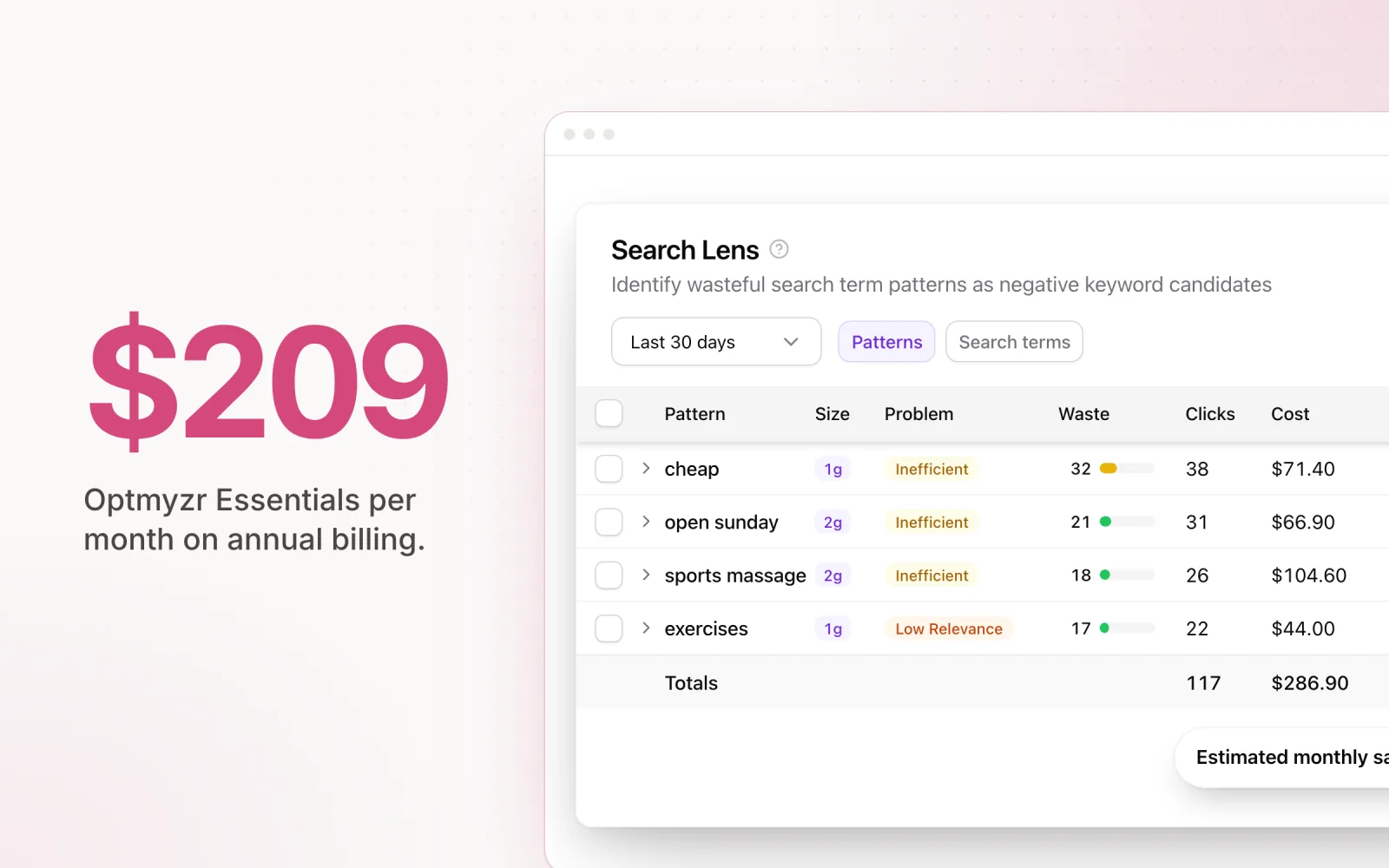
Beyond budget management, Pace includes Search Lens for keyword and search term analysis, a Creative Performance Analyzer for Meta, TikTok, and LinkedIn ads, and Demographic Exclusion tools for Google and Microsoft — extending into campaign-level optimisation. Findings provide automated anomaly detection, and Dot is a conversational AI agent for investigating account data in real time. Start a free trial to get started.
Best for: Mid-market agencies managing 10 to 100 accounts across Google, Meta, TikTok, LinkedIn, and Microsoft Ads that need accurate pacing with full transparency and fast setup.
Comparison Table
The following table summarises how each tool compares across the capabilities that matter most for agency ad management.
| Capability | Optmyzr | Shape.io / NinjaCat | EDEE | Marin | Pace |
|---|---|---|---|---|---|
| Platform coverage | Google, Microsoft | Google, Meta, LinkedIn, Microsoft + more | Google, Microsoft, Meta, LinkedIn | Google, Meta, LinkedIn, Microsoft, Amazon, Apple + more | Google, Meta, TikTok, LinkedIn, Microsoft |
| Budget pacing | Projections + alerts (Google/Microsoft only) | Spend tracking + alerts | Automated via OptiPacer | Portfolio-level allocation | Automated daily adjustments |
| AI / ML | Rule-based + scripts | AI agents (general) | Rule-based | ML bid optimisation | Frontier-model AI engine |
| Audit trails | Change history | Limited | Rule execution logs | Activity logs | Full log with reasoning + client reports |
| Setup time | Days to weeks | Days to weeks | Days | Weeks to months | Minutes |
| Pricing model | Per account | Enterprise platform fee | Platform subscription | % of managed spend | Per account |
No single tool dominates across every row. The right choice depends on where your agency's specific pain points sit. If the comparison above is useful, you may also find our broader roundup of budget pacing tools helpful for understanding the wider landscape. Our ad management platform buyer's guide also provides a structured evaluation framework for weighing these trade-offs against your agency's priorities.
Which Tool for Which Agency
The "best" digital ad management tool depends on your agency's size, client mix, and operational maturity. Here is a practical framework based on agency profiles I have encountered over the past decade.
Solo freelancers and micro-agencies (1–5 clients). At this scale, a dedicated management tool may not be necessary yet. Platform-native dashboards (Google Ads Editor, Meta Business Suite) combined with a well-structured spreadsheet can handle pacing for a small number of accounts. If you do adopt a tool, look for per-account pricing with no minimum commitment. Pace and Optmyzr both offer this model. The investment makes sense once manual pacing starts consuming more than a few hours per week.
Growing agencies (5–15 clients). This is where manual pacing breaks down. You are managing enough accounts that spreadsheet errors become inevitable, and the time spent on budget tracking competes with strategic work. A focused pacing tool pays for itself quickly at this stage. Pace is designed for this exact inflection point — fast setup, cross-platform coverage, and enough automation to remove the daily spreadsheet ritual. EDEE is also worth evaluating if you want integrated task management alongside pacing.
Mid-market agencies (20–50 clients). At this scale, you need both pacing and optimisation tooling, and you likely need them across multiple platforms. Most agencies at this level run a combination of tools. A common stack is Optmyzr for Google Ads optimisation plus Pace for cross-platform budget pacing. NinjaCat makes sense if reporting is a primary pain point and you want pacing bundled with it. The key consideration is integration overhead — every additional tool adds a login, a data source, and a maintenance burden.
Large agencies (50+ clients). Enterprise-scale agencies typically need Marin-level sophistication for bid management and attribution, combined with dedicated pacing and reporting tools. At this scale, the tools need to support team hierarchies, permission controls, and workflow automation. Marin handles the strategic layer. Pace or NinjaCat handles the pacing and reporting layer. Many large agencies also maintain Optmyzr for Google-specific optimisation tasks. The total cost of the tool stack is significant, but so is the cost of manual processes at scale.
One pattern I see consistently: agencies at every size use multiple tools, not just one. The expectation that a single platform will handle pacing, optimisation, reporting, and audit trails across all channels is unrealistic in 2026. The tools that succeed are the ones that do their specific job well and integrate cleanly with the rest of the stack.
Making the Decision
Start with your most urgent pain point. If your team is spending hours per week on spreadsheet-based pacing, that is the problem to solve first, and budget pacing tools (Pace, EDEE, or the NinjaCat platform) are the right category. If your Google Ads accounts need deeper optimisation, Optmyzr addresses that directly. If you are managing $500K or more per month and need portfolio-level budget allocation with revenue attribution, Marin is the appropriate scale.
Whichever direction you go, run the new tool in parallel with your existing process for at least one billing cycle before fully transitioning. Compare the tool's pacing recommendations against your manual calculations, verify that automated adjustments align with your expectations, and confirm that the audit trail captures the information your clients need.
The digital ad management market will continue to evolve as platform APIs change, AI capabilities mature, and agency workflows adapt. The tools that last are the ones built with a clear focus, transparent automation, and respect for the agency's need to maintain control over client budgets.

Jordan Parrello
Founder of Pace. Ran an agency pacing sheet by hand for years before building the thing that checks it every 5 minutes. About Pace or LinkedIn