Paid search is how businesses buy visibility at the exact moment someone is looking for what they sell. Display and social advertising interrupt people mid-scroll. Paid search meets them mid-intent. That difference is why it consistently produces higher conversion rates and more predictable ROI than almost any other digital channel.
The gap between running paid search and running it well is enormous. A poorly structured campaign burns budget on irrelevant clicks. A well-structured one compounds month over month. This guide walks the full process: how ads appear, how to structure campaigns, how to choose keywords, how bidding works, how to measure, and how to manage paid search at scale across multiple accounts.
What is paid search?
Paid search is digital advertising where businesses bid on keywords so their ads appear at the top of search engine results pages (SERPs). When someone types a query into Google or Bing, an auction runs in milliseconds. Advertisers who have bid on keywords matching that query compete for placement. The winning ads appear above the organic results, labelled "Sponsored." The advertiser pays only when someone clicks.
The two main platforms are Google Ads and Microsoft Ads (formerly Bing Ads). Google holds roughly 90% of global search market share. Microsoft Ads covers about 6%, often at lower CPCs with a slightly older, higher-income demographic. Most advertisers start with Google and expand to Microsoft once they have a profitable baseline.
The auction model is what makes paid search different from traditional advertising. You do not buy a placement. You compete for it in real time. Competition is governed by three things: your bid (what you are willing to pay per click), your quality score (Google's read on ad relevance and landing page experience), and the expected impact of your extensions. Combine those, you get your ad rank. Ad rank decides whether your ad appears and in what position.
Quality score is the equaliser. An advertiser with a lower bid but a higher quality score can outrank a competitor bidding more. It is calculated from expected click-through rate, ad relevance (how closely your copy matches the query), and landing page experience. Paid search rewards relevance, not budget size. A team running $10,000/month with tight keyword targeting and strong copy can outperform a competitor burning $50,000 on broad, poorly structured campaigns. I see this every month.
How does paid search work?
Knowing the mechanics matters for the strategic calls. Every time a user runs a query, this all happens in milliseconds.
Step 1: Keyword matching. Google scans active campaigns to find advertisers whose keywords match the query. The match depends on the match type you have set (broad, phrase, or exact). The keyword "running shoes" on broad match might appear for "best trainers for jogging" or "buy Nike runners." On exact match, it triggers only for "running shoes" and very close variants.
Step 2: The auction. Every eligible advertiser enters. Google calculates ad rank with the formula: Ad Rank = Bid x Quality Score x Expected Impact of Extensions. The highest ad rank wins the top spot. The second-highest gets position two, and so on. Ads below a minimum threshold do not appear at all.
Step 3: Actual CPC. You do not pay your maximum bid. You pay the minimum needed to hold your position above the advertiser below you. The formula: Actual CPC = (Ad Rank of the advertiser below you / Your Quality Score) + $0.01. Higher quality scores directly reduce your cost. A QS of 8 pays less per click than QS of 4 in the same position.
Step 4: Ad rendering. The winning ads display on the SERP. Google picks which extensions to show (sitelinks, callouts, structured snippets, call extensions) based on context. The user sees headline, description, display URL, and extensions.
Bidding strategies control how you place your bids. With manual CPC you set a specific maximum bid per keyword. Full control, full overhead. Enhanced CPC lets Google nudge your manual bids up or down based on conversion likelihood. Smart Bidding (Target CPA, Target ROAS, Maximize Conversions, Maximize Conversion Value) hands bid decisions to Google's algorithms, which evaluate hundreds of auction-time signals (device, location, time of day, audience, browser, OS) and set an optimal bid per auction.
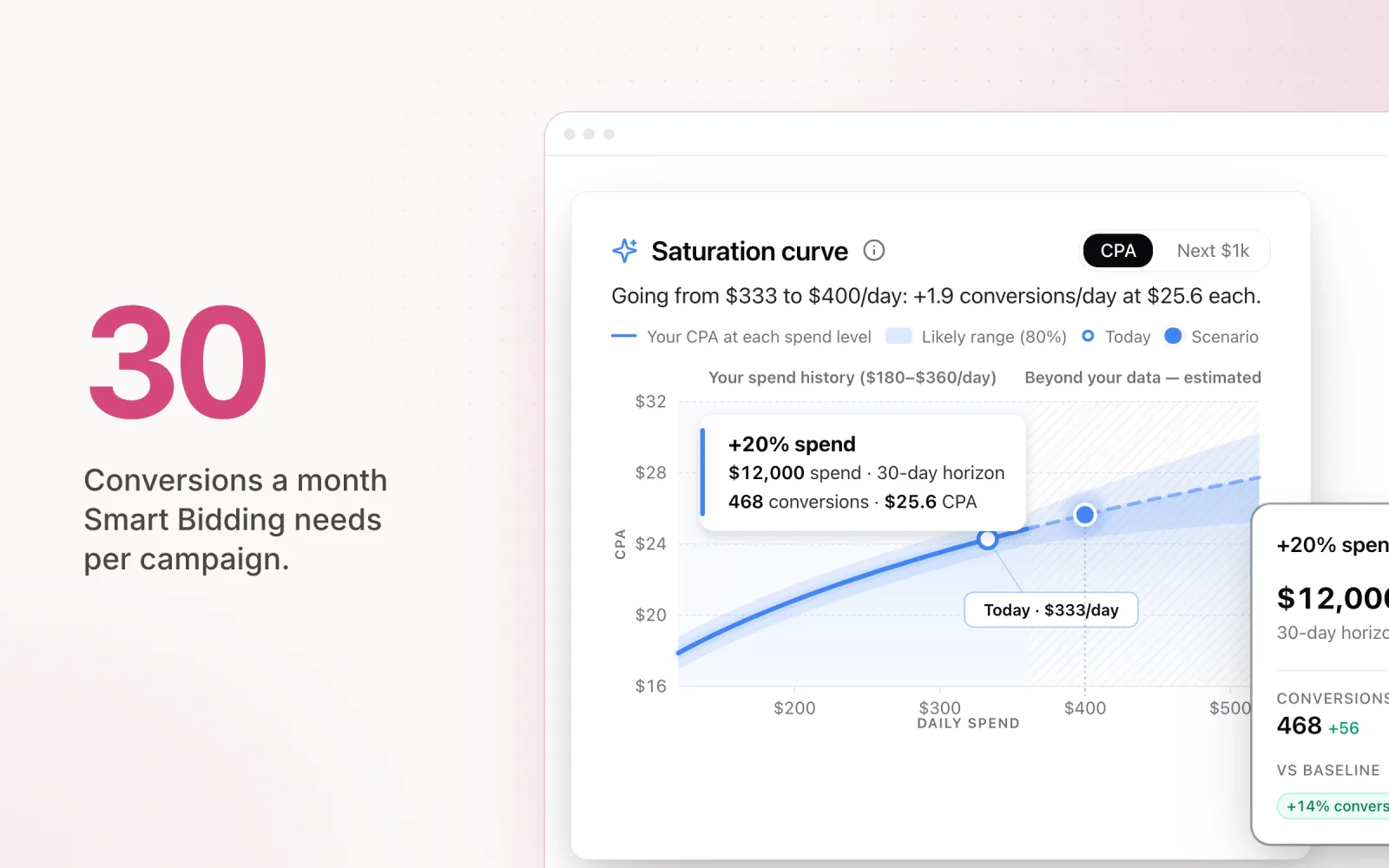
For accounts with enough conversion data (30+ per campaign per month), Smart Bidding outperforms manual. The algorithm processes more signals than any human can in real time. The catch: Smart Bidding is only as good as the data you feed it. Broken tracking or thin conversion volume produces erratic results no matter which strategy you pick.
Paid search vs. organic search
Paid search and organic search do different jobs on different clocks. The right answer is almost always both — our deeper breakdown of when to use organic vs paid search walks through the specific scenarios where each one pulls ahead.
Speed. Paid search delivers traffic the same day. Launch in the morning, get clicks by the afternoon. Organic is the slow lane. Even with strong SEO, new pages take 3 to 6 months to rank competitively. For launches, seasonal promotions, or anything time-sensitive, paid search is the only option that produces immediate visibility.
Cost structure. Paid search charges per click. Every visitor costs money, and that cost does not drop unless you improve quality scores or competition eases. Organic requires upfront investment in content and technical SEO, but the marginal cost per visitor approaches zero once pages rank. Over 12 months a well-ranked page often costs less per visit than paid search for the same query.
Control. Paid search gives you precise control over which queries trigger ads, what the copy says, which landing page they see, and what you spend per day. Organic is shaped by hundreds of ranking factors, most outside your control. Algorithms change, competitors out-publish you, positions move with nothing you did wrong.
Data and testing. This is the part that matters even if you are SEO-first. Paid search produces instant data on which keywords convert, which messages land, and which pages do the work. You can test five headlines in a week and know which wins. That data feeds your organic strategy: the keywords worth content investment, the messaging angles that perform, and the page layouts that convert. Running both in parallel accelerates learning on both sides.
How they reinforce each other. The strongest search strategies use both. Paid search catches immediate demand and competitive terms where ranking is slow or impossible. Organic builds a compounding traffic base and lowers your reliance on paid over time. Paid data informs organic targeting. Organic content lifts paid quality scores by improving landing page relevance. They are not separate channels. Treat them as one.
How to build a paid search campaign
Campaign structure decides whether your paid search strategy scales or collapses. A well-structured account makes optimisation easy. A poorly structured one creates cascading problems that no amount of bid adjustment can fix.
Account hierarchy. Google Ads and Microsoft Ads use the same hierarchy: Account → Campaigns → Ad Groups → Keywords + Ads. Each level has a job. Campaigns control budget, location, bid strategy, and scheduling. Ad groups hold clusters of related keywords and the ads that serve them. The split exists so you can apply broad settings at the campaign level and fine-tune relevance at the ad group level.
Campaign types. For paid search specifically, the main types are Search (text ads on SERPs), Shopping (product listing ads driven by a feed), and Performance Max (automated campaigns that serve across Search, Shopping, Display, YouTube, Discovery, and Gmail). Standard Search gives you the most control and transparency. Shopping is non-negotiable for ecommerce. Performance Max offers broader reach but less visibility into where your budget goes.
Structure principles. Organise campaigns by business objective, product line, or service category. Not by match type. Not by some arbitrary grouping. A SaaS company might run separate campaigns per tier. An ecommerce retailer might organise by category. Each campaign should represent a distinct objective with its own budget and target. That is what makes budget allocation calls obvious: you can shift spend between campaigns based on which objectives are performing.
Ad group structure. Each ad group holds a tight cluster of keywords. Five to twenty, all sharing the same intent. The ads in that group address that intent directly. If your ad group mixes "project management software pricing" with "free project management tools," you cannot write one ad that is relevant to both. Split them. Tight ad groups raise quality scores, which lowers CPCs and improves ad rank.
Goal setting. Before you launch anything, define what success looks like in numbers. For lead gen, target CPA. For ecommerce, target ROAS. For brand campaigns, impression share on the specific terms you care about. Without explicit targets you have nothing to evaluate against and no framework for budget calls.
Budget allocation. Allocate based on expected return, not even distribution. Campaigns targeting high-intent, bottom-of-funnel keywords (e.g., "buy CRM software") deserve more budget than top-of-funnel campaigns (e.g., "what is CRM") because they convert at higher rates and produce immediate revenue. As data lands, move budget from underperformers to outperformers. This is the highest-impact thing you can do as a paid search manager. Most agencies do it monthly. The strong ones do it weekly.
Paid search keyword strategy
Keywords are the targeting mechanism. Every click, every conversion, and every dollar of wasted spend traces back to a keyword decision. Getting them right is the single most impactful thing you can do for performance.
Keyword research process. Start with your product or service categories and list every term a potential customer might use to search for what you sell. Use Google's Keyword Planner, Search Console (for organic query data), and competitor tools like SEMrush or SpyFu to expand. Look at volume, competition, and suggested bid to gauge commercial viability. Prioritise keywords that combine meaningful volume with clear commercial intent.
Search intent alignment. Not all queries carry the same intent. "What is project management" is informational. The user is learning, not buying. "Best project management software" is evaluative. The user is comparing options. "Buy Monday.com annual plan" is transactional. The user is ready to convert. Your paid search keywords should target evaluative and transactional intent first. Bidding on informational queries with paid search usually produces traffic with weak conversion rates, which inflates CPA.
Match types. Google Ads has three. Exact match ([running shoes]) triggers only for the exact query or close variants. Most control, least reach. Phrase match ("running shoes") triggers for queries that include the meaning of your keyword in order, including ones with words before or after. Broad match (running shoes) triggers for queries Google considers related, even when the exact words are absent. Most reach, requires aggressive negative keyword management or it bleeds budget.
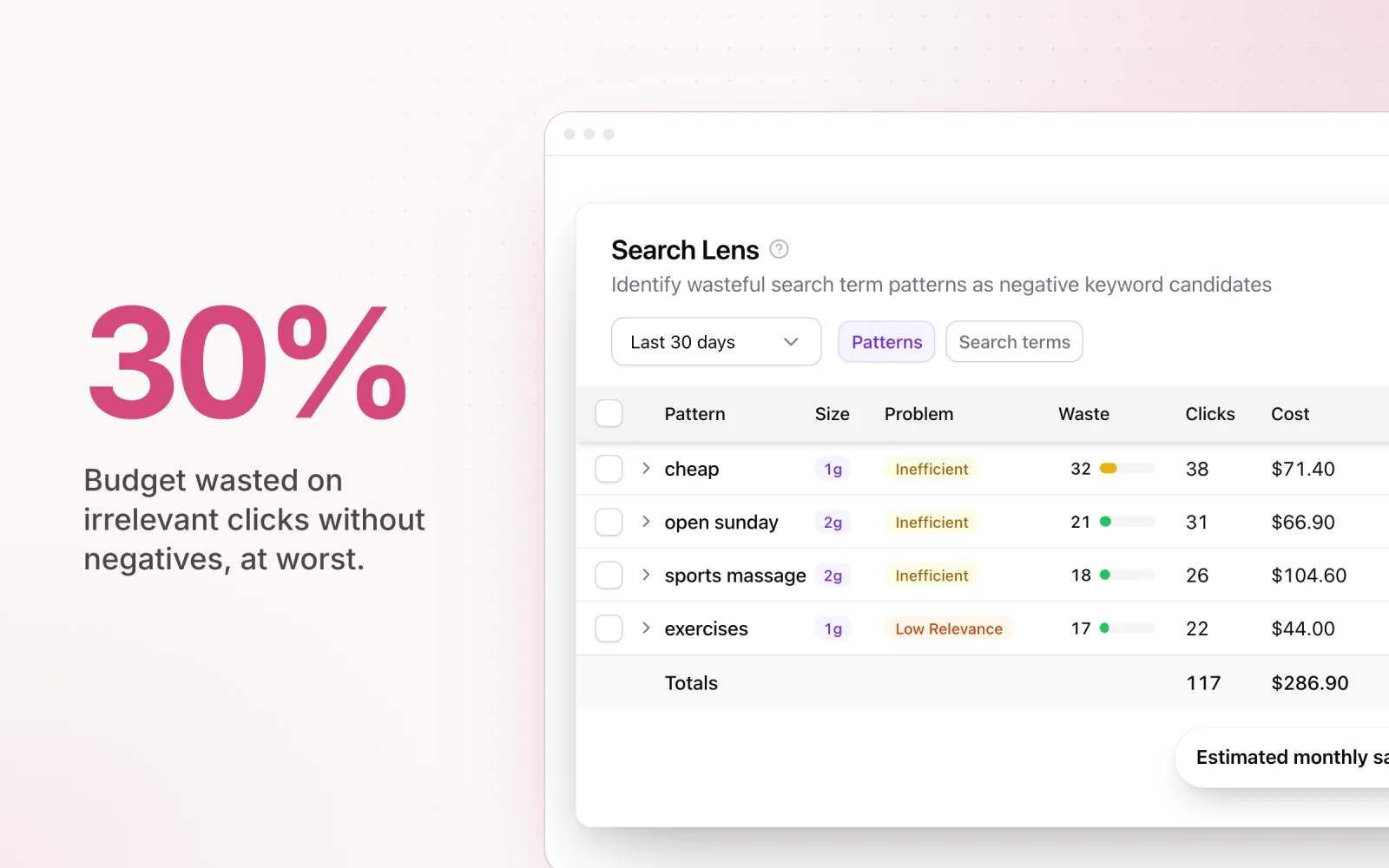
Negative keywords. Just as important as the keywords you bid on. They keep your ads off irrelevant queries, which protects your budget and lifts conversion rates. If you sell enterprise software, adding "free," "tutorial," "course," and "certification" as negatives keeps your ads off the eyes of people who will never buy. Most accounts I audit waste 15% to 25% of budget on irrelevant search terms that could have been excluded with proper negative management. For a deep dive, read our complete guide to negative keywords in Google Ads.
Long-tail vs. head terms. Head terms like "CRM" or "shoes" have huge volume but are expensive, competitive, and ambiguous. Long-tail keywords like "best CRM for real estate agents under $50/month" have lower volume but higher conversion rates and lower CPCs. A strong keyword strategy layers both: head terms for visibility and reach, long-tail for efficient conversions. As campaigns mature, the search terms report will reveal the specific long-tail queries driving your best conversions. Build ad groups around those. Be aware that very specific long-tail keywords sometimes get tagged with a low search volume status by Google and stop serving until query volume picks up, which is worth checking before pruning them as underperformers.
Paid search bidding strategies
Your bidding strategy decides how you compete in the auction and what you pay per click and per conversion. The right one depends on your data maturity, conversion volume, and business goals.
Manual CPC. You set a maximum bid per keyword or ad group. Complete control, constant overhead. Manual works for new campaigns with no conversion history, small accounts with limited keywords, or anywhere you want maximum predictability in CPC. The trade-off is that you are bidding on aggregate historical data, not the real-time auction signals that drive conversion probability.
Enhanced CPC (eCPC). Manual bidding with guardrails. You set the bid, Google nudges it up or down based on conversion likelihood. The bridge between manual and full automation. Google has been deprioritising eCPC in favour of Smart Bidding, and honestly, if you trust the algorithm enough for eCPC you may as well go all the way.
Smart Bidding. Machine-learning bidding that optimises for conversions or conversion value at every auction. Target CPA aims to maximise conversion volume at a specific cost per acquisition. Target ROAS optimises for maximum conversion value at a target return on ad spend. Maximize Conversions spends your full budget to get the most conversions with no CPA target. Maximize Conversion Value spends your full budget to maximise total conversion value with no ROAS target. For a deep breakdown of when to use each, read our complete guide to Smart Bidding in Google Ads.
When to use which. The framework is data-driven. New campaigns with no conversion history should start with manual or eCPC to gather a baseline. Once a campaign clears 30+ conversions per month, switch to Target CPA (lead gen) or Target ROAS (ecommerce). Use your actual historical CPA or ROAS as the starting target. Do not set aspirational goals on day one. Maximize Conversions and Maximize Conversion Value work best when volume is the priority and you accept whatever CPA or ROAS the algorithm finds.
Common bidding mistakes. Aggressive day-one targets choke impressions, leaving you with low volume at a technically efficient CPA that does not move the business. Changing targets mid-learning period (2 to 3 weeks) resets the algorithm and creates perpetual instability. Smart Bidding on campaigns under 30 monthly conversions produces erratic results. And running Target CPA on a "Limited by budget" campaign effectively becomes Maximize Conversions, because the algorithm cannot optimise bids when budget is the binding constraint.
Measuring paid search performance
Measurement is where paid search strategy becomes accountable. Without clear metrics and a structured analysis cadence, you are making decisions on intuition. These are the metrics that matter and how to read them.
Click-through rate (CTR). CTR is the percentage of people who see your ad and click. For non-brand Search, a healthy CTR is 3% to 8% depending on industry. For branded campaigns, 15% or higher is expected. Low CTR signals a mismatch between your copy and the query, or copy that just isn't compelling. Fixing CTR starts with tighter keyword-to-ad alignment and headline testing.
Cost per click (CPC). CPC tells you what each click costs. Track the trend, not the absolute value. Rising CPCs over 30 to 90 days indicate growing competition, falling quality scores, or both. If CPCs rise while conversion rates hold steady, CPA increases proportionally. Watching CPC trends lets you see performance shifts before they hit your bottom line.
Conversion rate. The percentage of clicks that result in your desired action (purchase, lead form, phone call). Falling conversion rate with stable CTR means the landing page is the problem, not the ad. Conversion rates vary heavily by device. Mobile is typically 30% to 50% lower than desktop. Always segment by device before drawing conclusions.
Cost per acquisition (CPA). Total cost to acquire one conversion. The most direct measure of efficiency for lead gen. CPA above target triggers investigation: CPC issue (more expensive clicks), conversion rate issue (fewer clicks converting), or quality issue (wrong audience hitting your landing page)? Isolating the cause picks the right fix.
Return on ad spend (ROAS). For ecommerce and revenue-tracked campaigns, ROAS shows how much revenue each ad-spend dollar produces. ROAS of 5.0 means every dollar returns five. Declining ROAS comes from lower AOVs, lower conversion rates, or rising CPCs. Segment by campaign, product, and device to find the leak.
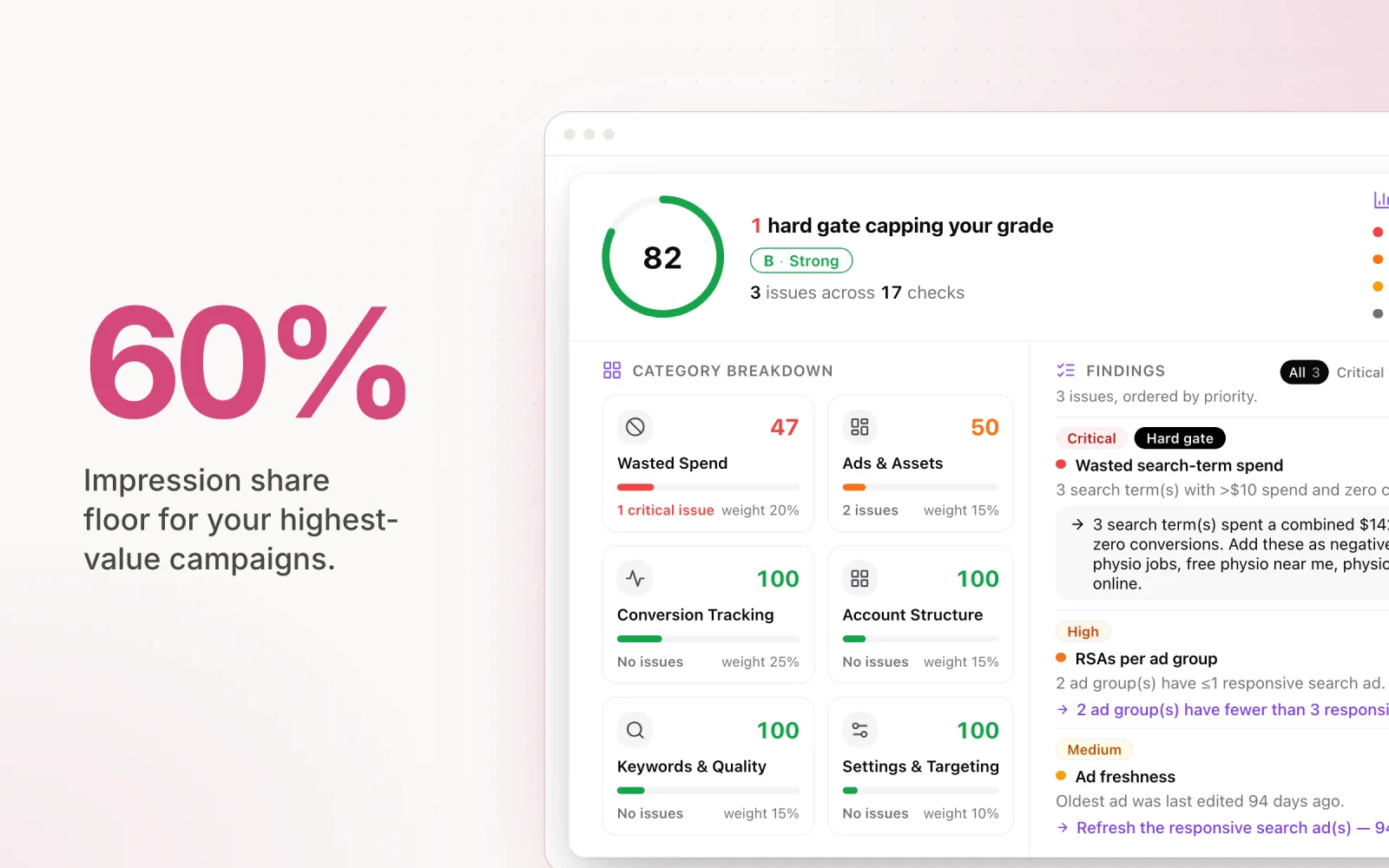
Impression share. How much of the available search inventory you are capturing. A 60% search impression share means 40% of eligible auctions are flying past you. Lost IS due to budget means more spend would buy more visibility. Lost IS due to rank means higher quality scores or bids. On your highest-value campaigns, watch impression share weekly. Drops are leading indicators of competitive pressure.
Quality score. Google's 1-to-10 rating of keyword relevance. Anything under 5 pays a premium on every click. Monitor monthly. A drop from 7 to 5 on a high-volume keyword can lift CPCs 20% to 40% without any change in the competitive landscape. For a full framework on interpreting these together, see our guide on paid search analysis and PPC performance measurement.
Search terms report. The actual queries that triggered your ads, not just the keywords you bid on. Reviewing this weekly is one of the highest-impact things you can do. It surfaces irrelevant queries eating budget (add as negatives), high-converting queries you have not explicitly targeted (add as keywords), and patterns in how users describe their needs (inform your ad copy). I have never audited an account where the search terms report did not produce at least three changes worth making.
Paid search management at scale
Managing paid search for one account is straightforward. Managing it across 20, 50, or 100 accounts, often across Google and Microsoft, is a different sport. The challenges have nothing to do with strategy and everything to do with systems.
The agency scaling problem. At 5 accounts, one person can log into each platform daily, review performance, adjust bids, check budgets, and update reports. At 20 accounts, that workflow eats 3 to 4 hours a day just on monitoring. At 50 accounts, it is physically impossible. The media buyer spends the day on ops tasks and has no time left for the strategic work that actually moves performance: keyword research, copy testing, campaign restructuring.
Why spreadsheets break. Most agencies start with spreadsheets for cross-account management. Budget trackers in Google Sheets. Performance dashboards updated by hand from platform exports. Pacing calculations referencing yesterday's spend. This works, until it does not. Spreadsheets break because they require manual data entry (errors), they are static (out of date by the time you finish), and they cannot do anything (a spreadsheet can tell you a campaign is overspending; it cannot pause it). More on this in how agencies waste 10+ hours a week on manual ad budgeting.
Cross-platform complexity. Running on both Google and Microsoft doubles the surface area. Different dashboards, different reporting interfaces, different pacing behaviours, different auction dynamics. A campaign that paces cleanly on Google might overspend 20% on Microsoft because the platforms handle daily budgets differently. Unified visibility across platforms is not a luxury at scale. It is a requirement.
Automation and tools. The answer at scale is purpose-built tooling that automates the operational layer while keeping strategy in human hands. Budget pacing, anomaly detection, cross-platform reporting, and performance alerts can all be automated. Campaign strategy, creative direction, keyword research, and client communication cannot. The best tools handle the first list so your team can focus on the second. For a comparison, see our roundup of the best Google Ads management tools.
Strategy at the portfolio level. At scale, the question shifts from "how do I optimise this campaign?" to "how do I allocate budget across 50 campaigns, 10 accounts, and 2 platforms to maximise total return?" That demands portfolio-level visibility: all accounts on one screen, performance against targets, and a way to see where incremental budget produces the highest marginal return. Campaign-level optimisation matters but it is not enough. The agencies that consistently outperform are the ones making portfolio-level calls based on cross-account, cross-platform data.
Frequently asked questions
What is paid search marketing?
Paid search marketing is a form of digital advertising where businesses bid on keywords to display their ads at the top of search engine results pages. When a user searches for a term that matches your keyword, your ad enters an auction. If your combination of bid amount and quality score is competitive, your ad appears above the organic results. You pay only when someone clicks your ad, which is why paid search is also called pay-per-click (PPC) advertising.
How much does paid search advertising cost?
Paid search costs vary widely depending on your industry, keywords, and competition. Average cost per click across all industries is roughly $2 to $5 on Google Ads and $1 to $3 on Microsoft Ads. Highly competitive industries like legal, insurance, and finance can see CPCs above $50 for top keywords. Your actual cost depends on your quality score, bid strategy, and the competitiveness of the keywords you target. There is no minimum spend requirement. You set your own daily and monthly budgets.
What is the difference between paid search and organic search?
Paid search delivers immediate visibility at the top of search results in exchange for a cost per click. Organic search relies on SEO to earn free rankings over time. Paid search gives you instant traffic and precise control over which keywords trigger your ads, but stops generating clicks the moment you pause spending. Organic search takes months to build but delivers sustained traffic without ongoing media costs. Most businesses use both: paid search for immediate results and competitive terms, organic search for long-term, compounding growth.
How long does it take for paid search campaigns to work?
Paid search campaigns can generate clicks and impressions within hours of launching. However, meaningful optimisation takes longer. Google's Smart Bidding algorithms need roughly 2 to 3 weeks and at least 30 conversions per campaign to learn effectively. Most campaigns reach stable, optimised performance after 4 to 8 weeks of active management, testing, and refinement. The initial weeks are about gathering data: which keywords convert, which ad copy resonates, and which audiences engage.
What are the best platforms for paid search advertising?
Google Ads is the dominant paid search platform, capturing roughly 90% of global search market share. Microsoft Ads (formerly Bing Ads) is the second-largest platform, covering about 6% of search traffic but often at lower CPCs and with a higher-income demographic skew. Most advertisers start with Google Ads and expand to Microsoft Ads once their Google campaigns are profitable. Running both platforms gives you broader reach and lets you compare performance across audiences.
Paid search is not a set-and-forget channel. It rewards structured thinking and steady refinement. The basics covered here (auction mechanics, campaign structure, keyword strategy, bidding, measurement) are the building blocks. The advantage comes from applying them consistently and improving incrementally, month after month.
Pace automates the operational layer of paid search management. Budget pacing, anomaly detection, cross-platform performance monitoring across Google Ads and Microsoft Ads. Your team focuses on the strategic work that actually moves the number. Start a free trial to see how it works.

Jordan Parrello
Founder of Pace. Ran an agency pacing sheet by hand for years before building the thing that checks it every 5 minutes. About Pace or LinkedIn